
JAMAICA'S TOURISM | Priced Off The Island
JAMAICA'S TOURISM | Priced Off The Island
Jamaica's tourism corridor is the Caribbean's worst performer — and the airlift maths explains why
In May, Tourism Minister Edmund Bartlett put Spirit Airlines' collapse at just under three per cent of Jamaica's passenger load and predicted that other carriers would absorb it. By August, a Montego Bay–Miami return was selling for US$3,744, Jamaica's recovery had reversed in the first full month without Spirit, and the country had become the worst-performing destination in the Caribbean while its competitors posted double-digit growth.
MONTEGO BAY, JAMAICA, August 29, 2026 -Calvin G. Brown | Analysis | Ninety minutes. That is the flying time from Sangster International Airport to Miami — shorter than the drive from Montego Bay to Ocho Rios, and considerably less trouble.
In the third week of August, The Gleaner's Western Bureau checked what those ninety minutes were costing. American Airlines was quoting US$3,744 return for travel between 20 and 27 August. For the 21st to the 28th, US$3,532.
For the 22nd to the 29th, US$3,472. Southwest fares between Montego Bay and Tampa were running near US$1,000. JetBlue's Fort Lauderdale flights were repeatedly sold out on the dates checked.
Prices fell sharply on later dates, which tells you precisely what is being priced: not distance, not fuel, not the cost of operating a narrowbody across the Windward Passage — but urgency. The premium falls on the traveller who cannot choose when to go. The funeral. The specialist appointment. The child's registration deadline. The emergency.
"If we have an emergency in Jamaica, we can't get a flight out, and that is the challenge we're faced with as a country right now," an aviation source at Sangster told the newspaper.
Four months earlier, the Ministry of Tourism had told the country this would not happen.
The Three Per Cent
Spirit Airlines shut down at three o'clock on the morning of 2 May, ending thirty-four years of flying and erasing every Jamaican route it operated. It was the carrier's second bankruptcy in under two years, and this time there was no reorganisation — only a wind-down.
Minister Bartlett's assessment that same day was measured and, on its own terms, entirely defensible. Spirit accounted for just under three per cent of passenger load, he said — a projected thirty to forty thousand seats for the summer.
It flew out of Fort Lauderdale, an airport very well served by other airlines. The expectation was that those carriers would pick up what Spirit had been projected to move.
Read that statement carefully and you will find nothing factually wrong with it. Three per cent is three per cent. Fort Lauderdale is well served. Other airlines did absorb Spirit's displaced passengers — American, JetBlue and Southwest between them took the traffic.
The assessment was arithmetically sound. It was also answering the wrong question.
What Volume Cannot Measure
A seat count measures capacity. It does not measure competitive pressure, and those are not the same instrument.
The aviation source at Sangster identified the mechanism with some precision. Airlines set routes, aircraft assignments, crew rosters and schedules six months or more ahead. When Spirit collapsed in May, the summer schedules of every remaining carrier were already locked.
Demand shifted instantly; supply could not. American was running two daily services into Miami, consistently full, with no realistic means of adding a third before the winter season.
The second effect was subtler and more consequential. Spirit's ultra-low-cost model, the source noted, had helped keep the other carriers in check. Remove the cheapest operator from a route and you do not merely subtract its seats — you remove the fare the others were obliged to price against.
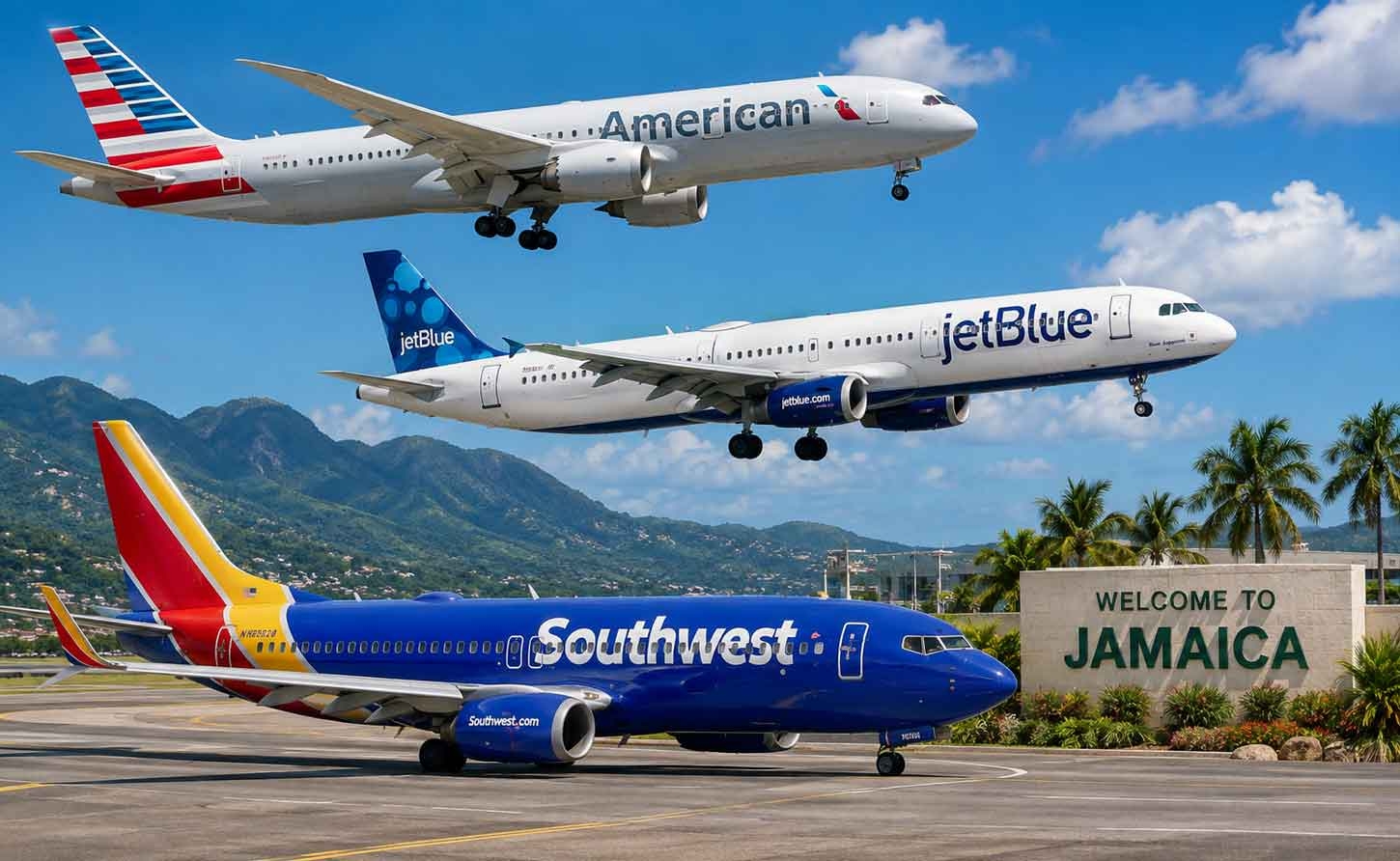
What is left in the Florida corridor now is not competition but partition. American holds Miami. JetBlue holds Fort Lauderdale. Southwest holds Orlando. One carrier per gateway, no meaningful overlap, and a passenger with nowhere to go when the aircraft fills or the fare climbs.
Three per cent of the seats had been disciplining one hundred per cent of the prices.
Spirit was never really about the seats it carried. It was about the prices it prevented.
The Numbers Jamaica Does Not Want To Read
The tourism data for 2026 is not ambiguous, and it does not flatter.
Jamaica Tourist Board figures released on 17 August put stopover arrivals for the first half of the year at 1,131,422, against 1,478,168 in the same period of 2025 — a fall of 23.5 per cent. Measured against 2024, before Hurricane Melissa existed, the deficit is 25.2 per cent.
Caribbean Tourism Organization data had already recorded Jamaica's first-quarter decline of 27.5 per cent as the largest of any destination in the region.
But it is the monthly sequence, not the aggregate, that repays attention. January fell 35.5 per cent. February, 27.1. March, 20.8. April, 20.4. May, 18.6. Month by month the gap was closing — a country climbing out.
Then June widened to 19.2 per cent.
That is the first month since the collapse began in which the year-on-year deficit grew rather than shrank. It is also the first full month in which Spirit Airlines did not fly. One month is not a trend, and it would be dishonest to present it as one. But it is the first reversal in six, and it arrived exactly when the seats did not.
Airport data from operator Grupo Aeroportuario del Pacífico confirms the shape of it. Sangster International handled 1.91 million passengers in the first half of the year against 2.60 million in the same period of 2025 — a fall of 26.7 per cent.
Now set beside it the figure almost nobody has remarked on. Norman Manley International, in Kingston, was down 3.6 per cent.
The two airports are not interchangeable, and the difference between them is the difference between two entirely separate categories of traveller. Montego Bay is the tourism hub — the resort belt, the packages, the winter leisure trade.
Kingston is where the diaspora lands: the returning Jamaican coming home to family in St Andrew, St Thomas, Portland, St Catherine and the parishes of the east and south-east. One airport receives visitors. The other receives relatives.
So this is not a national collapse in demand for Jamaica. Kingston held. Cruise arrivals held too, down just 2.9 per cent across the half-year at 690,951 passengers — because a cruise passenger's access to Jamaica is not priced by an airline. What failed was the leisure corridor into Montego Bay, the corridor that depends on cheap, plentiful, competitively priced North American lift.
The Control Group Nobody Noticed
Buried in the same Tourist Board release is something close to a natural experiment, and it is the most useful number Jamaica has produced all year.
Over the six months, arrivals from the United States fell 27.9 per cent. Arrivals from Canada fell 23.4 per cent. Arrivals from Europe fell 6.7 per cent — and in June, European arrivals were flat, up a statistically meaningless 0.1 per cent.
European visitors faced the identical hurricane. They faced the identical shortage of rooms, the identical damaged resorts, the identical news coverage of a devastated island. Every variable the Ministry cites as the cause of the downturn applied to them in full.
What differed was lift. Europe is the one source market where Jamaica added capacity rather than losing it: Virgin Atlantic to seven weekly from Heathrow, British Airways to four weekly from Gatwick. The market where seats were added fell by seven per cent. The market where seats were removed fell by twenty-eight.
The comparison is not perfect and should not be oversold. Europe is a fraction of the American base, European visitors book much further ahead and stay considerably longer, and the mix of properties serving them differs. But no reading of those two figures supports the proposition that airlift is a secondary factor.
What the Competitors Did in the Same Quarter
Regional comparison is where the argument stops being about weather.
In the same first quarter, the Dominican Republic grew 12.2 per cent, to 2,603,645 arrivals. The Cayman Islands grew 11 per cent. Nassau grew 4.6 per cent. Cancún, at a vastly larger base, held flat. The Dominican Republic took more than 825,000 stopover visitors in January alone — more in one month than Jamaica managed in three.
These destinations were not spared the same global conditions. They were not spared the Spirit collapse either; Punta Cana, Santo Domingo and Santiago all lost Spirit service, and Dominican fares rose accordingly. What they had was depth of lift. Multiple carriers on multiple routes from multiple gateways, so that the loss of one operator raised prices without severing access.
Jamaica had concentration. Concentration is efficient right up to the moment it isn't.
In Fairness: Melissa Did This, Not Spirit
The Ministry has a serious answer, and it deserves to be put fully rather than waved past.
Hurricane Melissa struck in late October 2025 as a Category 5 — the strongest storm ever recorded to hit Jamaica — and took out roughly thirty per cent of the island's tourism assets. Sangster itself sustained structural and water damage.
No airlift strategy on earth survives the loss of a third of your room inventory. The first-quarter collapse is overwhelmingly a hurricane story, and any analysis pretending otherwise is dishonest.
The recovery figures are also real. Jamaica passed 1.5 million visitors by May with only seventy per cent of inventory available. In 2025, the two major airports handled 3,879,579 seats and 3,127,575 passenger arrivals at an overall load factor of 80.6 per cent — Montego Bay alone running at 83.3 per cent.
Bartlett's reading of that statistic is fair: the aircraft were arriving full, which means demand was never the constraint.
And the forward airlift book is genuinely strong. Virgin Atlantic to seven weekly from Heathrow. British Airways to four weekly from Gatwick. Copa to fourteen weekly from Panama by January 2027. Wingo from Medellín. Porter into Toronto, Ottawa and Hamilton. Air Canada from Halifax, Ottawa, Edmonton and Winnipeg.
Roughly 400,000 Canadian seats for the 2026/27 winter — helped, it should be said plainly, by the collapse of Cuba's tourism sector pushing Canadian traffic elsewhere. Breeze Airways begins Montego Bay–Tampa in December. Southwest is expected to add capacity over the winter.
All of that is true. None of it moves a Jamaican to Miami this month.
The Trap
Here is where the two explanations stop competing and start compounding.
Airlines will not commit seats to Montego Bay until they can see rooms. The Sangster source was blunt about it: when he speaks to the carriers, what they ask is what the room capacity is now, because Montego Bay is a leisure market and leisure lift follows accommodation. The quicker the hotels reopen, the more seats return.
So the rooms wait on the visitors. The visitors wait on affordable seats. The seats wait on the rooms. Melissa opened the loop; Spirit's collapse welded it shut. Carriers were already approaching Montego Bay cautiously on reduced inventory when the low-cost competitor vanished — and the relief, on the industry's own account, does not arrive until the winter schedules.
Bartlett told Parliament in June that roughly 5,648 rooms were scheduled to return during the year, with hotel capacity projected past eighty per cent by summer. He is not wrong that rooms are the binding constraint.
But a government can influence the pace of reopening far more readily than it can conjure a competitive carrier into a partitioned route in ninety days — and the fare data suggests the sequencing was misjudged.
Two Markets, One Aircraft
There is one more finding that complicates the story, and it should be stated rather than buried.
In May, the flight-deal platform Going named Montego Bay the cheapest international destination to fly to anywhere — average deal fares of US$344 return, roughly fifty-four per cent below standard economy, the best value in the Caribbean. That is not nothing, and it is not propaganda.
But read the methodology. The report analysed deal pricing across the preceding twelve months, a window that ends almost exactly where Spirit's collapse begins. And a deal fare, by definition, is a discounted seat booked well in advance by a traveller who is free to choose the date.
Which exposes the real asymmetry. The same aircraft carries two entirely different markets. The American tourist booking a February package four months out gets one of the cheapest fares in the hemisphere. The Jamaican — or the Florida-based Jamaican — who must travel next Tuesday because someone has died pays US$3,744.
The Tourist Board counts these two travellers separately, and the separation is instructive. Over the first half of the year, arrivals of foreign nationals fell 24.9 per cent. Arrivals of non-resident Jamaicans fell 2.6 per cent. In May they rose three per cent against the previous year; in June, 7.6 per cent.
Set those beside the airport figures and the two datasets lock together. Sangster, the tourism gateway, fell 26.7 per cent; foreign national arrivals fell 24.9. Norman Manley, where the diaspora lands, fell 3.6 per cent; non-resident Jamaican arrivals fell 2.6. Two separate bodies, counting different things for different purposes, arriving within two percentage points of each other. The division is real, and it runs straight through the middle of Jamaica's air access.
Read quickly, the diaspora figure appears to demolish the fare argument. Read properly, it is the fare argument.
Jamaicans abroad do not fly home because the price is attractive. They fly home for funerals, for ailing parents, for weddings and graduations and the settling of family land. Their demand does not soften when the fare doubles, because it cannot. That is the textbook definition of captive demand — and captive demand is precisely what a route with no competitive discipline exists to monetise. The diaspora did not stay away. It paid.
Against 2024, however, non-resident Jamaican arrivals are down 16.5 per cent. That is where the travellers who could not absorb the price went. They do not appear in any complaint, any survey or any ministerial statement, because a journey not taken generates no statistic at all.
And it is worth noting precisely which route this describes. Kingston–Fort Lauderdale is the diaspora artery — the corridor Spirit was flying at eighty per cent capacity, and the one Caribbean Airlines abandoned in November 2025 after filling barely a third of its seats. The gateway that serves Jamaicans coming home is the gateway that has lost two carriers in ten months.
Jamaica is cheap to visit and expensive to belong to. That distinction rarely appears in a tourism figure, because the people it describes are not counted as tourists.
The Question the Region Is Not Asking
Strip away the hurricane and the bankruptcy and a structural fact remains: the air link between Jamaica and its largest overseas population is priced entirely by three foreign carriers operating one route each, on schedules set half a year in advance in boardrooms where Jamaican necessity carries no weight at all.
This is not a Jamaican peculiarity. It is the regional condition. Cuba's tourism shutdown redistributing Canadian charter traffic across the archipelago is the same dependency viewed from the other end — Caribbean fortunes moving on decisions made elsewhere, for reasons that have nothing to do with the Caribbean. LIAT's long decline, the thinness of intra-regional lift, the fact that Caribbean Airlines' Fort Lauderdale–Kingston service is the closest thing to a regionally owned counterweight on the entire Florida corridor: these are not separate problems.
CARICOM has spent two decades discussing a regional air transport policy with the urgency of a body that believes it has time. The Florida corridor in August 2026 is what running out of time looks like.
Minister Bartlett was right about the volume. Three per cent of the seats left the market. He was wrong about what those seats were doing — which was not carrying passengers so much as capping fares for everyone else. That is not a trivial distinction, and Jamaicans are paying US$3,744 to learn it.
— 30 —
