
JAMAICA | Black Star, Borrowed Crown: What Scott-Mottley Told Gordon House
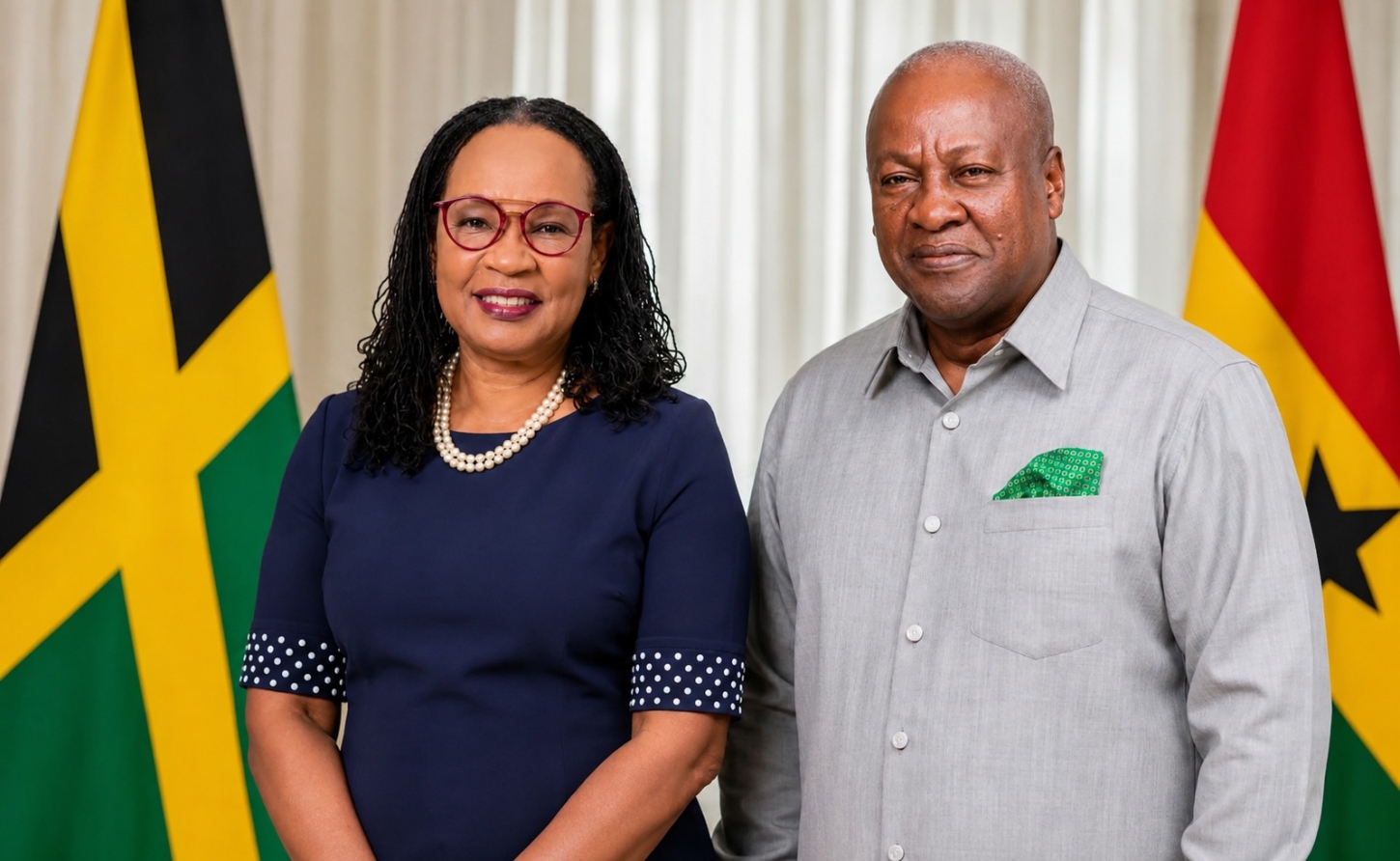
Senator Donna Scott-Mottley and His Excellency John Dramani Mahama, President of the Republic of Ghana,
A ceremonial welcome for Ghana’s president became the sharpest domestic challenge of Emancipendence week — and it was the Government’s own reparations diplomacy that supplied the ammunition.
MONTEGO BAY, Jamaica, August 7, 2026 - Calvin G. Brown| Gordon House has heard many welcomes. Few have been aimed so precisely at the hosts.When Opposition Senator Donna Scott-Mottley rose at Tuesday’s Special Joint Sitting of the Houses of Parliament to greet President John Dramani Mahama of Ghana, she began with ancestry and ended with arithmetic.
The Ghanaian delegation received the tribute. The Jamaican benches received the invoice.
Her opening movement was pure oratory — ancestors who walked through the Door of No Return, who crossed an ocean but did not cross out memory, identity or hope. Then came the turn.
She hoped the President’s presence would prompt Jamaica to reflect on its own unfinished journey towards full sovereignty, and called on the chamber to complete the passage from Monarchy to Republic and to embrace the Caribbean Court of Justice.
“For if we are serious about reclaiming our history, asserting our sovereignty, and shaping our own future, then surely we must have the courage to do so fully.”
A Jamaican dream on another nation’s flag
Scott-Mottley’s most effective device was the Black Star. Ghana placed at the centre of its flag a symbol drawn from Marcus Garvey’s Black Star Line — a Jamaican idea that became an African state’s emblem of freedom. Mahama spent the week acknowledging the debt, laying a floral tribute at Garvey’s shrine at National Heroes Park and touring the preserved Ghanaian Village houses at Seville Heritage Park in St Ann.
The contrast writes itself. Ghana took a Jamaican vision and made it constitutional furniture. Jamaica, sixty-four years after Independence, has kept the furniture the British left behind.
Petitioning our own Head of State
The week’s most uncomfortable fact was not spoken from the Opposition benches at all. It came from the visitor. Mahama pledged Ghana’s full backing for Jamaica’s planned petition to King Charles III on slavery — the petition Jamaican officials are due to present in the United Kingdom in September, seeking legal guidance on the country’s reparations claim against Britain.
King Charles III is also Jamaica’s Head of State.
That is the condition Scott-Mottley was pointing at: a nation preparing to petition a foreign monarch for redress while that same monarch remains its constitutional sovereign, and while its final court of appeal remains a committee of his Privy Council in London.
Ghana, meanwhile, is legislating. Mahama used the Gordon House rostrum to describe repatriation as a right of all persons of African descent rather than an act of charity, pointing to Ghana’s Right of Abode Act of 2000 and a proposed Homeland Return Bill that would codify residence and citizenship pathways for the global African family. Accra moves bills. Kingston moves committees.
The Government’s answer
The Holness administration is not without a case, and it deserves to be heard rather than caricatured.
First, the Jamaica Labour Party does not defend the monarchy. It accepts removing the King as Head of State. The dispute is sequencing: the Government maintains that the question of Jamaica’s final appellate court belongs to the Jamaican people in a referendum, not to a bargain struck between two front benches.
That is a defensible democratic position. The right of appeal touches every citizen, and a change carried by parliamentary arithmetic alone would rest on thinner legitimacy than one carried at the ballot box. The Opposition’s counter — that republic and CCJ must travel together or the court will never be reached — is a prediction, not a fact.
Second, the record is not one-sided. The Constitution (Amendment) (Republic) Act, tabled in December 2024, fell from the Order Paper when Parliament was dissolved ahead of the 2025 general election — a procedural death rather than a betrayal. And the People’s National Party, across its own long stretches in office since Independence, did not itself complete the passage to the CCJ.
Third, the Government can point to what it has done abroad. Prime Minister Andrew Holness has accepted a seat on Ghana’s newly established Global Advisory Council on Reparatory Justice, alongside Barbados Prime Minister Mia Mottley and Dr Ralph Gonsalves, telling Mahama he expects the Council’s first meeting within months. Jamaica also supported the United Nations resolution Ghana championed.
What the Government cannot easily answer is procedural. The JLP no longer commands a two-thirds majority in the House, which means constitutional change now requires Opposition votes.
Yet Opposition Leader Mark Golding’s written request for talks with the Prime Minister was declined and redirected to the Minister of Justice. An administration that needs the Opposition’s votes but will not meet the Opposition’s leader has a problem no referendum argument resolves.
A wider caution is also worth registering, and it came from neither front bench. Jamaica maintains resident diplomatic representation in only two African countries, Nigeria and South Africa. A relationship carried almost entirely on reparatory justice, without trade, investment and consular machinery beneath it, risks becoming ceremony with a moral vocabulary.
The unfinished sentence
Scott-Mottley closed with Kamau Brathwaite, whose years in Ghana taught him that Africa is not a place Caribbean people came from but a part of who they are. It was a gracious final line for a visitor. It was also, deliberately, an unfinished sentence addressed to the chamber.
Emancipation came in 1834. Independence came in 1962. The third instalment has an author, a bill and a lost majority — and, for now, no date.
— 30 —
