
MIDDLE EAST | One Child a Day: Gaza’s Children Are Still Dying
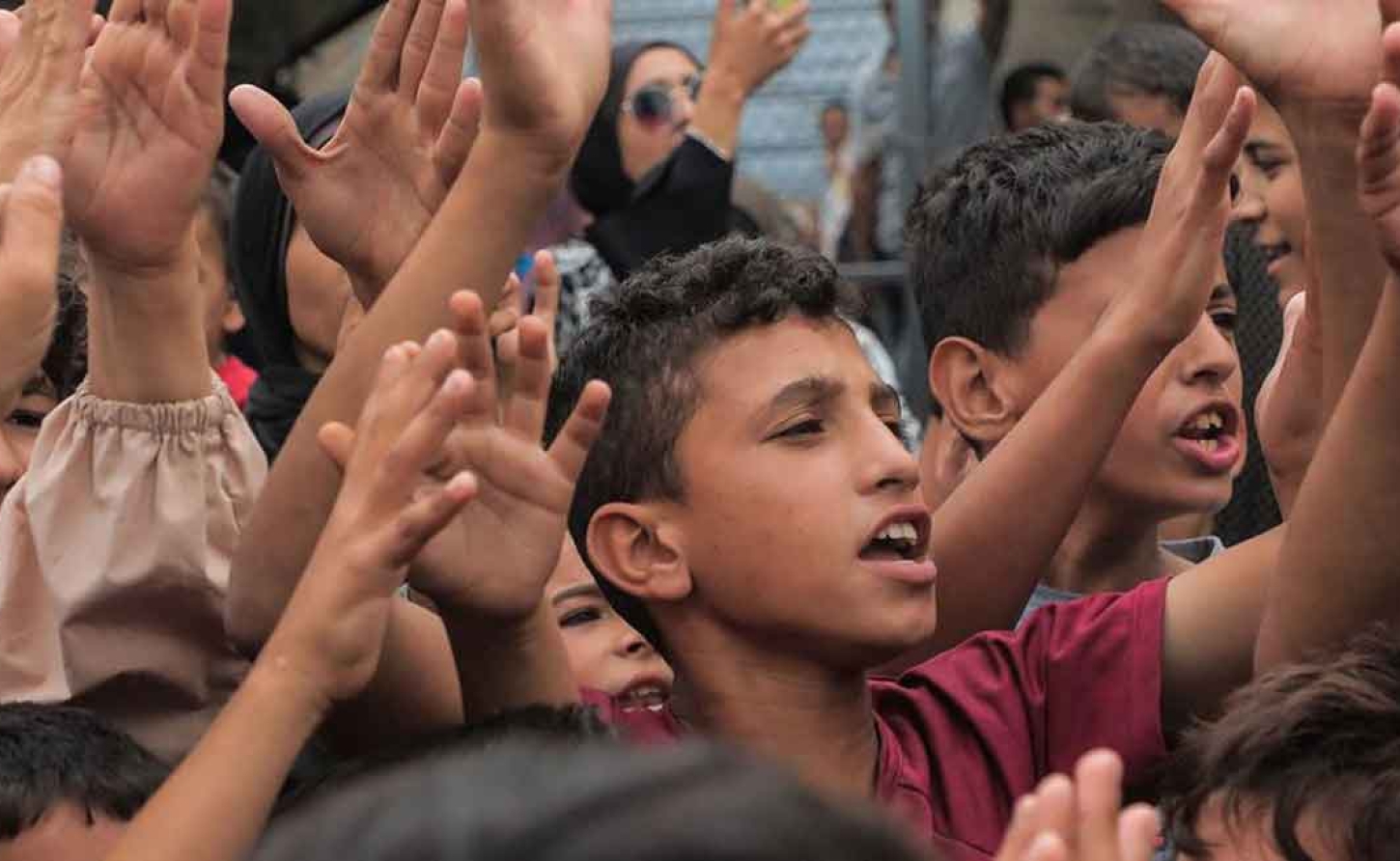
© UNICEF/Mohammed Nateel Palestinian boys celebrate the ceasefire announcement in October 2025.
Three hundred days of “ceasefire” have produced three hundred small graves. The killing did not pause when the paperwork was signed — and a Caribbean that has already declared where it stands cannot now look away.
MONTEGO BAY, Jamaica, Augusy 7, 2026 - CALVIN G BROWN - Count it however you like. Three hundred days. Three hundred children. One child, every single day, in a territory the world was told had stopped being a war zone.
The UN Children’s Fund released that arithmetic from Amman on Thursday: at least 300 children reported killed in Gaza in the 300 days since a ceasefire was announced on 10 October 2025. Hundreds more injured, many of them severely. And the counting has not stopped — in the first three days of August alone, at least four more children were killed.
“A ceasefire that leaves an average of one child dead each and every day is failing children,” said Edouard Beigbeder, UNICEF’s Regional Director for the Middle East and North Africa. Children in Gaza, he said, are still waiting for the end to the violence they were promised.
A Generation Counted in Graves
These 300 are an addendum to a ledger that already defies comprehension. By UNICEF’s own count, more than 21,000 children had been reported killed in Gaza by early February this year, with some 44,500 injured.
The Palestinian Central Bureau of Statistics, reporting to April, put the child dead at 21,283 — roughly a quarter of all casualties — and broke that figure down in a way no statistical office should ever have to. Among the dead were 450 babies born during the war itself.
More than 1,000 never reached a first birthday. Over 5,000 were under the age of five. More than 10,000 surviving children carry life-changing injuries; upwards of 1,000 have undergone amputations.
In June, an independent UN commission of inquiry concluded that Israeli authorities and forces had deliberately targeted Palestinian children, amounting to genocide, crimes against humanity and war crimes — findings Israel has rejected as scandalous and politically motivated. The commission calculated that around 30 per cent of all those killed in the war were children.
UNICEF spokesman James Elder framed what those numbers actually describe when he reported a further 265 child deaths in June. These children, he said, were not killed in a war zone. They were killed in their homes and their schools, playing football, fishing.
Three Babies, One Machine
Bombs are only the fastest way Gaza’s children are dying. Families are now compressed into roughly a third of the Strip, sheltering among destroyed buildings, rubble and uncleared waste, where acute malnutrition, unsafe water, disease and shattered sanitation do slower work.
UNICEF spokesperson Louise Wateridge supplied the detail that statistics cannot. There are not enough incubators, she said, and health workers describe seeing two or even three babies sharing a single machine.
Newborns days old are already fighting to stay alive in half-functioning hospitals stripped of equipment and medicine. Premature births are climbing.
Exhausted, hungry mothers keep walking into clinics carrying severely malnourished children — more than 3,700 aged between six months and five years were admitted for malnutrition treatment in February alone, over 600 of them with severe acute malnutrition, the condition that kills quietly.
“The world calls it a ceasefire but families in Gaza are still burying their children.”— Louise Wateridge, UNICEF
The Children Who Are Left
And then there are the survivors, who inherit an emergency of their own. UNICEF reports that more than 58,000 children in Gaza have lost one or both parents.
An estimated 17,000 are unaccompanied or separated from their families altogether — proportionally, one of the largest child protection crises anywhere on earth.
More than a million children require protection and psychosocial support, which is to say almost every child in the enclave.
Those are not casualties of the war. They are its inheritance, and the region will be carrying them for thirty years.
Another Roadmap, Another Promise
The timing of UNICEF’s statement is deliberate. Late last month the US-led Board of Peace, established under Security Council Resolution 2803, announced that mediators from Egypt, Qatar, Türkiye and the United States had finalised a roadmap for the next phase — Hamas disarming in stages against a phased Israeli withdrawal.
Israel has said it will not advance without demonstrable progress on disarmament. Gaza’s families, having watched a signed ceasefire kill a child a day for ten months, remain sceptical.
Beigbeder welcomed the announcement as a real chance to stop children being killed, then reduced it to four questions no diplomat can talk around. Does the killing stop? Does aid reach them at scale? Do hospitals reopen and water flow? Will children return to school safely in September? Children, he noted, have heard promises before.
Context is owed on every side. This war began with the Hamas-led attacks on Israel of 7 October 2023, and the fate of the hostages has never been peripheral to it.
The casualty figures are compiled by health authorities operating under a Hamas-led administration and are disputed by Israel, which has barred independent foreign journalists from Gaza; UN agencies have nonetheless found them broadly reliable across more than two years of cross-checking. But no argument about methodology changes the size of the coffins.
What the Caribbean Owes These Children
This is not somebody else’s file. Fourteen CARICOM member states have recognised the State of Palestine — Guyana leading in 2011, Jamaica following in April 2024, Trinidad and Tobago and The Bahamas close behind.
CARICOM has demanded an unconditional ceasefire, deplored the flouting of Security Council resolutions and ICJ provisional measures, and urged the General Assembly to invoke its “Uniting for Peace” powers. Barbados Prime Minister Mia Mottley called what the world was watching the first televised genocide.
Having said all of that out loud, the region cannot now fall silent because a governance architecture has been erected and the word “peace” attached to it. A Caribbean that insists, correctly and relentlessly, that crimes committed against a people do not expire with the passage of time has no principled route to indifference when the crime is happening live and the victims are five years old.
There is stubborn work continuing in the rubble. UN partners upgraded 3,000 makeshift shelters in Gaza City last week and distributed emergency supplies to 9,000 households. On Tuesday, UNICEF moved more than 600 pallets of school bags, recreational kits and soap into the Strip. More than 250,000 children are in summer learning programmes built to restore some scaffolding of routine.
The school year begins in about a fortnight. How many of those children walk into a classroom in September — and whether the count stops at 300 — will settle what the last 300 days should actually be called.
— 30 —
