
ENERGY | Is there oil in Jamaica? The odds shorten to One-in-Three as United Oil & Gas Raises Fresh Capital
ENERGY | Is there oil in Jamaica? The odds shorten to One-in-Three as United Oil & Gas Raises Fresh Capital
A £500,000 share placing keeps the Walton-Morant hunt alive as independent geologists rate Jamaica’s flagship prospect among the best frontier odds anywhere — but the make-or-break farm-out deal is still to be signed.
KINGSTON, Jamaica —Tuesday, July 7, 2026 - By Calvin G. Brown | United Oil & Gas PLC has raised £500,000 in fresh working capital through a placing of 250 million new ordinary shares at 0.20 pence each, as the AIM-listed explorer drives towards an October deadline to secure the drilling partner that could finally answer Jamaica’s 70-year-old question: is there commercial oil beneath the island’s southern waters?
The placing, arranged by Tennyson Securities and taken up by two long-standing institutional shareholders, was priced at a modest discount to the previous close and includes warrants exercisable at 0.28 pence over six months.
The new shares are expected to be admitted to trading on the London Stock Exchange’s AIM market on or around July 9, lifting the company’s issued share capital to approximately 4.64 billion shares.

CEO of United Oil and Gas Brian Larkin
A prize twice the size of Jamaica
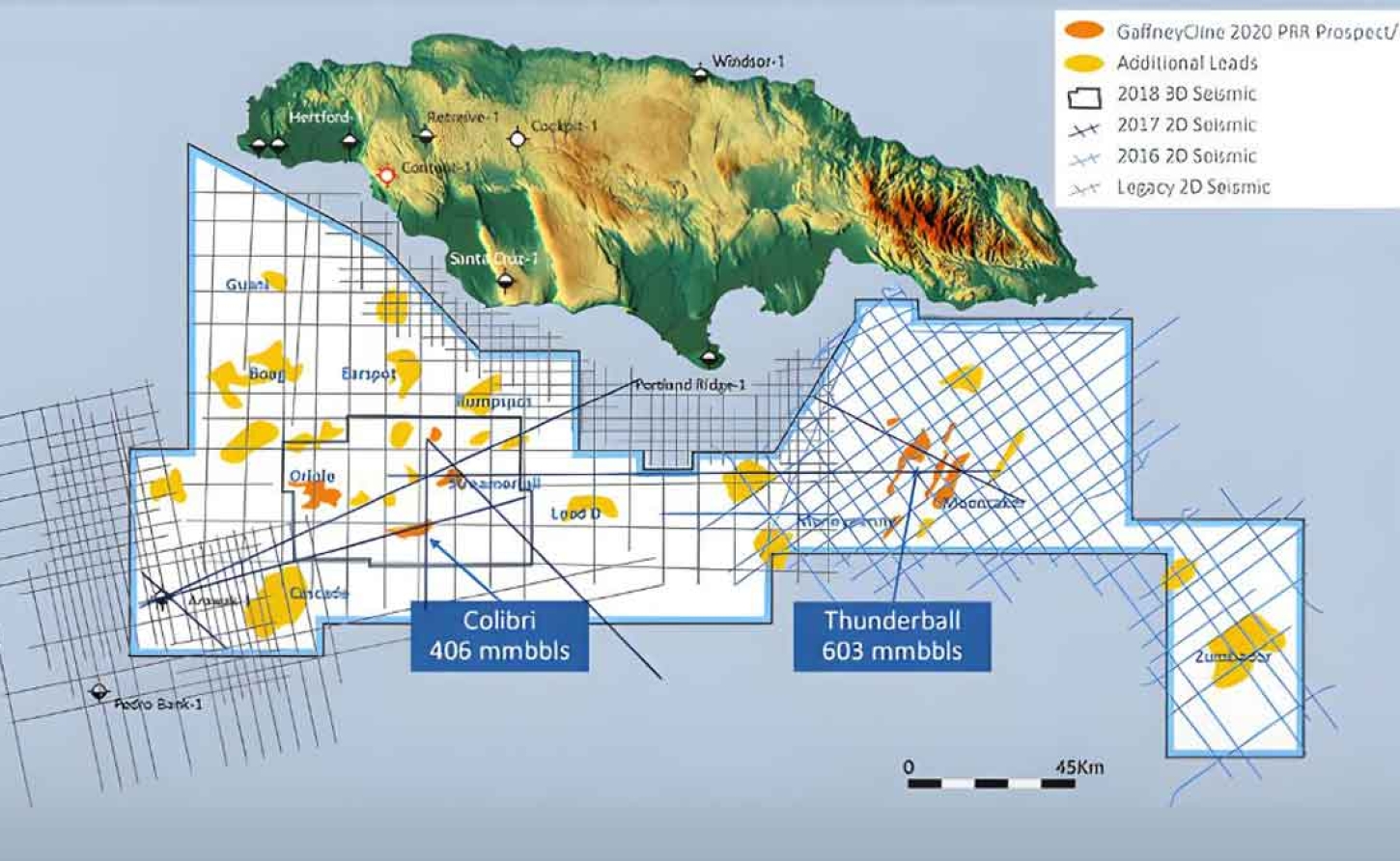
The Walton-Morant licence covers 22,400 square kilometres of seabed south of the island — an expanse twice the size of Jamaica itself. United, which holds a 100 per cent interest in the licence through January 2028, estimates the acreage could contain some seven billion barrels of unrisked mean prospective resources, with independent auditors Gaffney Cline & Associates assessing more than 2.4 billion barrels across five prospect zones.
The company’s success-case modelling suggests a net present value of roughly US$23 billion over a 25-year production life, with a breakeven oil price near US$25 per barrel — economics that would rank among the most attractive of any frontier play on the market.
So what are the odds?
For Jamaicans asking the only question that truly matters — what chance does the island actually have of striking it rich? — the industry has, unusually, published hard numbers.
The flagship Colibri prospect, a 406-million-barrel target in the Walton Basin, carries a Geological Chance of Success of 19 per cent as assessed by Gaffney Cline — roughly one-in-five odds.
An independent risking review by Iapetus Geoscience concluded that a successful seabed geochemical survey would lift Colibri’s odds to 32 per cent — one-in-three — with the Oriole prospect improving from 13 to 21 per cent.
That survey has now delivered. Earlier this year, United retrieved sediment cores from all 42 targeted sites across the licence, and laboratory analysis identified butane and pentane hydrocarbons — higher-order compounds not typically produced by biological activity, and consistent with a working thermogenic petroleum system deep beneath the seabed.
Measured against the five-to-20 per cent success odds typical of frontier exploration worldwide, Jamaica’s prospects now sit at the favourable end of the global spectrum.
One-in-three, however, still leaves two chances in three of a very expensive dry hole.
Why it matters
The stakes for the Jamaican economy are difficult to overstate. Tourism accounted for roughly 22 per cent of GDP in 2024, and remittances a further 15 per cent or so. Bauxite and alumina — the engine of post-independence prosperity — have withered to less than five per cent of GDP, while agriculture contributed under nine per cent in 2025 and remains hostage to every passing storm, a vulnerability Hurricane Melissa made brutally plain.
Layer on the island’s chronic dependence on imported fuel, and the appeal of domestic production — royalties, energy security, fiscal breathing room — is self-evident. Guyana’s transformation from regional afterthought into the world’s fastest-growing economy on the strength of offshore discoveries has not gone unnoticed in Kingston.
The sober arithmetic
Perspective, though, is essential. No commercial discovery has ever been made in Jamaican waters. The eleven exploration wells drilled between 1955 and 1982 — nine onshore, two on the Pedro Bank — all showed evidence of migrated hydrocarbons, but none tested the modern prospects United is now promoting.
Drilling Colibri would cost an estimated US$30 million to US$40 million — money a micro-cap explorer with no revenue and continuing losses cannot spend alone.
That is why everything hinges on the farm-out. United says several parties are reviewing the technical data under non-disclosure agreements, and it is targeting an agreement — covering back costs and the full forward work programme — by October 2026. Larkin has argued that renewed global appetite for frontier exploration, sharpened by instability at the world’s oil chokepoints, is working in Jamaica’s favour.
The £500,000 raised this month will not drill a well; it merely keeps United at the table where that decision will be made. But if a partner signs by October and a well follows — realistically no earlier than late 2027 — Jamaica will finally learn whether its future rests not only on sun, sand, bauxite and the sweat of its farmers, but on what has been waiting beneath the Walton and Morant banks all along. For the first time in seven decades of searching, the odds have never been shorter.
— 30 —
