
JAMAICA | Will Britain Show Up for Jamaica’s Reparations Case at the Privy Council?
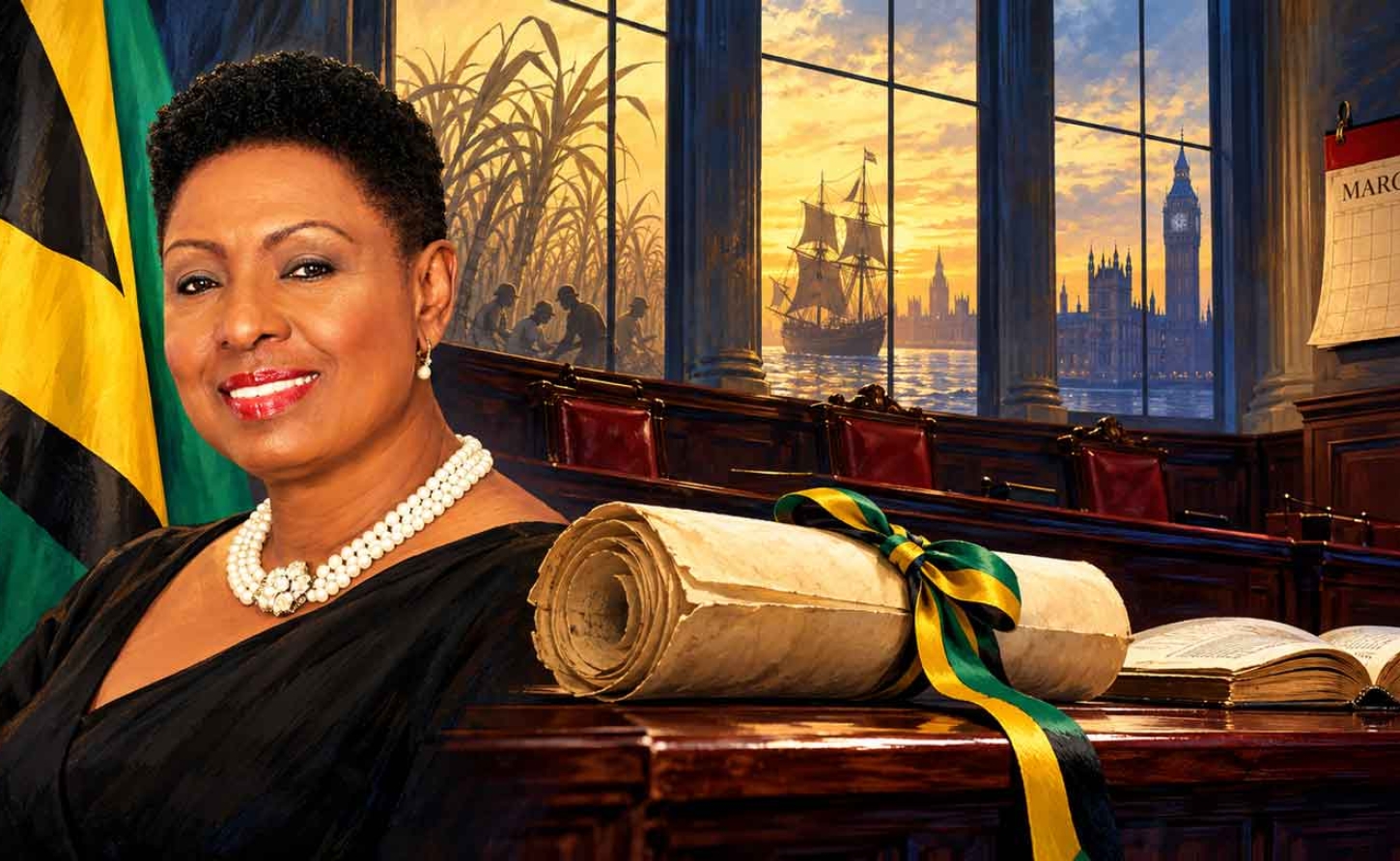
Culture Minister Olivia Grange beside an Illustration of a rolled petition tied with a black, green and gold ribbon on a courtroom bench, with a London skyline and a sailing ship in the windows
Jamaica’s government says the Privy Council has provisionally set the week of 8 March 2027 to hear the reparations petition the King referred in September. But every detail of that timetable comes from Kingston’s account of what the court’s Registrar said — and the UK government, named as respondent with a 20 November deadline, has not said whether it will take part.
MONTEGO BAY, Jamaica, October 16, 2026 - Calvin G Brown | On Thursday 15 October, Culture Minister Olivia Grange said the Judicial Committee of the Privy Council had provisionally set the week of 8 March 2027 to hear Jamaica’s reparations reference. She said the information came from the committee’s Registrar.
Two further details came with it. The respondent, as IRIE FM reported Grange’s update, “is the representative of the U.K. Government”. And that respondent has until 20 November 2026 to file its case.
All of it rests on one account. WiredJA could find no case page, case number or published directions from the Judicial Committee itself, and no UK government statement confirming that it is the respondent, that it will file, or who would argue for it.
Still, it is the first movement in more than three weeks. On 22 September Grange told the House of Representatives that the King had referred the petition. “We are awaiting directions from the Judicial Committee of the Privy Council as to the next steps to be taken in the case,” she said then. A regional report on 7 October still recorded no timetable.
The petition, dated 7 September, was signed by the Attorney General, Dr Derrick McKoy, “on behalf of the people of Jamaica”, and asks for a referral under section 4 of the Judicial Committee Act 1833. WiredJA set out its three questions, and the history behind them, on 8 September. The petition names no sum. Grange said on 9 September that “our petition does not include a monetary claim.”
What changed on 15 October is that the case now has the other side’s name on it — and that side has spoken about the matter once.
In September, Prime Minister Andy Burnham’s official spokesperson said: “The UK does not and will not pay reparations.” WiredJA found no UK government statement since then on whether it will take part in the reference, contest it or stay away, and none responding to the March date.
That sentence answers a demand for money the petition does not make.
The UK’s role was contested before this. A House of Commons Library briefing published on 23 September says that by convention the King refers only on ministerial advice, and that because the Crown is treated as divisible, realm ministers advise their own King. It quotes Lord Chancellor Kilmuir in 1955: “it is not open to the United Kingdom Government, or any of its Ministers, to tender advice to the Sovereign in relation to that matter.” The same briefing records that in 1972 the UK government called section 4 “a power vested in Her Majesty in the right of the United Kingdom and not in Her Majesty in some other capacity”.
It does not reconcile the two.
The referral has now been made, so that argument is settled in practice. Whether London treats itself as a party is a separate question, and the Registrar’s timetable, as Grange relayed it, puts the first answer at 20 November.
The court’s own rules show what follows. Part 11 of the Judicial Committee Rules 2024 governs references. Rule 61 requires the applicant — here, Jamaica — to file an index of documents “at least 8 weeks before the hearing”, agreed first with every respondent; the parties then file and serve written cases. Rule 62 lets the committee make “such orders as it considers just”, including ordering the applicant to pay a sum on account of the respondent’s costs.
By WiredJA’s calculation — not an announced deadline — a hearing in the week of 8 March puts Jamaica’s index due around Monday 11 January 2027. It has to be agreed with a respondent that has not said in public whether it is taking part.
Jamaica’s side is led by McKoy. At a post-Cabinet briefing on 23 September, Grange said: “It is a legal petition. It is not an interstate negotiation or a demand for payment.” No source has named instructed counsel for either side, and no interveners have been reported. CARICOM has given the petition its support but has not been reported as a party to the reference.
The pace, if it holds, is quick by the one modern comparison on record. In the Gibraltar Chief Justice matter, the case was issued at the Judicial Committee on 25 November 2008; the committee heard it on 15–18 June 2009 and delivered its advice on 12 November 2009. Jamaica’s provisional hearing falls about five and a half months after the referral was announced. The Commons Library treats Gibraltar as a reference under that territory’s constitution rather than a plain section 4 case, so the comparison is a guide to pace only.
The other clock is Jamaica’s own. The Constitution (Amendment) (Republic) Bill was tabled in December 2024, then fell from the Order Paper when Parliament was dissolved before the 2025 general election. As of June, the Gleaner reported, it had not been reintroduced, and WiredJA found no report that it has been since. The February 2025 Throne Speech had aimed to have it passed and “approved by citizens in the 2025/26 legislative year”.
Entrenched amendments need a two-thirds vote in both Houses, two three-month waits and a referendum. WiredJA found no referendum date.
No source WiredJA has seen addresses what would happen to a reference made by the King of Jamaica if Jamaica ceased to have one. On our reading of that procedure, the question cannot arise before March: no republic bill is before Parliament, and a new one would face two three-month waits, longer than the less than five months left.
For now, the March date is Kingston’s account of what a London registrar said.
-30-
