
JAMAICA Files Three Questions on Slavery to the Crown
JAMAICA Files Three Questions on Slavery to the Crown
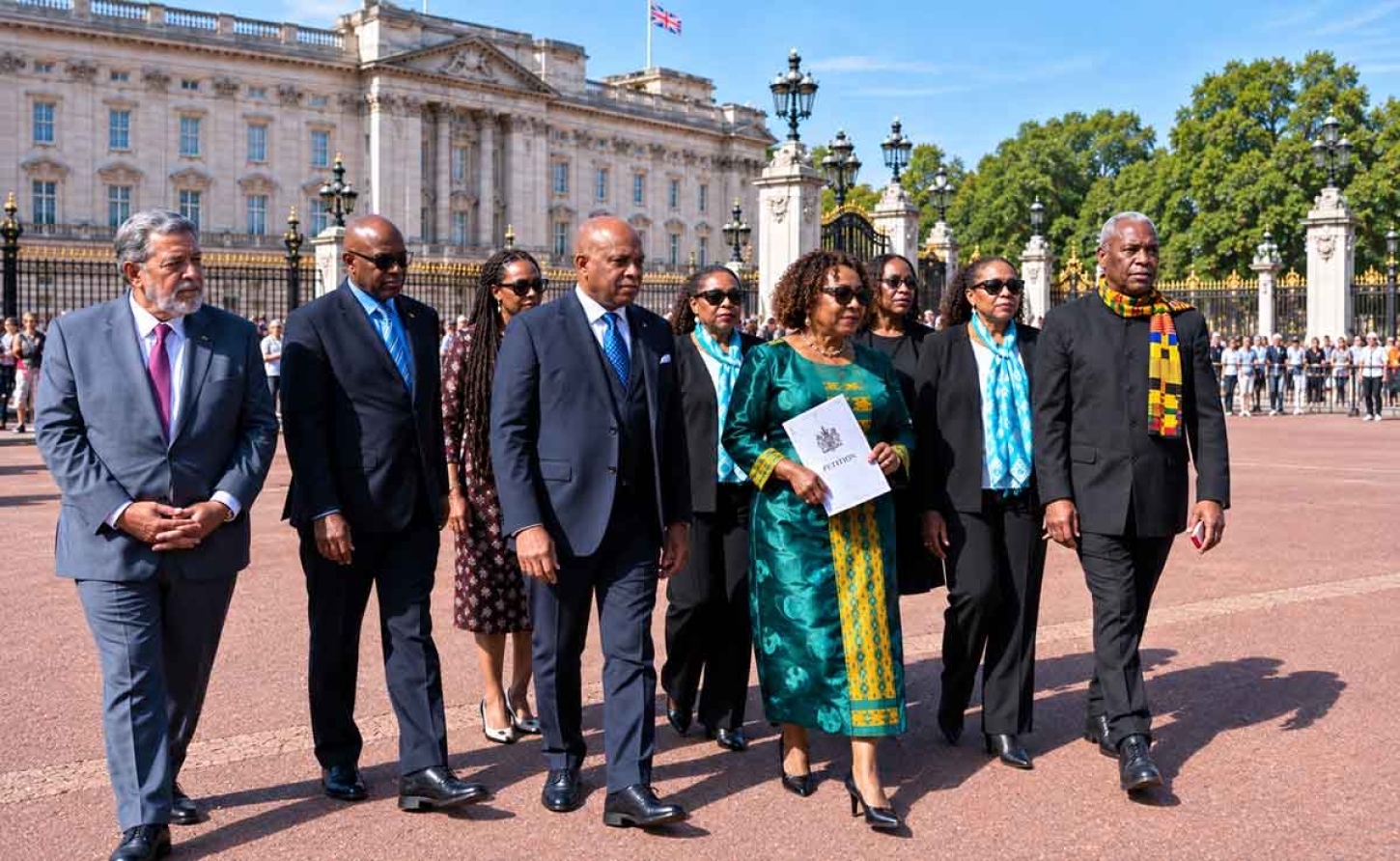
The petition Jamaica lodged at Buckingham Palace on Monday was never meant to be pressed into the King's hands. Reading it that way misses both the protocol and the point.
MONTEGO BAY, Jamaica, Sept. 8, 2026 |Calvin G Brown - Was it a breach of international law to seize African people and carry them by force to Jamaica?
Is the United Kingdom under a legal obligation to make reparation to the people of Jamaica for what was done to them there?
And was the forced transportation and enslavement of Africans as chattel ever lawful under English law in the first place?
Three questions. No invoice attached, no ultimatum, no deadline. Just three questions, drafted in Kingston and formally lodged at Buckingham Palace on Monday, 7 September, by a delegation led by Olivia Grange, Minister of Culture, Gender, Entertainment and Sport.
They ask King Charles III — who remains Jamaica’s head of state — to refer them to the Judicial Committee of the Privy Council, which remains Jamaica’s final court of appeal. It is the first time a Commonwealth state has taken this particular legal road in the cause of reparatory justice.
The audience that was never requested
A good deal of the international coverage has fastened onto the fact that the King was in Scotland and did not receive the delegation himself. One activist reading of the day had Charles ducking for cover the moment slavery and empire were raised. It makes a sharp line. It is also a misreading of how the instrument works.
A petition to the sovereign is not delivered like a summons at a door. It is lodged, through channels, and the channels are the whole point of its legitimacy. Buckingham Palace had been working with Jamaica’s Governor-General precisely to ensure the petition was correctly filed. That is not a snub dressed up as procedure; it is the procedure.
Nobody in the Jamaican delegation expected an audience and nobody asked for one. Grange’s own framing has been consistently unglamorous. She has declined to speculate about outcomes, saying only that Jamaica wants answers, and that what follows will be determined once a response comes.
The choreography of grievance is not the substance of it. And the substance carries a constitutional sting far sharper than any photograph of an empty balcony.
The King’s hands are tied, and that is the argument
Here is the awkwardness at the centre of Monday’s filing. Although the petition is addressed to Charles, he has no personal say over whether it reaches the Judicial Committee; he acts on the advice of his government. The head of state of Jamaica must, in this matter, do as the ministers of another country tell him.
Those ministers wasted no time. Within hours, a spokesperson for Prime Minister Andy Burnham called the transatlantic slave trade abhorrent while restating that “the UK does not and will not pay reparations”.
The Palace, for its part, offered the sort of carefully engineered warmth that commits to nothing: a personal commitment to greater understanding, and to finding ways of addressing historic wrongs for the benefit of communities today.
So the King who owes Jamaicans a constitutional duty of care will decide nothing, and the government that will decide has already announced its answer. Jamaicans are entitled to notice what that arrangement reveals.
Whatever the Privy Council eventually says, the petition has already produced one finding at no cost: a country cannot be fully sovereign while its final court sits in London and its head of state takes instruction from Downing Street.
An 1833 door, opened from the inside
The route Jamaica has taken is older than the grievance is recent. The petition rests on the 1833 statute that made the Judicial Committee the highest court for civil and criminal appeals across the British Empire, a role it retained for those nations that kept their legal ties after independence.
Behind that sits an even older principle — the right to petition the Crown over the administration of justice, traced by the Committee itself to the Norman conquest and the notion of the king as fountain of justice throughout his dominions.
The symmetry is not lost on anyone in Kingston. The Judicial Committee Act and the Slavery Abolition Act share a birth year. Jamaica is now asking the machinery of 1833 to examine the morality of 1833.
The question that will decide everything
Of the three, the third is the one that lawyers will circle for years: was chattel slavery ever lawful under English law?
It is not a rhetorical flourish. Slavery in Jamaica rested on colonial statute — assembly-made law, enforced by colonial courts. But the common law of England took a different view of the same institution on English soil, most famously in Somerset’s case in 1772, which held that no positive law authorised a master to remove an enslaved man from England by force.
If chattel status was never grounded in English common law, and the colonial statutes that created it were repugnant to it, then the entire legal edifice on which two centuries of Jamaican plantation wealth rested may have been void from the beginning.
The British counter-argument will be anachronism: that you cannot try the eighteenth century in a twenty-first-century courtroom, that abolition came from within Britain itself after 1807, and that identifying claimants and quantifying loss across ten generations is not a judicial exercise but a political one.
That case deserves to be met at full strength rather than waved away. It is the case the Judicial Committee will hear if the referral is made.
Two figures that keep being mangled
Reporting on this story has repeatedly fused two separate things, and Jamaican readers should have them apart.
First, the compensation paid to slave-owners at abolition. The British state raised £20 million to buy out the planters — but that money was financed through a borrowing instrument, and the consolidated stock behind it was retired on 1 February 2015. It was a debt that took an extraordinarily long time to clear, not a payment stream flowing to slaveholding families until the Cameron era.
The distinction matters, because the honest version of the point is damning enough: Britain compensated the owners of people, borrowed to do it, and taxpayers including Jamaican-descended Britons were still servicing that borrowing within living memory. The exaggerated version invites a correction that lets the underlying scandal off the hook.
Second, the money. The £7.6 billion figure attached to Jamaica’s claim in headline after headline did not come from Monday’s petition. It traces to a private motion brought by Mike Henry in 2021, an estimate of what Britain’s payout to slaveholders would be worth today.
The petition names no sum at all. Conflating the two allows critics to cast a request for legal clarity as a shakedown — which is precisely the frame Jamaica’s delegation has spent a week refusing.
Parallel, not fragmented
Grange has been careful to place the petition alongside, rather than against, the regional campaign. Her stated position is that Jamaica’s action runs parallel to the continuing CARICOM demand for reparations, to which Jamaica remains a party — no fragmentation of the Caribbean project.
The petition carries the endorsement of the Caribbean Community and of Ghana’s president, and echoes a United Nations committee’s call to consider reparatory measures.
That coordination is the thing to watch. A favourable advisory opinion, however non-binding, would hand every CARICOM state a piece of persuasive authority it does not currently possess. An adverse one would cost the region something real.
The delegation’s other business in London — talks with the British Museum on returning artefacts taken from the Taino, Jamaica’s first people — makes the fuller point. Restitution, repatriation and legal reckoning are one argument in three registers.
Jamaica did not go to London to be received. It went to file. The King never had to take the envelope for the questions to be asked, and the questions are now on the record, in the Crown’s own filing system, in the Crown’s own language.
— 30 —
