
CARIBBEAN | The Cure They Can’t Reach: Sickle Cell, Race and the US$2.2 Million Question
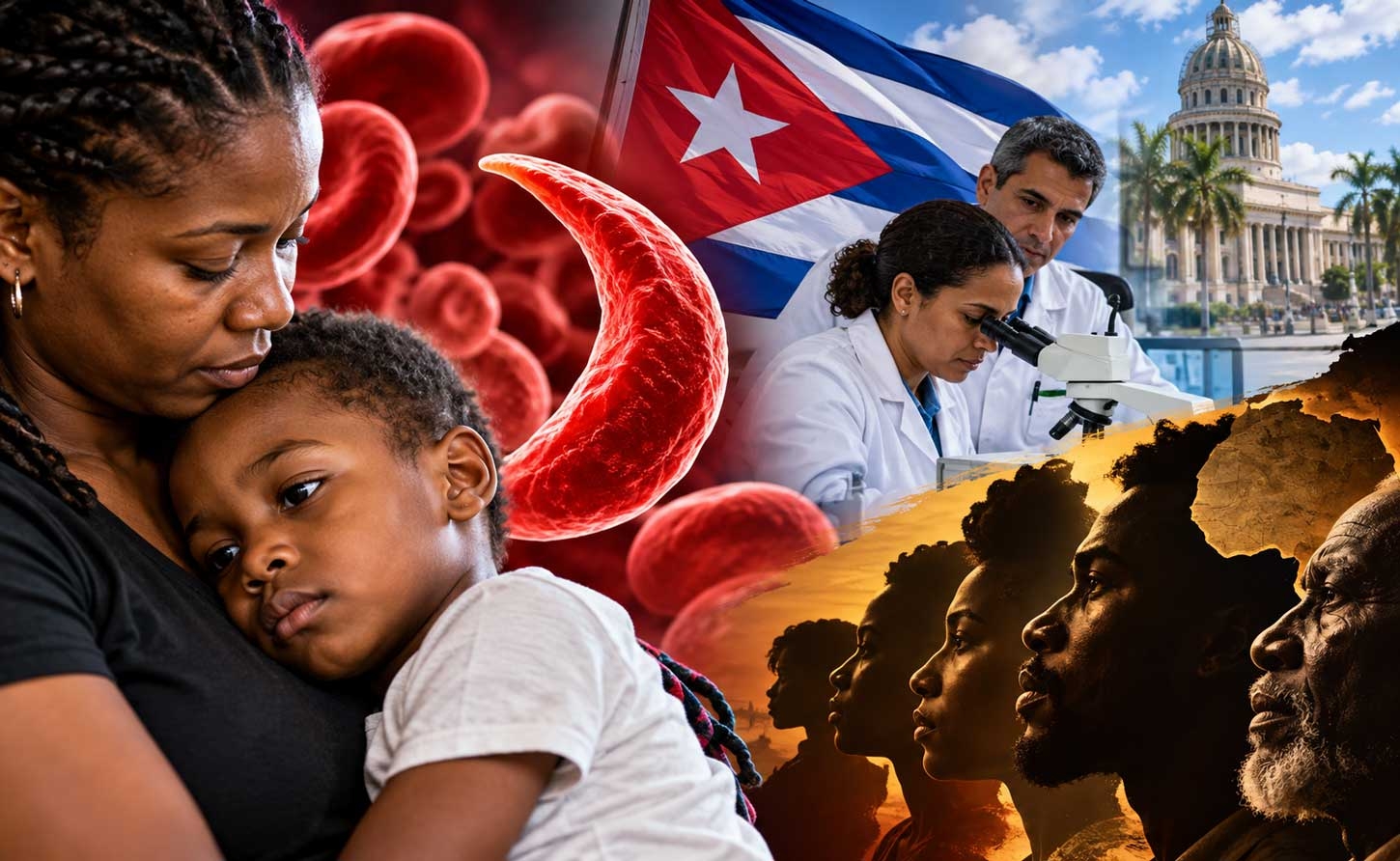
The sickle cell trait evolved as protection against malaria in West and Central Africa; the populations forcibly transported to the Caribbean carried the gene with them. Today, about one in every 150 Jamaican babies is born with sickle cell disease, and roughly one in ten Jamaicans carries the trait.
A disease born of slavery’s genetic legacy now has a functional cure — at US$2.2 million per patient, available almost exclusively in wealthy countries. But Cuba built a comprehensive care model four decades ago that CARICOM nations could adopt tomorrow. The question is whether anyone will.
MONTEGO BAY, Jamaica, October 12, 2026 - Calvin G. Brown | There is a disease that killed an estimated 81,000 children under the age of five in 2021, making it the 12th-leading cause of death among the world’s youngest children, according to the Global Burden of Disease study published in The Lancet Haematology.
It was one of the first conditions in medical history to be understood at the molecular level — in 1949, four years before Watson and Crick described the double helix. More than half a million babies are born with it every year, overwhelmingly in sub-Saharan Africa, India and the Caribbean. And for the better part of a century, the world largely looked the other way.
Sickle cell disease is the most common serious inherited blood disorder on the planet — and in the Americas it is inseparable from the history of the transatlantic slave trade. The sickle cell trait evolved as protection against malaria in West and Central Africa; the populations forcibly transported to the Caribbean carried the gene with them.
Today, about one in every 150 Jamaican babies is born with sickle cell disease, and roughly one in ten Jamaicans carries the trait. Across the CARICOM nations built on the plantation economy, the pattern repeats: the descendants of enslaved Africans bear the heaviest burden of a disease the world has chosen not to prioritise.
In the United States, roughly 100,000 people live with sickle cell, the large majority of them Black. The US Centers for Disease Control and Prevention puts the rate at about one in every 365 Black American births.
Now, after decades of neglect, science has delivered a functional genetic cure. It costs US$2.2 million per patient. It is approved in 39 countries across North America, Europe and the Middle East. None of them is in the Caribbean. None is in sub-Saharan Africa.
Cuba showed the way — forty years ago
Before examining what the wealthy world has failed to do, it is worth looking at what a small, embargoed Caribbean nation accomplished with political will and very little money.
Cuba’s Sickle Cell Anemia Prevention Program began in Havana in 1982, built around screening pregnant women and couples, and reached the other provinces by 1986 — twelve years before the United States approved the first effective drug for the disease.
By 1989 it was screening more than 90 per cent of pregnant women. Between 1982 and 2018, according to a review in MEDICC Review, Cuba screened more than 4.8 million pregnant women and identified 1,299 affected pregnancies through prenatal DNA testing, with genetic counselling for the families.
The programme is not glamorous. There is no gene editing, no US$2.2 million moonshot. What there is: screening from pregnancy onward; lifelong folic acid; penicillin prophylaxis from three months to five years of age to prevent the bacterial infections that kill sickle cell children; hydroxyurea; and specialist follow-up led by haematologists in every province.
The results are measurable. The average age at death of Cuban sickle cell patients rose from 28 in the late 1980s to 44 between 2010 and 2018 — and to 53 in Villa Clara province over the same period.
Cuba built this under a US economic embargo that has now lasted more than six decades. It did it without pharmaceutical profit margins. And it did it for a population that, like the rest of the Caribbean, inherited the sickle cell gene through the Middle Passage.
A blueprint CARICOM cannot afford to ignore
The Cuban model is not abstract. It is a functioning programme in a Caribbean nation with comparable resource constraints, comparable demographics and a shared history. The question for Jamaica, Trinidad and Tobago, Barbados, Guyana and every other CARICOM state where sickle cell is a fact of daily life is straightforward: why hasn’t it been replicated?
Jamaica has the scientific foundation. Professor Graham Serjeant, a British-born physician who arrived on the island in 1966, spent nearly six decades studying sickle cell disease. His Jamaica Cohort Study screened about 100,000 newborns and followed more than 500 patients over decades — one of the longest-running genetic disease studies in the world.
The UWI Sickle Cell Unit, described by the Jamaica Gleaner as the only comprehensive sickle cell centre in the English-speaking Caribbean, cares for roughly 3,000 patients a year. Public hospitals reached universal newborn screening in 2015, private hospitals followed by 2020, and more than 99 per cent of Jamaican infants are now screened. As a Gleaner editorial put it in June 2026, “Jamaica is among the world’s leaders in research and understanding and treatment of sickle cell disease.”
The urgency is entering the public conversation. On Sunday, Professor Jennifer Knight-Madden, who co-chairs the Ministry of Health and Wellness’s National Sickle Cell Technical Working Group, urged Jamaicans to know their sickle cell status — and their partner’s — before starting families. “Make sure you’re not putting yourself at risk of having a child with sickle cell disease,” she told the Jamaica Gleaner, which headlined her warning to get tested before “you’re so in love you don’t care.” Nearly 20,000 Jamaicans live with the disease; about one in ten carries the trait, many without knowing it.
But the infrastructure beyond screening remains fragile. Genetic counselling is limited. Specialist care is concentrated in Kingston. Many Jamaicans still learn their genetic status only after having an affected child. Across much of the rest of CARICOM, the picture is thinner still.
The components of the Cuban model — prenatal screening, newborn testing, prophylactic antibiotics, hydroxyurea, genetic counselling — are not expensive technologies. Hydroxyurea is an old generic drug. Penicillin prophylaxis costs pennies. What they require is political will: the decision to build a system and fund it.
CARICOM governments spend significant diplomatic energy on trade agreements, visa negotiations and climate financing. Sickle cell disease — a condition rooted in the very history that defines these nations — has not received comparable attention.
The US$2.2 million cure nobody here can access
While the Caribbean has yet to build even basic care infrastructure across the region, the wealthy world has leapfrogged to something extraordinary — and extraordinarily expensive.
In December 2023, the US Food and Drug Administration approved Casgevy, the world’s first CRISPR-based gene-editing therapy, for sickle cell disease. In its pivotal trial, about 94 per cent of evaluable patients went at least a year free of the agonising pain crises that define the condition. A second gene therapy, Lyfgenia, was approved the same day, at a list price of US$3.1 million.
Uptake has been slow. As of September 30, 2025, Vertex’s partner CRISPR Therapeutics reported that just 39 patients worldwide had been infused with Casgevy since launch — across sickle cell and the related blood disorder beta-thalassaemia combined. By the spring of 2026, the company said, more than 500 people globally had begun the treatment process.
Each treatment is bespoke: stem cells harvested, gene-edited over weeks, quality-tested and returned. The process takes months. Patients must first undergo myeloablative chemotherapy — the destruction of their existing bone marrow — which requires extended hospitalisation and carries a high risk of permanent infertility.
The arithmetic is brutal. A disease concentrated in the world’s poorest, Blackest populations now has a cure concentrated in the world’s richest countries, at a price that exceeds the lifetime earnings of most of the people it could save.
The funding gap that tells the racial story
The neglect is not accidental. A 2020 study in JAMA Network Open found that the US National Institutes of Health spent US$2,807 per person with cystic fibrosis — a genetic condition that predominantly affects white Americans — compared with just US$812 per person with sickle cell disease. A ratio of nearly 3.5 to one.
The same study counted 15 FDA-approved drugs for cystic fibrosis against four for sickle cell. Hydroxyurea was not FDA-approved for sickle cell until 1998 — nearly fifty years after the molecular basis of the disease was identified. Half a century of knowing what was wrong, and doing almost nothing about it.
In a 2020 New England Journal of Medicine essay titled “When Actions Speak Louder Than Words — Racism and Sickle Cell Disease,” paediatric haematologists Alexandra Power-Hays and Patrick McGann argued that racism has shaped how the disease is funded, researched and treated. Black patients seeking sickle cell care in the United States routinely describe stigmatisation, disbelief of their pain and accusations of drug-seeking — patterns documented over decades.
The question that won’t go away
There is a thought experiment that clarifies everything. Imagine that sickle cell disease predominantly affected white children in Europe and North America. Imagine that half a million white babies were born with it every year; that white teenagers suffered strokes and organ failure in their prime; that white adults died decades before their peers.
Would it have taken fifty years to approve the first effective drug? Would federal research funding per patient be less than a third of what a comparable disease receives? Would the cure have reached only a few dozen patients in its first two years? The question answers itself.
Cuba proved four decades ago that comprehensive sickle cell care is achievable with political will and without billions. Jamaica proved that world-class research can emerge from a small island. The gene therapy revolution proved that a cure exists.
What CARICOM has not yet proved is that the governments of nations built on slavery — nations whose populations carry sickle cell precisely because of that history — are prepared to treat this disease with the urgency it demands. The Cuban model is there. The science is there. The people who need it are there. What is missing is the political will to act — and the honesty to ask why it has taken this long.
-30-
