
TRINIDAD | The Notebook Is Not a Weapon: T&T’s Crime Bill and the Journalist’s Dilemma
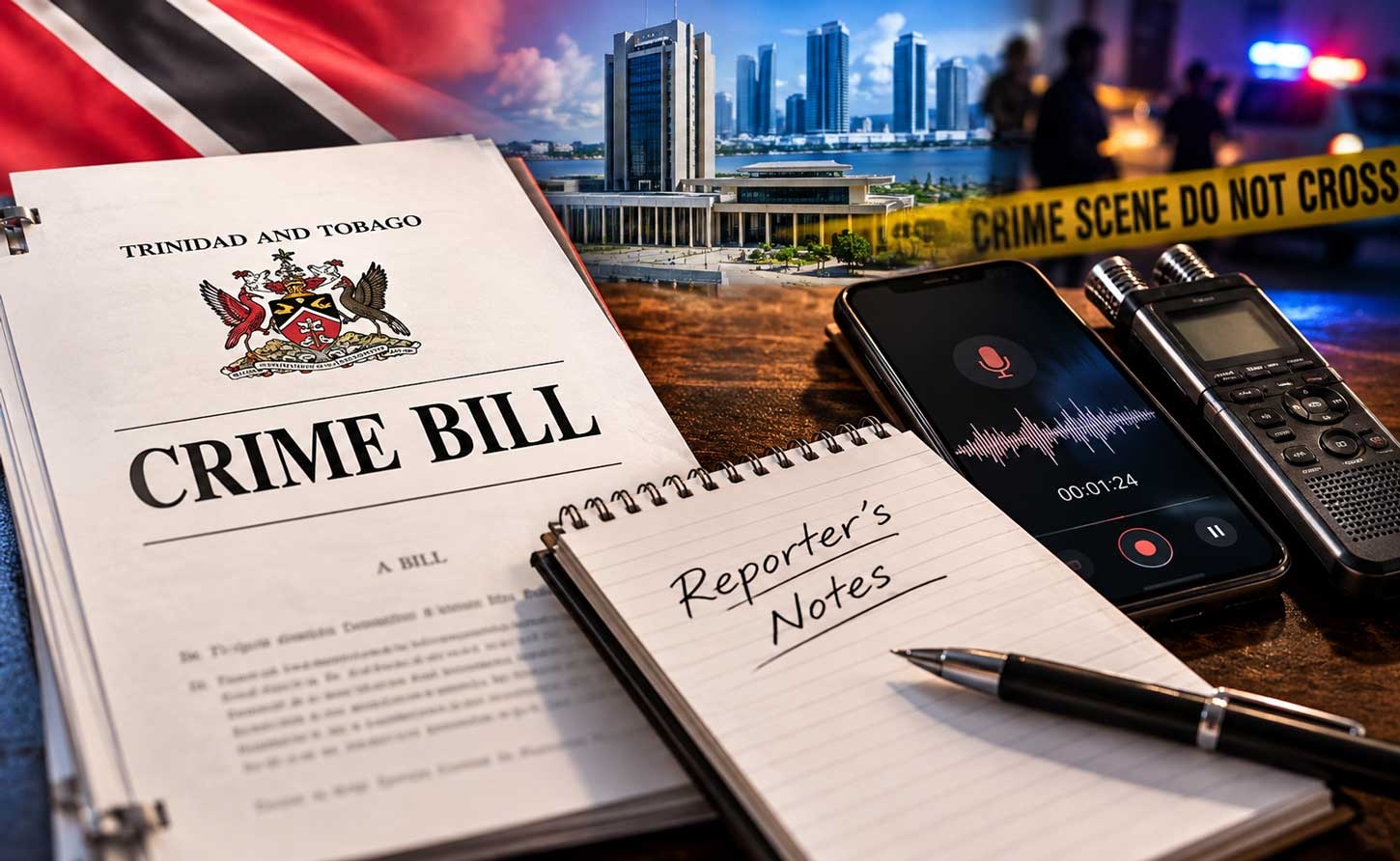
Clause 15 bars police from seizing “a tool of a lawful trade or business” and any material protected by legal professional privilege. A lawyer’s privileged files are named. A reporter’s notes, cell phone and voice recorder are not.
Trinidad and Tobago’s new Special Operations Bill shields a lawyer’s privileged files from police seizure. It is silent on a reporter’s notebook. Journalists warn that silence could cost the country its sources, and its reputation for a free press.
PORT OF SPAIN, Trinidad and Tobago | Calvin G Brown, October 10, 2026 | In Port of Spain, a journalist’s notebook rarely looks like a notebook any more. It is a cell phone: the voice memo of a frightened witness, the WhatsApp thread with a whistleblower inside a ministry, the contact list that took fifteen years to build. Under a law passed by the slimmest of margins last month, that phone could be bagged and carried off by police, with no special procedure to stop officers from reading what is inside.
That is the warning from the Media Association of Trinidad and Tobago (MATT), which is demanding an urgent amendment to the Special Operations Bill, 2026 before the damage is done.
A law passed on a knife’s edge
The bill cleared the Senate on September 24 by 16 votes to 15. It is the government’s second attempt. Its earlier Zones of Special Operations bill, modelled on Jamaica’s 2017 ZOSO law, failed to win the three-fifths special majority it needed in the Senate earlier this year.
The new law lets police establish policing districts and run special operations inside them, with or without support from the Defence Force. The government’s case is blunt. Piloting the bill, Attorney General John Jeremie reminded the House that the country recorded 626 murders in 2024. Few Trinidadians doubt the scale of the crisis.
A nation governed by emergency
Context matters here, because Trinidad and Tobago has spent most of the past two years under emergency rule. A state of emergency declared on December 30, 2024 ran until Parliament was dissolved for the April 2025 election. A second was imposed in July 2025 and lapsed on January 31, 2026. A third took effect on March 3, 2026, was extended twice by three months, and expired on September 17 after 199 days.
Under those emergencies, police could arrest and search without warrants, and bail was suspended for suspects. The Special Operations Bill passed just seven days after the last emergency ended. The government has presented special operations as the successor to emergency rule: a way to keep pressure on the gangs without a fresh proclamation.
That is precisely why the drafting matters. Emergency powers expire. Statutes do not. Whatever protections are left out of this bill stay left out until Parliament decides otherwise.
Journalists are not disputing the crisis. Their quarrel is with one clause.
The missing word
Clause15 bars police from seizing “a tool of a lawful trade or business” and any material protected by legal professional privilege. A lawyer’s privileged files are named. A reporter’s are not.
MATT points out that journalism is not explicitly recognised as a protected trade, and that the bill sets out no procedure for handling confidential journalistic material discovered during a search. Its president, Prior Beharry, wants the clause rewritten to name journalism expressly as a lawful trade, and to shield reporters’ devices, materials and confidential sources from routine seizure.
“The tools of a journalist is ... usually a cell phone.” — Prior Beharry, MATT President
In other words, the phone is not just a device. It is the newsroom, the archive and the confidential file all at once. Seize it, and police take far more than evidence in the case at hand.
International press freedom advocates have gone further. Pedro Cárdenas of Article 19 has been reported as warning that the bill allows officers to seize items deemed to be of “substantial value”, a standard he says is too vague to meet international human rights law.
The currency of trust
Investigative journalism runs on a single promise: your name stays with me. The clerk who leaks a dodgy procurement file, the officer who reports corruption in the ranks, the resident of a gang-controlled community who describes what really happens after dark. None of them will speak again if they believe a raid on a reporter’s home could expose them.
A chilling effect does not need a single phone to be seized. It needs only the possibility. Sources make their own calculation, and silence is the safer bet.
Trinidad and Tobago’s courts have already been here. In 2021, a ruling struck down police search warrants used to enter the home and office of a Trinidad Express journalist. MATT is effectively asking Parliament to write that lesson into statute, rather than leaving each reporter to fight it out in court after the door has been kicked in.
A darkening climate
The clause lands in an already deteriorating environment. Trinidad and Tobago ranked 19th of 180 countries in the 2025 Reporters Without Borders World Press Freedom Index. This year it fell 13 places to 32nd.
Beharry concedes that journalists were not directly targeted under the recent states of emergency. But he says access is shrinking. The Prime Minister has not held an official press conference in more than a year, and ministries invite state media to state-funded events while independent outlets are left outside.
Independent journalist Pearce Robinson has argued that the mix of surveillance capability, expanded search powers with no explicit cover for journalism, and dwindling access to ministers is a real and present danger, above all to investigative reporting. Opposition figures, among them former Prime Minister Stuart Young, have been reported as calling the bill unconstitutional and a threat to entrenched civil liberties.
The government’s safeguards
The government insists the law is not a blank cheque. Every officer and soldier involved in special operations must be trained in human rights, the use of force, community engagement and de-escalation. The bill requires monthly reports to the Prime Minister and ministers, and an annual report laid before Parliament. Jeremie has also credited the state of emergency with a 42 per cent fall in violent crime, including murders and kidnappings.
Those are real safeguards. But none of them protects a newsroom. A report to Parliament a year later does not return a seized phone, and it cannot un-burn a source.
One sentence away
Jamaica, whose ZOSO law supplied the template, knows that security zones and a free press can coexist only when the boundaries are written down. The fix in Port of Spain is not complicated. A single line naming journalism in Clause 15, and a clear protocol for confidential material, would close the gap without weakening a single crime-fighting power.
The government says it wants citizens to be free to live without fear. That freedom must include the freedom to tell a reporter the truth. A notebook is not a weapon, and the law should stop treating it like one.
— 30 —
