
JAMAICA | Guyana Has Been Selling Hurricane-Proof Houses Since 2022. Jamaica Sent Its Order to Jiangsu
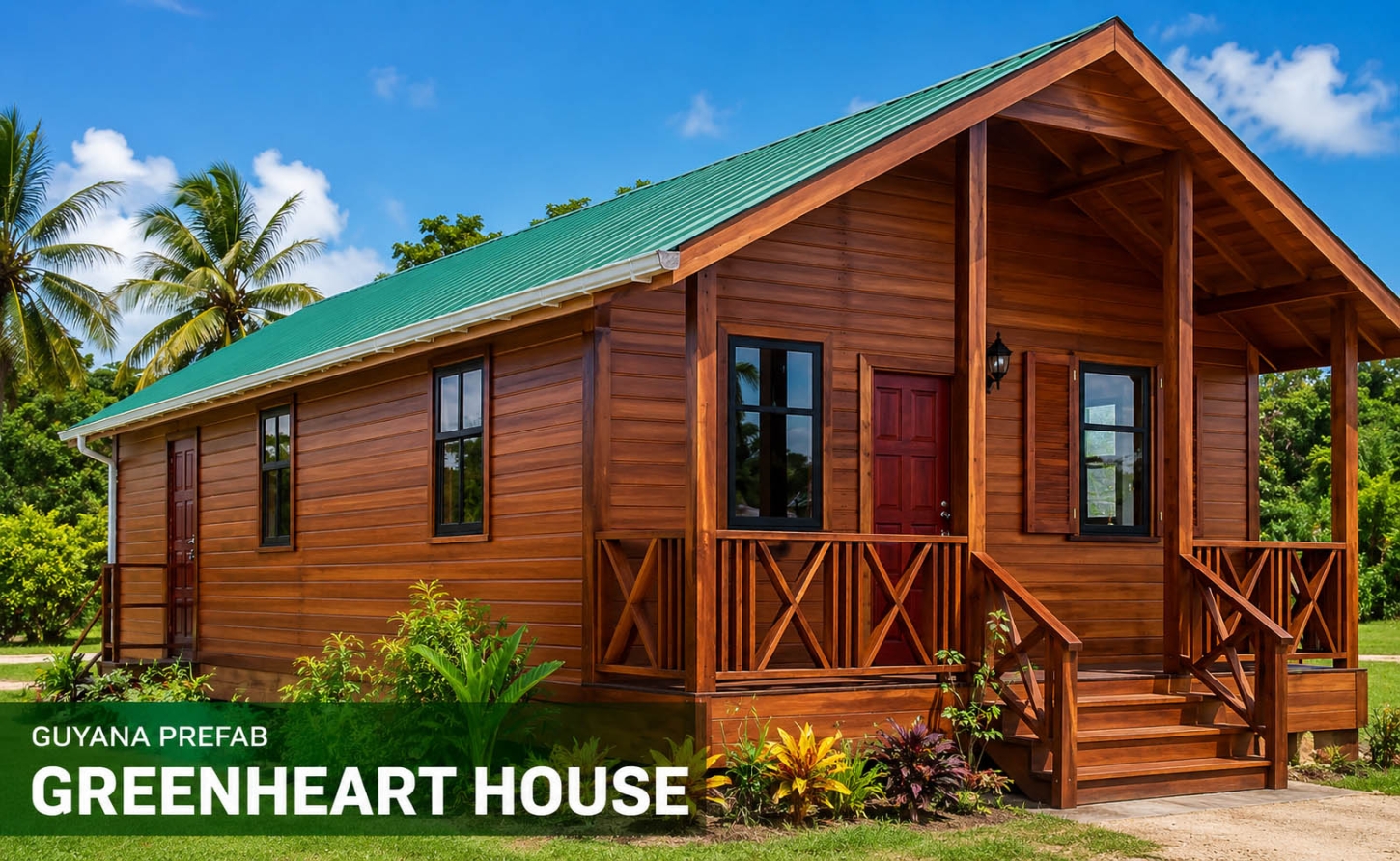
A sample of prefab greenheart houses from Guyana
Ten months after Melissa, Hanover families are still without homes. A CARICOM neighbour manufactures the answer in hardwood — and Kingston has been shopping in the wrong hemisphere.
HOPEWELL, Hanover, 21 August 2026 by Calvin G Brown — The most damning testimony at Wednesday’s public forum in Hopewell came not from the platform but from the floor — citizens rising one after another to tell Opposition Leader Mark Golding what ten months of “recovery” has meant in Hanover: no house, no timeline, and a second hurricane season already upon them.
Golding, accompanied by Angela Brown Burke and Natalie Neita-Garvey, heard those appeals alongside East Hanover MP Andrea Purkiss and West Hanover MP Heatha Miller-Bennett. Purkiss pledged what an elected representative can pledge.
But pledges do not shed water. Out of that meeting came a recommendation both unglamorous and, on inspection, rather obvious: that the Government of Jamaica buy prefabricated hardwood houses from Guyana.
The precedent is already written
This is not speculation. When La Soufrière erupted in St Vincent in 2021, Ralph Gonsalves did not wait on a donor conference. He flew to Georgetown, toured DuraVilla Homes at Land of Canaan, and arranged to buy ready-made one-, two- and three-bedroom houses — kitchen and bathroom included — with financing already in place. Barbados went further, contracting a thousand units. Grenada has enquired about 2,500.
These are not sheds. They are greenheart — Chlorocardium rodiei, the timber that sheathed the hulls of the Fram and the Endurance against polar ice and still holds the lock gates of the Manchester Ship Canal. It resists rot, termites and marine borers without chemical treatment. Guyanese families have lived in greenheart houses for generations, and those houses are still standing.
Meanwhile, Jamaica went shopping in Jiangsu
On 1 December 2025, five weeks after Melissa, the National Housing Trust invoked emergency procurement to award US$19.15 million — roughly J$3.1 billion — to the Jiangsu Zhenhuai Construction Group for 2,500 foldable EPS panel units.
By late June, some 924 containerised units sat in holding yards at Spanish Town, Luana and Montpelier under Jamaica Defence Force supervision, alongside donated Chinese units and 300 wooden structures from the Red Cross.
Be fair about what that money bought: speed, at roughly US$7,660 a unit. Foldable panels ship flat and go up fast, and after a Category 5 storm speed is no trivial virtue. But be equally honest about what it did not buy. Not one of those units is a house. They are shelter — a holding pattern that has now lasted ten months.
A donation of 300 houses is charity. A standing order for 3,000 is a Caribbean economy.
Turn the gift into a trade
On 25 June, at the International Building Expo in Providence, President Irfaan Ali announced that Guyana would build more than 300 homes in Jamaica as a second phase of Melissa support, delivered through Guyanese banks, builders and suppliers.
Prime Minister Andrew Holness was in the room. Guyana has kept faith with us before — generators, tarpaulins and water tanks in the first weeks, then GDF engineers working beside the JDF to get people under cover by Christmas.
Three hundred houses is generous. It is nowhere near sufficient. Minister Robert Montague’s own figures put severely affected families at 12,000 on first assessment, revised to roughly 2,500 after review. In Hanover in May, twenty people remained in four shelters and the Mayor of Lucea was reduced to formally requesting fifteen container houses.
So the argument is not that Georgetown should give us more. It is that Kingston should buy. A commercial order — permanent greenheart units, specified to Jamaican code and financed through the reconstruction envelope the NHT already commands — would put durable housing stock on the ground within a delivery cycle rather than a decade, and keep the money circulating inside CARICOM.
The honest objections
Three deserve stating plainly. DuraVilla’s units are engineered for Category 3 winds; Melissa came ashore at Category 5, so any Jamaican order must be specified upward, not taken off the shelf. Greenheart carries a Data Deficient listing on the IUCN Red List and regenerates slowly, though Guyana’s Forestry Commission code of practice won PEFC endorsement in 2024. And a finished timber house costs several multiples of a folding panel: this is a capital decision, not a relief line item.
None of that argues for doing nothing. All of it argues for negotiating properly, and now, while a sister government is publicly volunteering to help.
Ten months on, the state’s answer to Melissa has arrived largely by container ship from the other side of the world. There is a shorter voyage available. It begins in Demerara, and it ends with a family in Hopewell sleeping under a greenheart roof before Christmas.
— 30 —
