
JAMAICA | Gov’t Moves On With Secret Third-Country MOU; PNP Objects, Demands Details
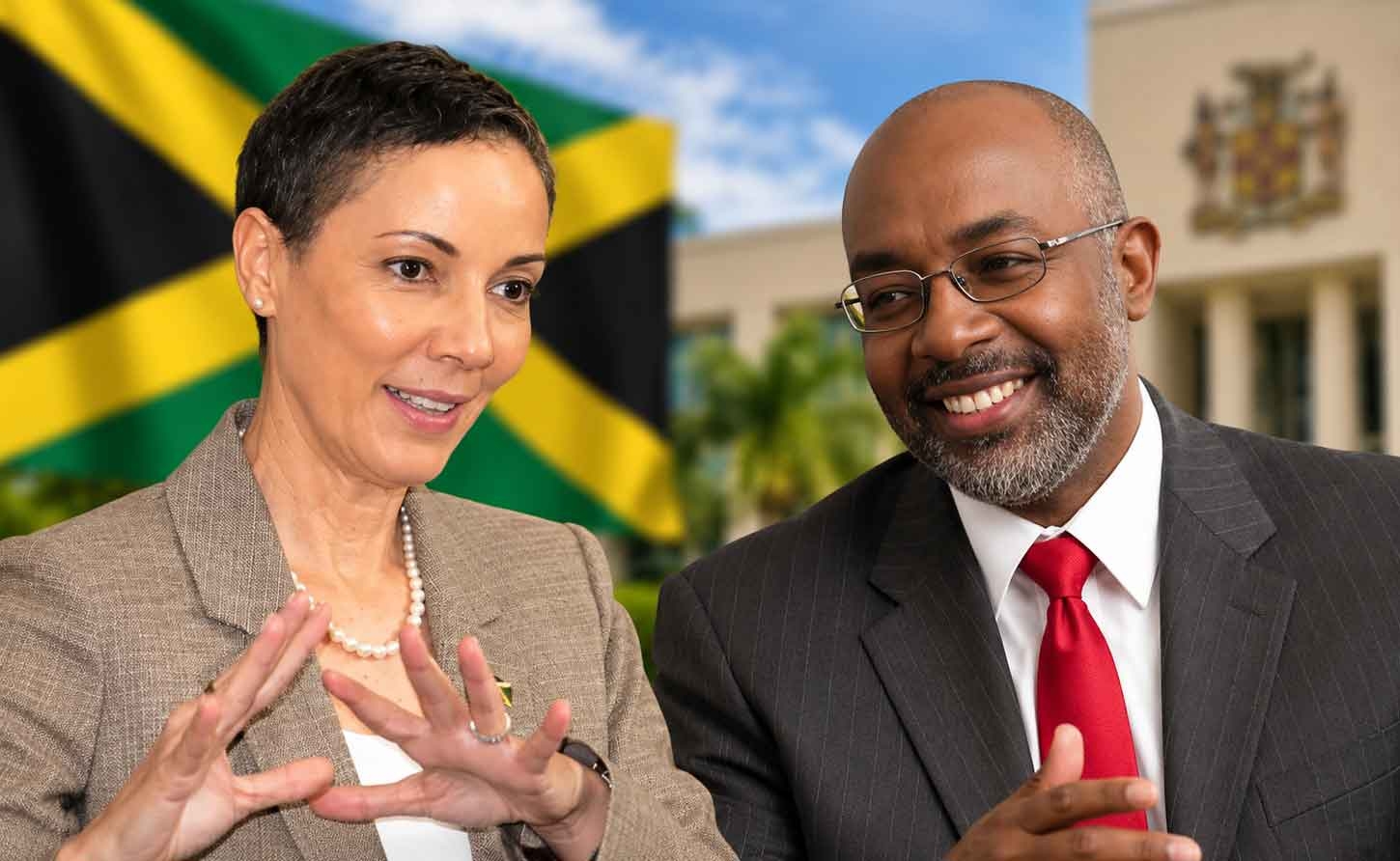
Foreign Affairs Minister Kamina Johnson-Smith and Opposition spokesman on national security Fitz Jackson
Jamaica and Washington have settled the operating procedures for moving third-country nationals through the island. Jamaicans are being asked to take the rest on faith.
MONTEGO BAY, Jamaica , Sept 16, 2026 - The Government is pressing ahead with its agreement to move third-country nationals from the United States through Jamaica. The Opposition says Jamaicans should be allowed to read it first.
At Wednesday's post-Cabinet briefing, Foreign Affairs Minister Senator Kamina Johnson Smith announced that Kingston and Washington have finalised the operating procedures under the Memorandum of Understanding (MOU) on Third Country Nationals (TCNs), signed on June 10. Those procedures, she said, set the “guardrails and parameters”. What the guardrails say, the public will not be told.
The People's National Party responded the same day, demanding that the full MOU be tabled in Parliament. Opposition Spokesman on National Security Fitz Jackson, MP, dismissed the update as an announcement that the Government has decided and the people will be told nothing, and insisted that Parliament must debate the agreement before a single TCN arrives.
The minister, for her part, confirmed the MOU will not be released, because it is a bilateral arrangement and the United States has not agreed to publish it.
The Government's Case
To be fair, the Administration has not been silent on substance. By its account, TCNs are not deportees and not Jamaicans, but nationals of other countries who entered the US illegally and are being sent home through the International Organization for Migration's (IOM) US-funded Assisted Voluntary Return programme. Jamaica pays nothing. No one with criminal antecedents will be accepted. Arrivals are capped at 25 a fortnight, and the arrangement is suspended if 10 TCNs seek asylum or humanitarian protection here.
In June, National Security Minister Dr Horace Chang promised health, identity and criminal-record checks, plus National Intelligence Bureau clearance, and said Jamaica may refuse anyone. Close to 30 countries, several in CARICOM, have similar arrangements. No start date has been set while the IOM completes its assessment.
“There's nothing being hidden per se.” — Senator Kamina Johnson Smith
The Promise That Quietly Expired
But assurances are not a text. Johnson Smith acknowledged that some ministers had earlier signalled willingness to publish the MOU, in full good faith. Good faith does not change the outcome: a commitment offered to calm public anxiety has been withdrawn.
The gap matters because the record already contains contradictions. The Gleaner reported in June that a US diplomatic note spoke of up to 10,000 TCNs. The minister says Jamaica never agreed to that figure. Without the document, citizens must referee between a foreign diplomatic note and a ministerial assurance.
“Silence Is Not Governance”
Jackson has framed the dispute as a question of democratic accountability rather than migration policy.
“Jamaicans are being asked to trust a secret agreement that touches their security, their communities and their public services.” — Fitz Jackson, MP
He accused the Administration of an “autocratic disregard” for Parliament. Beyond tabling the MOU and its operating procedures, the PNP wants all funding sources and any benefit to Jamaica disclosed, the vetting process explained, and clarity on what happens to TCNs once the ten-application suspension trigger is reached.
The Questions Nobody Has Answered
Strip away the partisan heat and the questions remain stubbornly practical. Where will TCNs be housed, and for how long? Minister Chang said in June that the US would pay for their initial stay; who pays if that stay runs long? Whose records underpin the criminal checks, Washington's or Jamaica's own?
Constitutional scholar Dr Lloyd Barnett has asked which home countries are involved, and what happens if one refuses to take its nationals back. And if the suspension trigger is pulled, what becomes of the ten applicants in a country without a mature asylum system?
Follow the Money
Then there is the question never answered: what, if anything, is Jamaica getting for this? Ministers have said what Jamaica will not pay. They have not said whether Jamaica will be paid, or what Washington offered.
Elsewhere, the price tags are on the record. A report by Democratic staff on the US Senate Foreign Relations Committee, released earlier this year, found Washington paid more than US$32 million to five governments to accept roughly 300 third-country nationals, including US$7.5 million to Rwanda for just seven people and US$5.1 million to Eswatini for 15. According to the US Committee for Refugees and Immigrants, the Central African Republic agreed to take deportees after an US$85 million infusion for IOM operations there, the same UN agency at the centre of Jamaica's arrangement.
None of this establishes that Jamaica has been offered money, and the Government has not said it has. But if a payment, grant or aid package is attached, Jamaicans are entitled to know its size and terms. If there is none, the Government should say so plainly, and explain why a country still rebuilding after Hurricane Melissa would take on America's legal difficulty for nothing.
Sovereignty Belongs to the People
The Government's central reason for secrecy deserves hard scrutiny. In effect, what Jamaicans may know about an arrangement on Jamaican soil is being decided in Washington. Yet these are people whom United States law will not allow to remain in the United States, and Jamaica is being asked to receive them on America's behalf.
A nation asked to carry the burden should not need Washington's permission to explain it to its own people.
The minister says she consulted her Cabinet colleagues and the US Government. What she has not said is whether Jamaica insisted on disclosure as a condition of taking part, or simply accepted Washington's refusal.
States do not routinely publish every diplomatic text, and the Access to Information Act treats sensitive bilateral agreements differently. But secrecy is not the only alternative. The MOU could be shared in confidence with a bipartisan parliamentary committee, and Parliament could hold its debate before implementation, not after.
Ministers have repeatedly said Jamaica's sovereignty was never compromised in these negotiations. Sovereignty, however, is not only the right to say no to Washington. It is also the right of Jamaicans to know what their Government has said yes to.
Until then, the guardrails exist only on paper, and the public has not been allowed to see the paper.
— 30 —
