
JAMAICA | Freedom Without Land: The Patterson Institute Turns the Reparations Case Inward
JAMAICA | Freedom Without Land: The Patterson Institute Turns the Reparations Case Inward
One hundred and eighty-eight years after full emancipation, the UWI-based Institute argues that land ownership and productive enterprise are not a domestic footnote to the reparations claim — they are its foundation.
KINGSTON, Jamaica, August 1, 2026 - The reparations argument is usually aimed outward — across the Atlantic, at the treasuries that grew fat on stolen labour. The P.J. Patterson Institute for Africa-Caribbean Advocacy has used Emancipation Day 2026 to aim it somewhere considerably less comfortable: homeward.
In a message issued on 1 August, the Institute urged the region to complete what it termed the unfinished work of emancipation, arguing that while political and civil rights have been won, broad access to land and economic opportunity continues to elude Caribbean people. “Land ownership remains beyond the reach of too many families,” the message states.
Then comes the line that stings. The Institute attributes the migration of millions of Caribbean people northward to the plain fact that ownership and enterprise have proved more achievable there. That is a regional institution acknowledging, on the anniversary of freedom, a verdict already rendered in departure lounges.
The Ledger Since 1838
Emancipation Day 2026 marks 188 years since full freedom came to the formerly enslaved of the British West Indies, following the Emancipation Act of 1834 and the apprenticeship that delayed its effect. The Institute credits the interval with real achievement: independent nations led, a culture exported to the world, distinction won in sport, scholarship, music and letters.
But it reaches back to 1865 for its warning. Twenty-seven years after emancipation, the Right Excellent George William Gordon was lamenting the poverty of the newly freed African population, while the Right Excellent Paul Bogle and the people of St Thomas marched demanding dignity, equality and opportunity. Freedom, the message argues, was never intended to mean merely the absence of slavery.
What distinguishes this year’s statement is where the Institute files that domestic argument. It does not treat land and enterprise as housekeeping, separate from the international claim. It treats them as load-bearing — an important step in strengthening the case for reparatory justice from Europe, and part of the fundamental ground on which that case rests. The charge to regional leaders is accordingly two-handed: press the demand abroad, and develop and empower the people in whose name it is pressed.
Patterson’s Long Argument
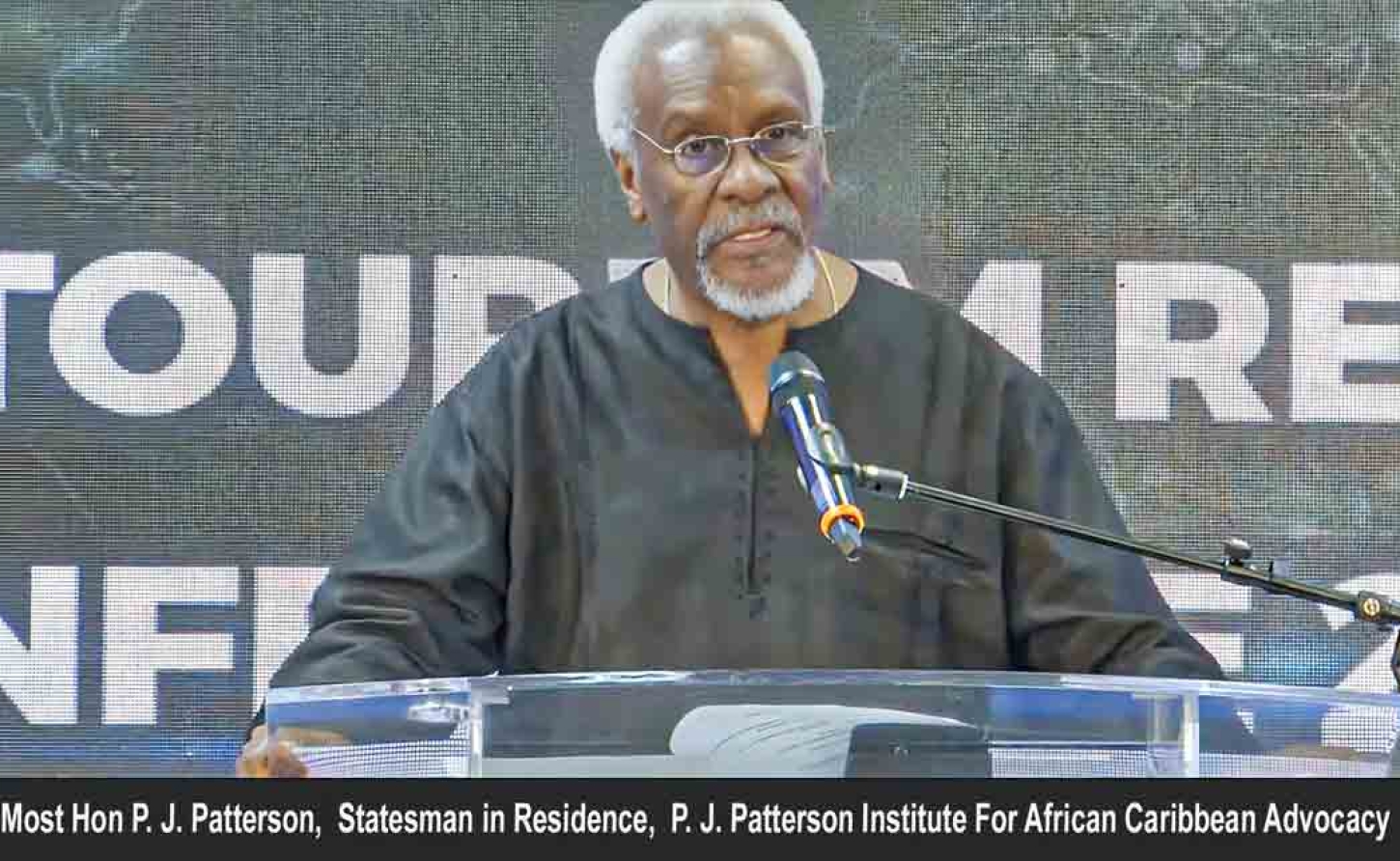
The framing carries the signature of the Institute’s Statesman-in-Residence. The Most Hon. P.J. Patterson, ON, OCC, OE, KC, Jamaica’s longest-serving prime minister, has spent the six years since the entity’s launch at Mona pressing one line: that 1838 closed a chapter without closing the book.
“Emancipation did not come easily. It certainly was not a favour or a gift,” Patterson declared in his Emancipation Day message last year. In 2022 he called for sustained attention to “the unfulfilled mission of dismantling the remaining vestiges of systemic discrimination” — naming inequitable access to land and shelter first among the restrictive practices embedded in national and international arrangements since abolition.
Speaking at the Norman Manley Law School in April, Patterson tied the reparations campaign directly to regional capacity, warning that “CARICOM will flounder unless there is an effective machine and binding mechanisms” to enforce the decisions its leaders take. He read the United Nations vote of March as conclusive proof of what the scholarship and political will of Africa and the Caribbean can secure in combination.
The Verdict, and What It Does Not Do
That vote is the altered backdrop to this Emancipation Day. On 25 March, the General Assembly adopted Resolution A/80/L.48, declaring the trafficking of enslaved Africans and racialised chattel enslavement the gravest crime against humanity.
The count was 123 in favour and three against — Argentina, Israel and the United States — with 52 abstentions, among them all 27 European Union member states, the United Kingdom, Canada, Australia and Japan. Ghana carried the text on behalf of the African Union, co-sponsored by all 54 of its members.
The CARICOM Reparations Commission, marking the same first of August, relaunched its expanded Ten Point Plan for Reparatory Justice under the subtitle A Manifesto for the Coming Enlightenment, approved by Heads of Government at Gros Islet in July and carried to Westminster days later.
The argument about history has been won. The argument about remedy has barely opened.
The region gains nothing by overstating what it holds. The resolution creates no binding obligation. Washington’s representative dismissed the text as problematic in countless respects. London continues to acknowledge the horror of the trade while declining, as successive British governments have declined, to accept legal liability.
Which is precisely the gap the Institute’s message occupies. A declaration in New York does not register a title deed in Hanover or capitalise an enterprise in Castries. The calendar ahead offers tests rather than guarantees: CARICOM’s presence at the Commonwealth Heads of Government Meeting in November, a third regional reparations conference in Barbados, and the unveiling of the Newton Slave Burial Ground Memorial.
The Institute’s own standard is the sterner one, and it applies at home as squarely as abroad. Freedom, it argues, should be measured not only by rights guaranteed under the law but by genuine opportunity and shared prosperity — a Caribbean in which ownership accompanies freedom. On that measure, the 188th anniversary finds the work well short of done.
— 30 —
