
CARICOM | Robes, Panels and Power: CCJ President Rejects 'Panel Fixing' as Region Weighs the Damage
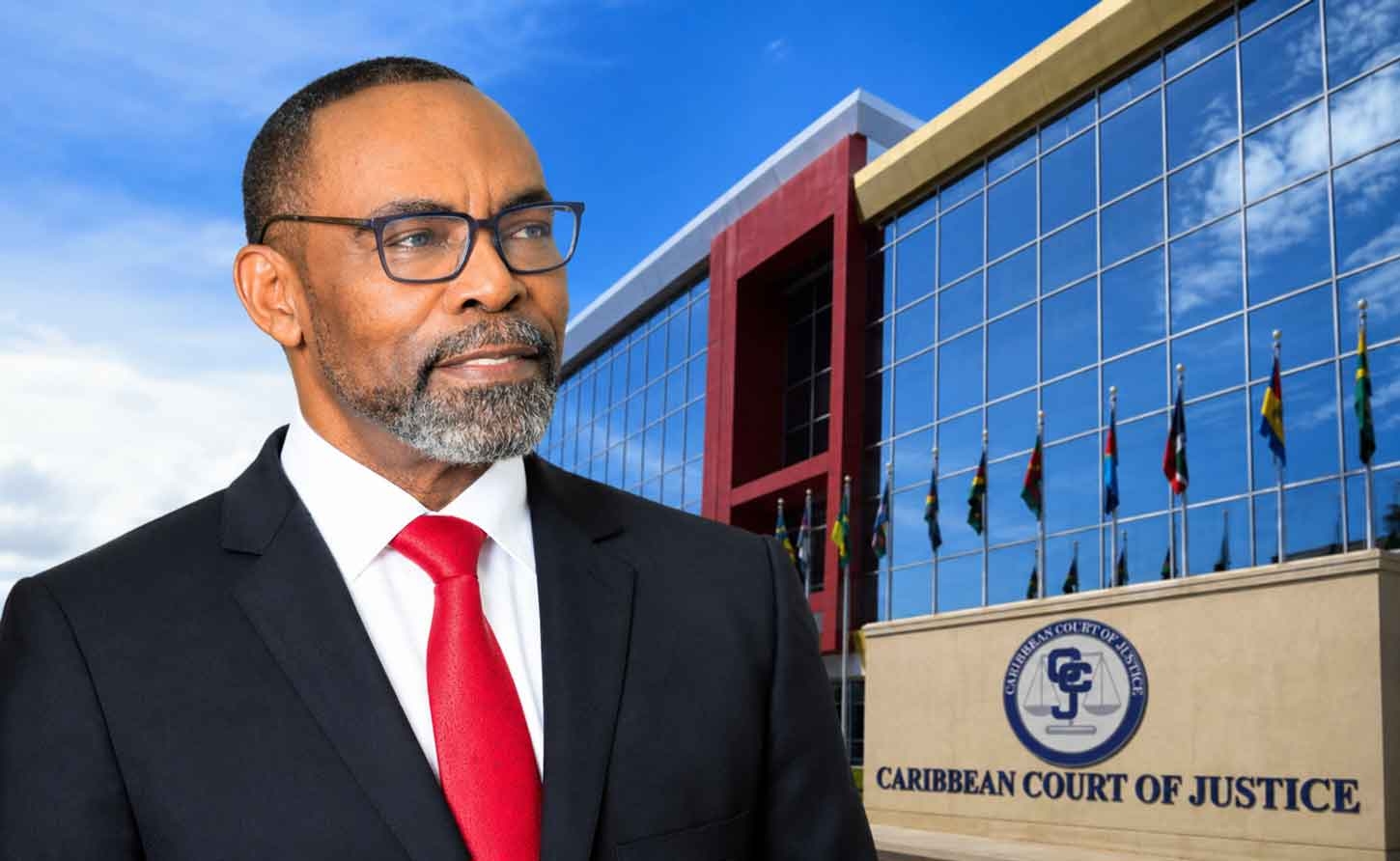
CCJ President Justice Winston Anderson
Justice Winston Anderson has issued a point-by-point rebuttal of allegations levelled by a majority of his own colleagues. He concedes ground on two fronts, denies the most damaging charge absolutely, and proposes a remedy that may outlast the quarrel that produced it.
CALVIN G. BROWN | REGIONAL AFFAIRS | WIREDJA
MONTEGO BAY, Jamaica, Calvin G Brown, August 16, 2026 | The Caribbean Court of Justice was founded on an argument: that this region could be trusted with the final word on its own justice. For a fortnight that argument has been tested — not by its old opponents in London or sceptics in Kingston, but by the Court's own bench.
On Friday, 14 August, Justice Winston Anderson — President of the CCJ since July 2025 — broke a week of institutional silence with a lengthy statement responding to allegations first carried by Trinidad's Sunday Express and drawn from leaked internal correspondence. In those exchanges, a majority of his judicial colleagues challenged his administration of the Court, from the imposition of a dress code to accusations of "panel fixing" and attempts to influence the outcome of cases.
The response is neither blanket denial nor capitulation. It concedes two matters, refuses a third absolutely, and quietly proposes a structural change that may prove more consequential than any of its rebuttals.
Two Admissions, Freely Given
The first concerns the dress code. Anderson accepts he may have approached it too strongly, explaining that he treated it as an institutional question about the appearance and consistency of the Court rather than a challenge to any individual judge — an unusually candid line for a sitting court president to commit to paper.
The second concerns Guyana. Anderson confirms that in October 2025 he travelled to Georgetown and spoke separately with the President and the then Leader of the Opposition, hoping to break a two-decade impasse over the substantive appointment of a Chancellor and Chief Justice.
His predecessors raised the same concern publicly — Sir Dennis Byron in 2013, Justice Adrian Saunders in 2022. Then the admission: another course would have been much better, and he might have confined himself to public commentary as they did.
The distinction matters. Public commentary on a constitutional defect is advocacy. Private shuttle diplomacy between a head of government and an opposition leader, conducted by the president of the court to which both may one day be parties, is something else — and Anderson now says so himself.
The Charge He Will Not Accept
On panel fixing there is no concession. Anderson calls the suggestion the most serious wound of the episode and rejects it as wholly untrue. Constituting panels, he argues, has always formed part of the President's administrative responsibilities, exercised to secure the orderly and impartial administration of justice and never to shape an outcome.
His account of the disputed case is specific. The change of panel in D'Almada v Trinidad and Tobago arose solely from the question of judicial attire, pending consideration of a proposed dress code.
He says he recorded in writing at the time that the removal had nothing whatsoever to do with the judge's opinions or expression of judicial views, and that the same colleague was later assigned to the substantive hearing. The disputed sitting was interlocutory, and all five judges agreed leave should be granted.
The inferential leap required to elevate a question of bench attire into an allegation of panel fixing is, in Anderson's words, irresponsible, intellectually dishonest, injudicious — and malevolent.
On the Mohamed extradition matter he adds that all seven judges were unanimous on the disposition of the appeal, and that the Original Jurisdiction publishes no dissents, as is standard in international courts of that type. Robust exchange while a judgment is prepared, he argues, is judges doing their work.
Then the remedy: every judge will henceforth sit on every panel unless excused for legitimate reason. It is offered as reassurance. Read closely, it is the most telling line in the statement — an acknowledgement that unfettered presidential discretion over panels is a vulnerability the Court can no longer afford, whatever the intentions of the president exercising it.
The Other Side of the Ledger
That account must be weighed against what has been reported of the correspondence, which the Court has not disputed as inauthentic. According to the Trinidad Express and subsequent regional reporting, five of the Court's six sitting judges — Justices Chile Eboe-Osuji, Chantal Ononaiwu, Arif Bulkan, Maureen Rajnauth-Lee and Peter Jamadar — challenged the President's administration.
Justice Jamadar is reported to have described a toxic environment and an attempt to influence colleagues holding differing views during deliberations in the Mohamed matter. Justice Eboe-Osuji is reported to have alleged a level of dictatorship in judicial administration he had not previously encountered, insisting the President is "not its lord and master" over his peers. Justice Rajnauth-Lee is reported to have warned of an absence of proper process.
The gap between the two accounts is narrower than the temperature of the exchange suggests, and it is a gap about sequence. Anderson says his reasons were made abundantly clear in writing; the reported correspondence suggests colleagues received the decision first and the reasoning afterwards. In a collegiate court, that order of operations is the whole of the thing.
Whose Formality Is Neutral?
Beneath the governance quarrel sits a question the region has never answered, and Anderson deserves credit for naming it rather than burying it. If national dress is appropriate on the bench, he asks, what constitutes national dress in a Caribbean of such diversity — and who decides?
It is the right instinct, arriving after the rupture rather than before it — and the irony is hard to set aside. The attire the Court treats as customary, the suit and tie and the bench jacket, is not neutral. It is inherited: the sartorial residue of the same colonial legal order the CCJ was created to supersede. When the judge at the centre of the dispute is Nigerian-born, a former President of the International Criminal Court, and the garment in question is his own traditional dress, the question of whose formality counts as default is not vanity. It is a question about what decolonised justice looks like when it sits down.
The case on the other side is real. An apex court sets the pattern for every court beneath it, and uniformity of the bench signals that a panel speaks as one institution rather than a collection of individuals. A unilateral departure by one judge, however principled, forecloses the very consultation Anderson says he wants. Which is why the matter belonged in consultation from the start, not in an ultimatum.
Who Judges the Judges?
On 10 August the Regional Judicial and Legal Services Commission acknowledged the allegations, recognised their seriousness, and said the concerns are best addressed through the Court's internal governance mechanisms and a "transparent and independent review".
That formulation carries an architectural problem. The RJLSC appoints the judges and oversees discipline; the President of the CCJ chairs the RJLSC. A commission chaired by the subject of the complaint cannot, without more, satisfy the ordinary meaning of independent — a point sharpened by former commission member Martin Daly, SC, who has argued the President should step aside. Regional judicial heads have voiced continuing confidence while condemning the leak, a posture both correct and insufficient.
Jamaica's Collateral Damage
Nowhere has the fallout landed harder than in Kingston, where the CCJ is not an abstraction but the unresolved centre of a stalled constitutional reform. Senate President Tom Tavares-Finson, KC, has called it "extremely reckless" for Jamaica to commit to the Court in present circumstances and demanded a public enquiry, while questioning whether the People's National Party still conditions its support for a republic on accession.
The Opposition has not moved. Mark Golding maintains accession should proceed; the PNP has framed the Senate President's position as indifference to the fact that final-instance justice in London remains a privilege of the wealthy, and asked what is dignified about petitioning a court in the United Kingdom sixty-four years after independence.
The argument in Jamaica is therefore not really about Justice Anderson. It is about whether a governance dispute inside a fourteen-month-old presidency justifies postponing, perhaps indefinitely, a decolonisation pending since 1962. Institutions are not disqualified by having disputes. They are disqualified by being unable to resolve them.
Anderson opened his statement by describing the Court as the product of decades of blood, sweat and tears by Caribbean people who believed the region capable of sustaining its own final court. He is right, and it is why the leak is now the least of it. Having reached the public, the correspondence cannot be un-known.
The CCJ has never had to prove that Caribbean judges can decide cases; two decades of jurisprudence settled that. It must now prove something harder — that a Caribbean institution, under pressure and in full view, can hold its own leadership to account without being told how by anyone outside the region.
That, and not the dress code, is the case now before the Court.
— 30 —
