
AFRICA | China’s Grip Tightens on Ethiopia’s $12.5-Billion Airport as Washington Changes Tack
AFRICA | China’s Grip Tightens on Ethiopia’s $12.5-Billion Airport as Washington Changes Tack
Chinese firms hold nearly half the shortlisted positions for Africa’s largest airport. Washington is now selling engines and avionics instead of concrete — and Addis Ababa has just bought itself four more months.
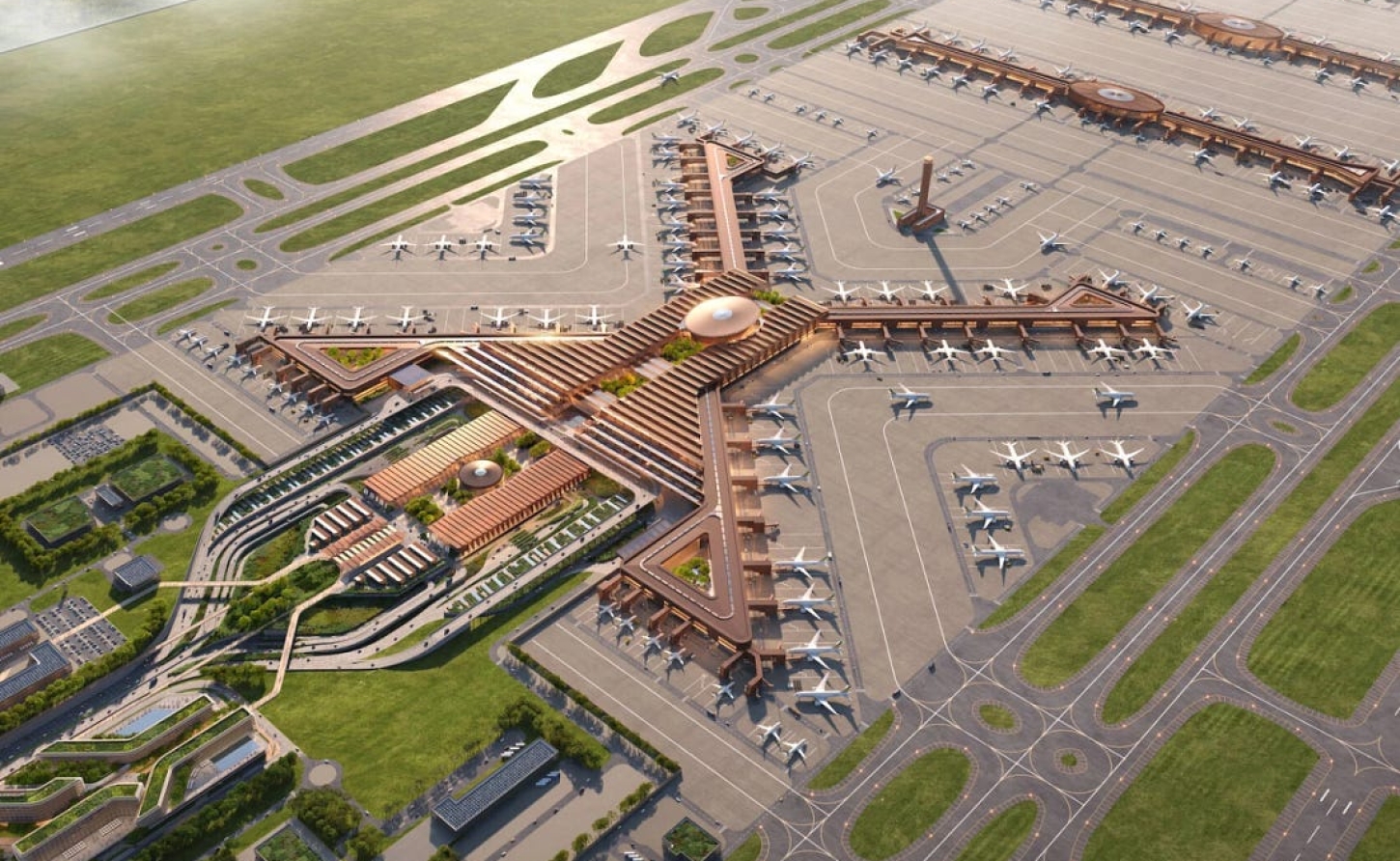
KINGSTON, Jamaica, 17, August 2026 - Calvin G Brown | On highland farmland some 40 kilometres southeast of Addis Ababa, Ethiopia is grading the site of what it intends to be Africa’s largest airport — and, less visibly, staging a contest between Washington and Beijing over who supplies the continent’s next generation of infrastructure.
The numbers in Ethiopian Airlines Group’s prequalification results are not ambiguous. Of 33 shortlisted positions across the four main engineering, procurement, construction and finance packages, 15 are held by Chinese firms, alone or in joint venture.
These include China Communications Construction Company. China Road and Bridge Corporation. China Civil Engineering Construction Corporation. Beijing Urban Construction Group. The same names that built much of modern Ethiopia’s road, rail and industrial estate.
No major independent American contractor made the list. The only US-linked name is Connecticut’s Lane Construction Corporation, which appears in three packages — and does so as part of a consortium led by its Italian owner, Webuild, alongside Türkiye’s IC İçtaş.
Washington has responded not by fighting for concrete but by selling what gets bolted on afterwards. Mark Mitchell, US deputy assistant secretary of commerce for the Middle East and Africa, told a symposium in Ethiopia in July that his department was “closely engaged in pushing to secure strong United States participation”.
The target is the aviation ecosystem: aircraft, engines, avionics, air traffic control, surveillance and the data architecture required to run a 60-million-passenger terminal. Boeing and GE Aerospace are the obvious beneficiaries — Ethiopian Airlines has already committed to six more 787-9s on top of twenty on order. Those contracts run for decades and lock in a supplier long after the bulldozers leave.
Ethiopia is not choosing between Washington and Beijing. It is making them bid.
Financing is the larger battleground, and the arithmetic is revealing. Ethiopian Airlines intends to fund roughly 30 per cent of the project from its own balance sheet, leaving lenders to find more than $9 billion. About $8.5 billion of interest has been indicated; nothing decisive has been signed.
The African Development Bank is mandated lead arranger and may commit $500 million subject to appraisal, with the US International Development Finance Corporation, the Export-Import Bank and JPMorgan Chase circling. So are Bank of China, China Exim Bank, ICBC and China Development Bank.
That structure quietly settles a question about the price. AfDB documents originally costed Bishoftu near $10 billion, and the $12.5 billion figure now in general circulation carries no official paper behind it — but 30 per cent equity plus $9 billion of debt lands close to $13 billion. The financing plan, not the press releases, tells you where the number has gone.
And the clock has slipped. Contractor selection, expected this month, has been pushed to early January 2027. Group chief executive Mesfin Tasew insists the overall timetable holds. What the delay hands every consortium is four additional months to bolt financing onto engineering — an advantage that favours bidders whose state banks already sit in the same room as their builders.
None of which reads as drift. It reads as design. Addis Ababa unbundled a mega-project into four packages, then invited Chinese, Italian, French, Turkish, Qatari, Korean, Indian and Russian bidders to undercut one another inside each.
Qatar’s UCC Holding is shortlisted in all four. Ethiopian Airlines already flies a mixed Boeing and Airbus fleet for the same reason. This is not non-alignment as sentiment; it is non-alignment as procurement method.
The ground truth is harder. Residents of Abu Lugna told Addis Standard they were displaced without compensation or replacement housing, allegations the Bishoftu City Administration denies.
The Oromo Liberation Front alleged “forced displacement” after January’s groundbreaking and demanded equity for affected farmers. Ethiopian Airlines said in February that housing had been handed over and livelihood support introduced. Sovereignty rhetoric means little to a farmer holding no title and no cheque.
Caribbean readers know this film with different subtitles. China Harbour Engineering built Jamaica’s North-South highway, hotels and the Montego Bay convention centre — largely through bilateral arrangement rather than the multi-bidder gauntlet Addis has staged. Guyana, flush with oil, fields the same suitors now.
The lesson from Bishoftu is not that Beijing is preferable to Washington, or the reverse. It is that leverage belongs to the state capable of running a four-package prequalification, publishing the shortlist, and saying no. That capacity — bureaucratic, unglamorous, expensive to build — is what our region has too often traded away for speed.
The runway is being graded. The terms are still being written.
— 30 —
Sources: Ethiopian Airlines Group EPC-F prequalification announcement; South China Morning Post; Addis Standard via allAfrica; African Development Bank press releases; Capital Ethiopia; Business Insider Africa.
