
CARIBBEAN | Gunboat at the Gate: The USS Nimitz, Jamaica, and Washington’s War on Cuba
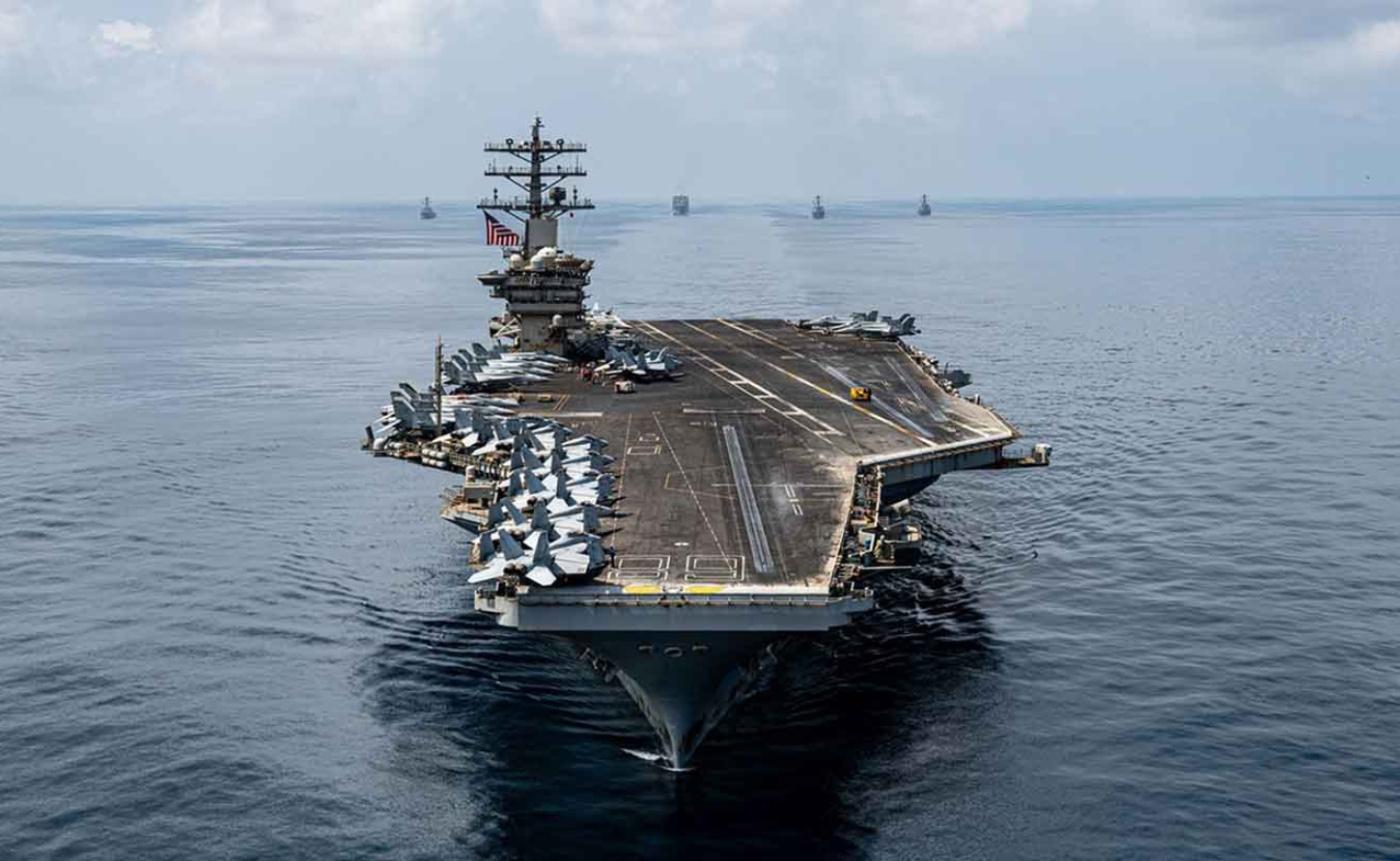
The Nimitz-class aircraft carrier USS Nimitz (CVN68) in Jamaica from June 1 to June 5 as part of the maritime cooperation deployment Southern Seas 2026. Now in its 11th iteration, Southern Seas announced in March by U.S. Naval Forces Southern Command and Jamaica will serve as the final stop in a multinational goodwill deployment that has taken the carrier throughout South America and the Caribbean.
As Trump and Rubio accelerate a sixty-year campaign to strangle and overthrow the Cuban government, a nuclear aircraft carrier now sits 90 miles from Havana—docked in Kingston Harbour, on Jamaican soil.
MONTEGO BAY, Jamaica, June 3, 2026 - Call it what you will. Washington calls it a goodwill visit. The USS Nimitz, one of the most powerful warships ever built, arrived at the Port of Kingston on Monday, June 1, 2026—the largest warship ever to dock in Jamaica—and it will sit here until Thursday. The timing is not incidental. It is a message, written in steel and uranium, 90 miles south of Cuba.
The Trump administration and its Secretary of State Marco Rubio—the son of Cuban immigrants whose politics have been shaped by a generational vendetta against Havana—are prosecuting the most aggressive campaign against Cuba in decades. An aircraft carrier in Kingston Harbour is the latest chapter in that campaign.
Indictments, Blockades, Surveillance: The Full-Spectrum Assault
Since returning to office, the Trump-Rubio axis has moved on Cuba with speed and deliberate intent. In May, the United States Department of Justice unsealed charges against 94-year-old former Cuban president Raül Castro—indicting him for the 1996 shooting down of two planes belonging to Brothers to the Rescue. The charges included murder and destruction of an aircraft. Five Cuban military pilots were also charged.
The legal mechanics are less important than the political signal. The indictment of a former head of state—filed by a grand jury in April and timed to a Miami ceremony honouring the 1996 victims—is a declaration of intent. Trump said it plainly at the announcement: “They’ve been looking for this moment for 65 years, so we’ll see what happens.” No reading between the lines required.
Rubio, addressing Cubans in Spanish, went further. He told Cubans that their deprivation—no electricity, no fuel, no food—was not caused by a US embargo but by a “criminal” government that had “plundered billions.” He offered $100 million in US aid. The transaction was unmistakable: displace your government, and we will reward you. This is the playbook that preceded the US-backed removal of Venezuelan President Nicolás Maduro.
“They’ve been looking for this moment for 65 years, so we’ll see what happens.”
— President Donald Trump, on the indictment of Raül Castro, May 2026
Meanwhile, SOUTHCOM has deployed over 150 hours of aerial surveillance over Cuba using P-8A Poseidon, RC-135V, and MQ-4C Triton aircraft, and has positioned the 24th Marine Expeditionary Unit—more than 1,300 personnel—in the region under Operation Southern Lance since May 30. The USS Nimitz’s “goodwill tour” does not arrive in this context by accident.
Six Decades of Economic War
Lost in the noise of indictments and aircraft carriers is the most durable weapon Washington has deployed against Cuba: the embargo. For more than sixty years, successive US administrations have maintained a comprehensive economic blockade against the island, strangling trade, blocking financial transactions, and isolating Cuba from international markets.
The United Nations General Assembly has voted—33 consecutive times—to condemn the embargo as illegal. Washington has ignored every resolution.
The humanitarian consequences are severe and worsening. Cuba’s economy has collapsed further following the disruption of Venezuelan oil supplies after US intervention in Caracas. The island is experiencing chronic fuel shortages, widespread power outages, and acute food scarcity.
The Trump administration has compounded this by threatening tariffs on any country that continues to supply oil to Cuba—a threat that has already frozen shipments from companies including Mexico’s state oil firm Pemex.
Rubio’s gambit—blaming the Cuban government for the very conditions that US policy created—is cynical in the extreme. It is also effective propaganda.
CARICOM Speaks—But Two Members Blink
The region has not been silent. CARICOM’s Council for Foreign and Community Relations issued one of its strongest statements in recent memory, warning that US threats of military action against Cuba would “inflict unnecessary human suffering, impose grave material costs, and fundamentally destabilise the security architecture of the entire Caribbean region.” Caribbean foreign ministers reaffirmed the region’s identity as a Zone of Peace.
But the statement came with a damaging caveat. Guyana and Trinidad and Tobago formally reserved their positions. Both countries are now members of the US-led Shield of the Americas, launched by Trump in March 2026.
Trinidad has gone further—allowing the US to establish military radar installations on its territory to monitor Venezuela and hosting American troop exercises, despite fierce domestic opposition. Port of Spain and Georgetown are, in effect, operating as Washington’s forward assets in the Caribbean basin.
The fracture in CARICOM solidarity is not merely diplomatic inconvenience. It hands Washington a propaganda victory: proof that even the Caribbean cannot unite against aggression directed at one of its own members.
Jamaica’s Uncomfortable Position
Jamaica welcomed the Nimitz with open arms. Ministers Daryl Vaz and Dana Morris Dixon took a high-seas tour of the vessel before it docked. Investment Minister Aubyn Hill dismissed any suggestion of geopolitical intent: “The Nimitz is here on a goodwill tour.” The Holness administration has dutifully echoed every line from the US Embassy playbook.
What that playbook does not account for is the memory of the Jamaican people.
For the Jamaican public, Cuba is not a geopolitical abstraction. It is the doctor who staffed the rural clinic in Westmoreland when no Jamaican-trained physician would go. It is the scholarship that sent a young Jamaican who could not afford university abroad to study medicine in Havana and come home a doctor.
It is the eye surgeon who restored sight under Operation Miracle. For fifty years, Cuban doctors and nurses served in hospitals and clinics across Jamaica—in the communities that budgets forgot and governments neglected. More than 700 Jamaicans graduated from Cuban medical schools through 2024, with over 300 still studying there today. That is not a bilateral agreement. That is a debt of the heart.
Which is what made the Holness government’s decision in March 2026 so staggering. After fifty years of unbroken cooperation, Jamaica quietly terminated its medical partnership with Cuba—the announcement wrapped in the clinical language of diplomacy.
The Jamaican public did not receive it quietly. Hundreds took to the streets in a gratitude walk from downtown Kingston to Heroes’ Circle—a spontaneous outpouring of thanks to the Cuban doctors and nurses who had given half a century of service. It was, in its own way, a rebuke of the government that ended the programme.
Jamaica was one of four Caribbean nations—alongside Guyana, Barbados, and Trinidad—that in 1972 broke decades of regional isolation by establishing diplomatic relations with Cuba. That act of sovereign courage helped reintegrate Cuba into Caribbean diplomatic life.
It is sobering that fifty-four years on, two of those four nations now sit on America’s side of a regional security bloc, and a third has welcomed a nuclear carrier into its harbour as Havana faces its gravest crisis in a generation.
Barbadian diplomat David Commissioning has called Cuba’s situation a “severe humanitarian crisis that demands a significant and meaningful response from all people and governments of conscience.” He is right. And he has identified what is ultimately at stake: not just Cuba, but “the entire edifice of multilateralism and international law” that the Caribbean has spent decades trying to build and defend.
The USS Nimitz will sail from Kingston on Thursday, headed to its new homeport at Naval Station Norfolk before a planned decommissioning in 2027. It will leave behind school beautification projects, memorable selfies, and the lingering question every Caribbean leader must answer: when Washington finally moves on Cuba, which side of history will we be on?
— 30 —
