
TRINIDAD | ‘She Did Not Distinguish Herself’: Opposition Savages Kamla’s UN Address
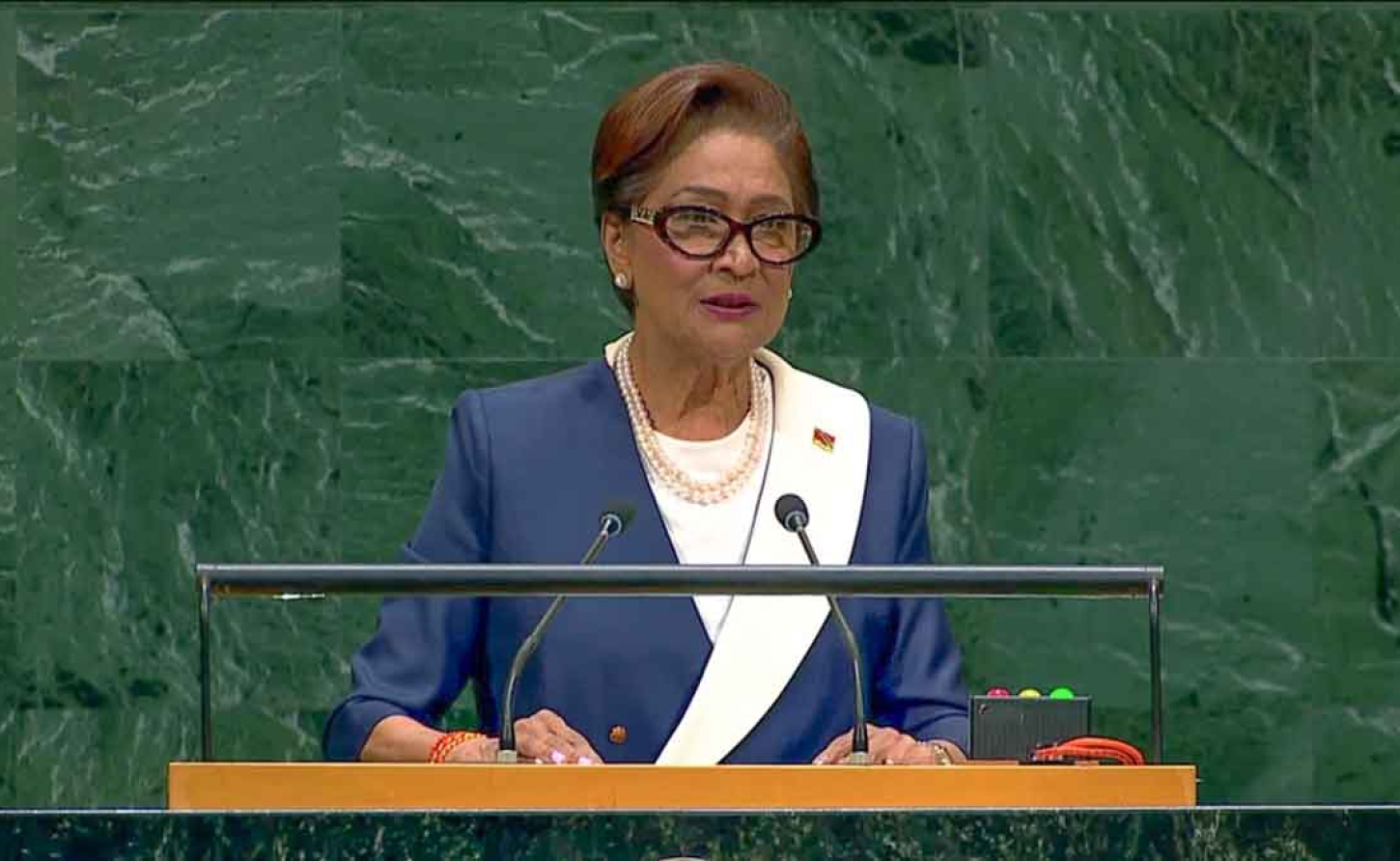
Prime Minister of Trinidad and Tobago Kamla Persad Bissessar addressing the 81st session of the United Nations General Assembly
PNM senators and party chairman accuse Persad-Bissessar of sidelining CARICOM, ignoring the ICC and courting Washington — barely three months before Trinidad and Tobago takes the region’s seat on the UN Security Council.
CARIBBEAN POLITICS, Trinidad and Tobago, September 26, 2026 | By Calvin G. Brown | - Kamla Persad-Bissessar went to New York as the Caribbean’s incoming voice at the world’s most powerful table. She has returned to a barrage from an Opposition that says she spoke for Washington, sidestepped the region and turned Trinidad and Tobago into an international punchline.
Her address to the 81st session of the United Nations General Assembly on Tuesday, September 22, was meant to set out Port of Spain’s priorities ahead of its 2027–2028 non-permanent term on the Security Council. Instead, senior figures in the People’s National Movement (PNM) have spent the week taking it apart — over what she said, what she left unsaid, and whose approval she appeared to be courting.
The Charge Sheet
Opposition Senator Faris Al-Rawi, the former attorney general, opened with omission. The Prime Minister, he said, “missed an opportunity to speak to the International Criminal Court, and that is a huge issue,” arguing that any serious treatment of terrorism and state responses must engage the ICC. The point carries historical weight: it was Trinidad and Tobago’s own A.N.R. Robinson who revived the idea of an international criminal court at the UN in 1989.
Al-Rawi’s sharper blade was regional. “She has studiously avoided speaking as one of Caricom and has not focused on the market Caricom represents to us,” he said, noting that the Community remains the country’s largest market outside traditional partners such as the United States, Europe and the Far East. He flagged trade, sovereignty and “the maintenance of a zone of peace” as live concerns.
Senator Foster Cummings went further, saying international memes about the speech had caused “some embarrassment to the country.” His verdict was blunt: “The Prime Minister did not distinguish herself, did not represent a collective Caricom position as we have seen in the past, and did not put forward a proper representation of Trinidad and Tobago’s interests.”
Then came the party chairman. Marvin Gonzales, taking aim at the Prime Minister’s embrace of US President Donald Trump’s language on artificial intelligence, reached for words that do not survive polite company: “She must stop licking a** and be a Prime Minister for the people of Trinidad and Tobago instead of making herself look foolish on the international stage.”
The ‘Super Intelligence’ Moment
The flashpoint is instructive. Earlier the same day, Trump told the Assembly that all US documents would henceforth replace “artificial intelligence” with “super intelligence.” Within hours, Persad-Bissessar pledged that Trinidad and Tobago, during its Council term, would encourage greater consideration of the implications of “super intelligence” for international peace and security.
The substance was defensible. The vocabulary was a gift to her critics.
In fairness, AI and global security was one of three pillars on which Trinidad and Tobago campaigned for its Council seat, alongside small-arms trafficking and women, peace and security. Her warnings about the technology’s risks, and her note that it “can support conflict prevention, early warning, peacekeeping and the protection of civilians,” were sound. But adopting a term coined by a foreign head of state that same morning handed critics a ready-made caricature of deference.
What She Actually Said
Stripped of the noise, the speech was a security-first document. Persad-Bissessar framed transnational criminal networks as a direct danger to small island states. “For Trinidad and Tobago, this is not an abstract threat,” she said. She pledged Council advocacy on the sources, movement and diversion of illicit weapons, and thanked Trump for inviting her country into the Shield of the Americas and its Counter-Cartel Coalition.
On Haiti, however, she stood squarely on traditional CARICOM ground, insisting that the country’s political future must be “Haitian-led and Haitian-owned” — a line that complicates any claim that she abandoned the regional script entirely.
The Real Fault Line
The deeper grievance is the Shield itself. Only two CARICOM heads of government — Guyana’s Irfan Ali and Persad-Bissessar — attended its March launch in Doral, Florida, and analysts note its founding agreements contemplate the use of lethal military force against cartel targets. For a Community that has long defended the Caribbean as a zone of peace, that is the tension Al-Rawi is pressing.
The Other Side of the Ledger
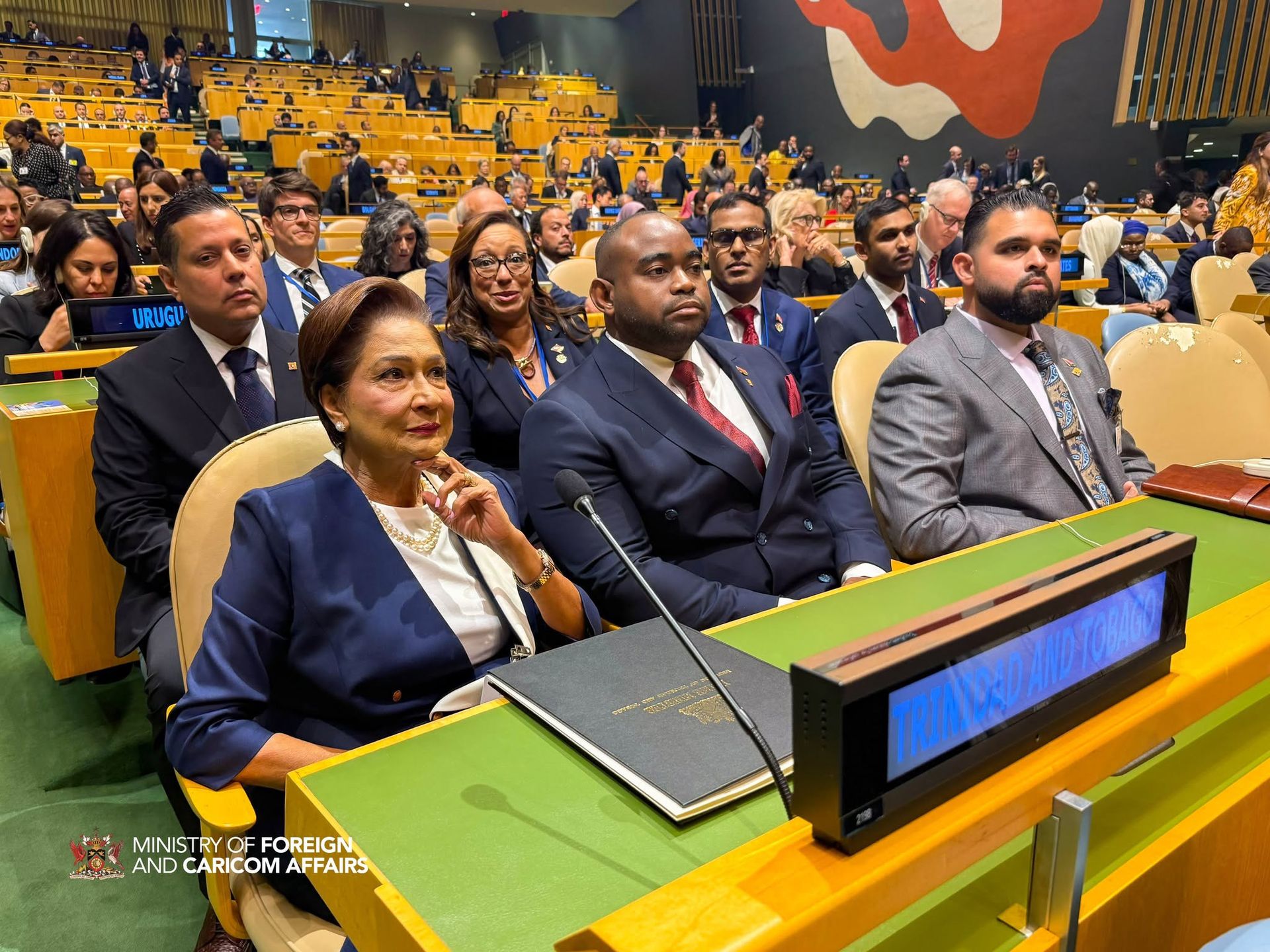
Prime Minister Kamla Persad-Bissessar, from left, Minister of Foreign and Caricom Affairs Sean Sobers and Minister of the Office of the Prime Minister Nicholas Morris during the United Nations General Assembly in New York on Tuesday.
Nor should the Opposition’s verdict be taken as neutral. These are the assessments of a party defeated at the polls in April 2025, and Gonzales’s vulgarity arguably did more to cheapen the national conversation than any meme. No response from the Office of the Prime Minister to the specific criticisms had been reported at the time of writing.
The Question for January
On January 1, 2027, Trinidad and Tobago takes the only Council seat held by the Caribbean. The region will be watching to see whether Port of Spain sits there as CARICOM’s voice or as an amplifier for someone else’s. This week’s row suggests that question is far from settled — and at home, the verdict on New York is already in dispute.
— 30 —
