
CARICOM | Rubio's War Drums Over Cuba: And CARICOM Stares Into Space
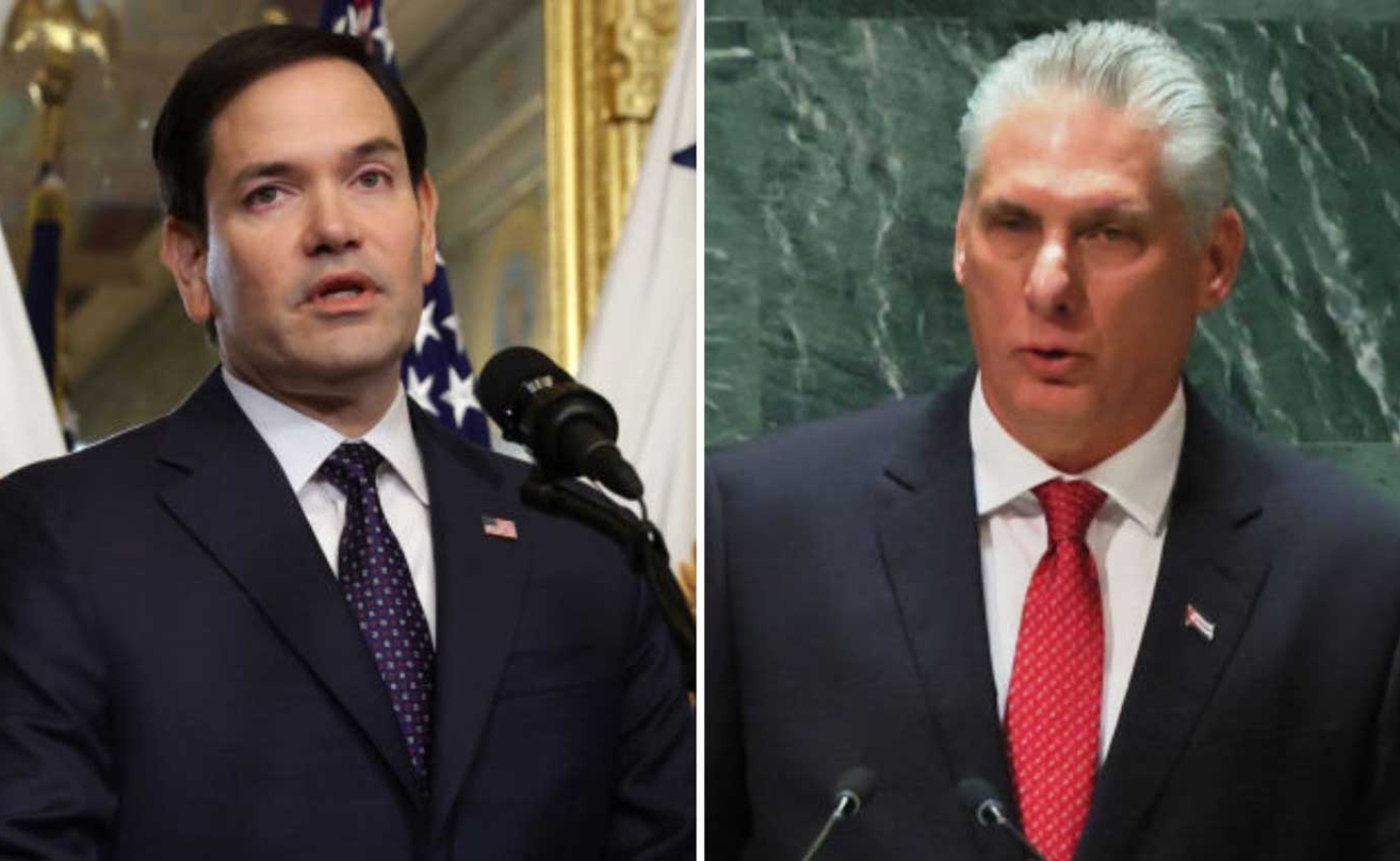
US Secretary of State Marco Rubio and Cuban President Miguel Díaz-Canel
As Washington weaponizes indictments, aircraft carriers, and immigration raids against Havana, the Caribbean's own regional body offers nothing but silence — a dereliction that may carry a catastrophic price
MONTEGO BAY, Jamaica, May 22, 2026 |Calvin G. Brown | Marco Rubio is not a man who does things quietly. The United States Secretary of State has, in the span of a few weeks, orchestrated a Raul Castro indictment, deployed a U.S. aircraft carrier to the Southern Caribbean, and personally revoked the permanent residency of a Cuban national to facilitate her arrest by federal immigration agents in Miami. He has done all of this with the methodical intensity of a man who has decided that this time, Cuba will break.
The context for that intensity is important. Six decades of American economic blockade have failed to bring Cuba to its knees. Successive administrations — from Kennedy through Biden — tried isolation, embargo, sabotage, and covert destabilization, and Havana endured them all. What Rubio is now doing is not foreign policy in any conventional sense.
It is an escalation born of institutional failure: when sixty years of economic siege cannot finish the job, you reach for indictments, aircraft carriers, and the personal revocation of green cards. You take the war to Miami. You make the message personal. You make it hurt.
And where is CARICOM?
Silent. Unmoved. Apparently unaware — or indifferent to the reality — that what Washington is assembling on Cuba's doorstep is the machinery of regime change, and that the Caribbean itself stands in the crossfire.
On Thursday, Immigration and Customs Enforcement agents arrested Adys Lastres Morera in Miami. She is the sister of Ania Guillermina Lastres Morera, the executive president of Grupo de Administración Empresarial S.A. — known as GAESA — the Cuban military's vast financial conglomerate.
Rubio himself announced the arrest on social media, framing it with characteristic prosecutorial swagger: Adys had been "managing real estate assets and living in Florida, while also aiding Havana's communist regime." Her green card, Rubio noted with evident satisfaction, had been revoked by his personal authority the day before.
This was not merely an immigration enforcement action. This was a message — delivered through the life of one woman — that no one connected to the Cuban government is beyond Washington's reach, not even those who have made their lives in the United States.
The arrest came hard on the heels of the most audacious move yet: the unsealing of federal indictments against former Cuban President Raul Castro and five others, charging them with the 1996 deaths of four members of the anti-Castro exile group Brothers to the Rescue.
The charges, returned nearly a month earlier, were strategically unveiled on May 20 — a date Rubio knows well, a date celebrated by Cuban exiles as "Independence Day." The press conference at Miami's Freedom Tower was less a legal proceeding than a political rally, complete with standing ovations, a hostile crowd, and an Acting Attorney General who spoke with the fire of a campaign operative.
The Legal Theatre and Its Dangerous Subtext
The indictment has a foundational problem: it is built on a profoundly incomplete account of what happened in February 1996. The Brothers to the Rescue were not innocent humanitarians. They had spent years provoking Havana — violating Cuban airspace, dropping propaganda leaflets, deliberately testing the patience of a government that had, according to declassified FAA documents, spent months urging the United States to stop the flights. White House officials warned the FAA the night before the fatal mission that Cuba might shoot the planes down. The FAA refused to intervene.
None of this featured in Acting Attorney General Todd Blanche's performance at the Freedom Tower.
Analysts are not struggling to identify the pattern here. The same template was used to justify the January abduction of Venezuelan President Nicolás Maduro — a U.S. indictment deployed as legal scaffolding for what was, in practice, an act of state kidnapping.
Secretary Rubio himself invoked that indictment to justify the intervention in Venezuela, describing the country as a hub for Iranian, Russian, and Chinese operations. He is now using identical language about Cuba.
Meanwhile, a U.S. aircraft carrier has taken up position in the Southern Caribbean. CIA Director John Ratcliffe has visited the island. U.S. military flights off the Cuban coast have multiplied. And a steady drip of leaks to sympathetic media outlets — allegations of Chinese surveillance installations, Iranian drones, Russian intelligence facilities — are constructing the kind of threat narrative that, in the Western Hemisphere, has historically served one purpose: to prepare domestic opinion for military intervention.
Cuba's Foreign Minister has called it a "fraudulent case" for war. President Miguel Díaz-Canel, while insisting his country poses no threat to Washington, has warned that any attack would produce a "bloodbath with incalculable consequences." These are not the words of a government feeling secure.
CARICOM's Abject Silence
Two days ago, CARICOM's Council of Foreign and Community Relations — COFCOR — concluded a meeting in Paramaribo. The ministers found language. Firm, unambiguous language. The Community's statement declared its "absolute support" for the security and sovereignty of Belize against Guatemala's territorial claim, and for Guyana's territorial integrity against Venezuela's relentless pressure on the Essequibo. That language is right and proper. Belize and Guyana deserve exactly that solidarity, and CARICOM delivered it without hesitation.
But the same communiqué — spanning two days of deliberation that apparently found room for Saudi collaboration mechanisms and the establishment of an Austrian office — contained not a single sentence about Cuba. Not one.
Sovereignty, if it means anything, cannot be a principle applied only to CARICOM passport holders. If the Caribbean Community will only defend the Caribbean when the aggressor is a neighbour rather than Washington, then we must ask plainly: what exactly is this Community for?
Cuba is not simply a neighbour. It is a pillar of Caribbean identity — the largest island in the region, a country currently being strangled by an American energy blockade, unable to keep its lights on, its hospitals running, or its children fed. Cuba: whose doctors have stood in our clinics when we had no one else to call.
Cuba: whose sugar lands built the bloodlines of thousands of Caribbean families — including countless Jamaicans who are the sons and daughters of men and women who crossed the water to cut cane and never fully came home.
That Cuba. The one whose relationship with CARICOM dates to 1972, when the then newly independent states of the region had the courage to defy Washington and recognize Havana. That recognition cost them. They paid that price because Caribbean sovereignty demands the right to chart one's own course in defiance of hemispheric bullying.
And yet CARICOM's foreign ministers, assembled in Paramaribo while Washington assembles a legal and military stranglehold around Havana, apparently could not find the words.
This is not merely a diplomatic failure. It is a civilizational one.
Silence Is a Decision
Rubio is establishing something that should terrify every small state in this hemisphere: the principle that Washington can indict, sanction, arrest, and militarily threaten foreign governments and their associates at will, with no multilateral check, no regional resistance, and no diplomatic consequence.
The Venezuela precedent already demonstrated that a U.S. indictment can be a prelude to abduction. The Cuba campaign is demonstrating that even family members living quietly in Florida are not safe if they bear the wrong surname.
Silences of this magnitude are not oversights. They are decisions. And the Caribbean needs to understand what this particular silence is deciding.
The Caribbean has always understood, in its bones, what it means to be small and surrounded by the ambitions of larger powers. The Middle Passage, the plantation, the Monroe Doctrine, the gunboat diplomacy — these are not abstractions in this region. They are memory. CARICOM was built, in part, as a collective answer to that history: the small can protect the small when they stand together.
Today they come for Cuba. Tomorrow they will come for you — Jamaica, Trinidad and Tobago, Grenada. The silence CARICOM keeps now is the silence that will be kept then.
Marco Rubio beats his war drums over Havana, and across the Caribbean Sea, the foreign ministers of this Community sit in Paramaribo and discuss Austrian offices. The silence is not merely deafening. It is a verdict.
— 30 —
