
CARIBBEAN | Enemies of Civilization: The New McCarthyism Comes for the Caribbean
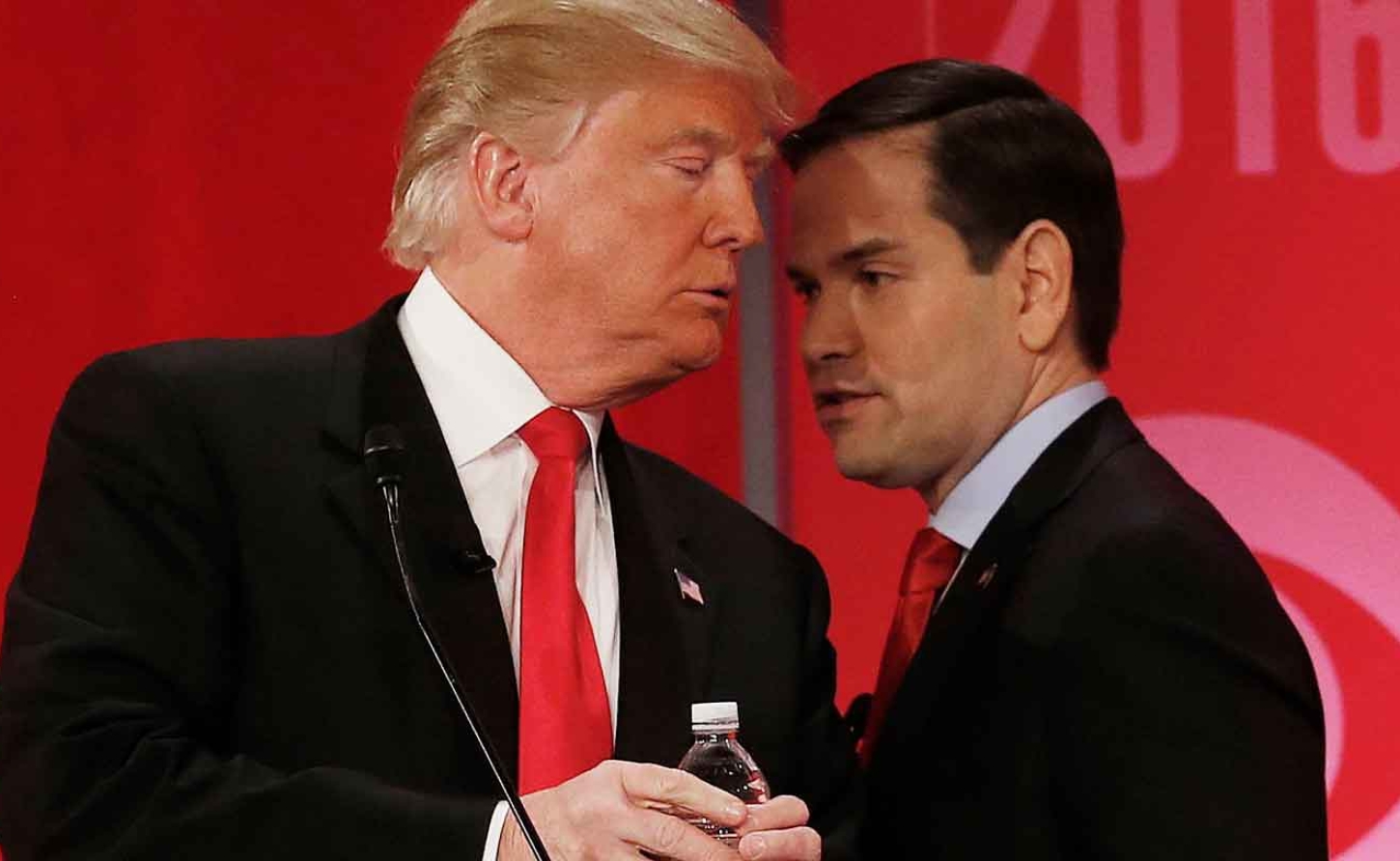
US President Donald Trump and Secretary of State Marco Rubio
When Washington summoned 66 nations to hear the political left branded a terrorist threat, it was not Russia or China cast as the ideological arch-villain — it was Cuba, an embargoed island of 11 million. The Caribbean now sits inside the blast radius of an inquisition built for export.
The scene at the US State Department on July 16 would have been instantly recognisable to anyone who lived through the 1950s. Officials from 66 countries were summoned to Washington for a “Ministerial on the Resurgence of Political Terrorism” — and what they received was not a briefing on bombs or battlefield threats, but a declaration of ideological war against one half of the political spectrum.
White House deputy chief of staff Stephen Miller told the assembled delegations that leftists are “enemies of civilization” — a “cancer” that will destroy society if not rooted out. Without producing evidence of any epidemic of left-wing violence, Miller announced that the United States had formally recognised left-wing politics as a form of terrorism, and complained that American institutions had grown too “soft” in crushing it.
Secretary of State Marco Rubio vowed to designate more left-wing organisations as terrorist entities, while the State Department unveiled visa restrictions targeting members of what it now calls far-left and “aligned” groups — a category elastic enough to fit anyone.
Miller went further still, dismissing appeals to civil liberties as a left-wing tactic that must “fall on deaf ears” — an extraordinary declaration from the seat of a government that lectures the hemisphere on democracy.
The machinery behind the rhetoric is codified in National Security Presidential Memorandum 7, which directs every US law enforcement and intelligence agency to “disrupt, identify, defund, debank, arrest and prosecute” the administration’s political opponents. Six verbs. Not one of them requires a crime — only a belief.
Joseph McCarthy needed a Senate committee and a television camera. His heirs command the Treasury, the surveillance state, and the international banking system.
The Enemy Is… Cuba?
Four days after the ministerial, the State Department released a 100-page report titled Cuba: The Capital of 21st Century Communism. Its thesis is remarkable: not Russia, with its war in Europe; not China, with its trillion-dollar economy and blue-water navy — but Cuba, an island ground down by more than six decades of American embargo, is the ideological headquarters of the threat to the United States.
Rubio declared that Havana has spent over sixty years as the leading sponsor of “radical leftism” in America. The report attributes Cuban influence to everything from the George Floyd protests to campus activism, and it names names: dozens of American solidarity organisations, with some 145 groups now under investigation for potential violations of the Foreign Agents Registration Act. The blacklist is back, updated for the digital age.
Consider the inversion at work. The country that has spent sixty-plus years strangling its neighbour’s economy — that cut off Venezuelan fuel shipments and plunged Cuban hospitals into darkness — now presents itself as the victim of Cuban aggression.
A nation preoccupied with keeping its lights on and its people fed is recast as an ideological superpower whose tentacles reach into every American protest movement. The absurdity is not a flaw in the argument. It is the argument. McCarthyism never required its demons to be plausible — only useful.
McCarthyism as an Export Product
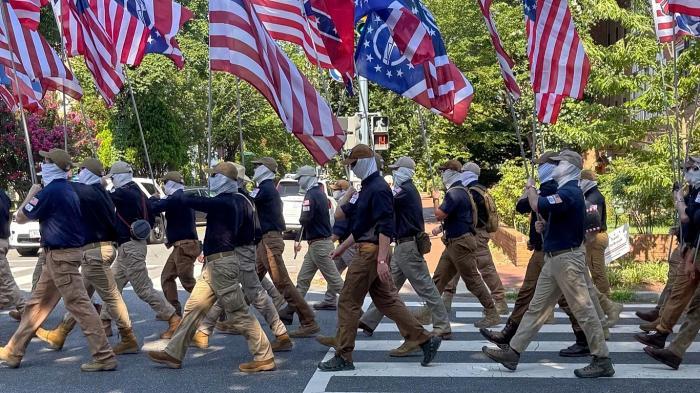
White supremacist groups march in Washington on July 4. Photo: AP
The loyalty oath is no longer demanded of Hollywood screenwriters; it is being demanded of sovereign states.
The reach extends into the diaspora. Caribbean nationals in the United States who march against the embargo, donate to solidarity organisations, or simply advocate for the countries of their birth now do so under the shadow of visa revocations, foreign-agent investigations, and that ever-elastic category of “aligned” groups. The chilling effect is not a by-product. It is the point.
And here the Caribbean enters the frame — not as an observer, but as a target of recruitment.
The Squeeze on the Region
The pressure is already biting. In January, US commandos seized Venezuela’s Nicolás Maduro in a raid on a sovereign state. Donald Trump has since declared publicly that “Cuba’s next.” Washington has severed Cuba’s fuel lifeline and threatened sanctions against any nation that dares to sell to Havana, precipitating blackouts and a humanitarian crisis that CARICOM itself has described in the gravest terms.
Meeting in Suriname in May, CARICOM’s foreign ministers expressed “profound concern” at the escalating measures, affirmed Cuba’s sovereign right to import fuel, and reaffirmed the Caribbean as a Zone of Peace in the face of open talk of military action.
But the statement carried an asterisk: Guyana and Trinidad and Tobago reserved their positions — both now enlisted in the US-led “Shield of the Americas” security alliance launched in March. At the United Nations weeks ago, Grenada and Trinidad abstained on the debate over US sanctions; Guyana and Antigua and Barbuda did not appear at all.
This is what the new McCarthyism looks like from the Caribbean: not tanks on the Malécon, but the slow prying apart of regional solidarity — state by state, incentive by incentive, threat by threat.
The Cuban doctors who staffed the region’s clinics through the pandemic, the scholarships that trained generations of Caribbean professionals, the medical brigades that some governments have already been pressured into abandoning — all of it is being reclassified, in Washington’s new lexicon, from cooperation into complicity.
The region has lived this before. When Michael Manley’s Jamaica dared to befriend Havana in the 1970s, it paid the price in destabilisation, capital flight, and a poisoned press.
Half a century later the instruments are more sophisticated — security alliances, debanking, terrorist designations — but the message to Caribbean capitals is unchanged: your foreign policy is negotiable, and your solidarity is not permitted.
When Solidarity Becomes a Crime
The logic of NSPM-7 does not stop at the water’s edge. If support for left-wing causes is itself grounds for persecution, as Miller insists, where does that leave a region whose governments — of every partisan stripe — have defended Cuba at the United Nations for more than three consecutive decades?
Every CARICOM state that has ever thanked a Cuban doctor, accepted a Cuban scholarship, or voted against the embargo now lives, by Washington’s new definition, somewhere on the spectrum of suspicion.
The McCarthyites of the 1950s eventually overreached, and the word “McCarthyism” became a synonym for disgrace. But the damage was done in the years before the reckoning: careers destroyed, movements criminalised, dissent frozen in place.
The Caribbean cannot afford to wait for history’s verdict. The Zone of Peace was declared for precisely a moment like this one — and the moment has arrived.
— 30 —
