
JAMAICA | Why a Ghanaian Nurse Come to Jamaica and a Jamaican Nurse Takes a Flight

JAMAICA | Why a Ghanaian Nurse Come to Jamaica and a Jamaican Nurse Takes a Flight
Jamaica advertises a registered nurse post at about US$1,705 a month. That is roughly double what a Ghanaian specialist earns at home, and a fifth of what New York pays. Every movement in Caribbean health staffing follows from that one asymmetry — including the quiet return of the Cubans.
MONTEGO BAY, Jamaica, August 25, 2026 - Calvin G Brown- Picture a ward at Kingston Public or Cornwall Regional a few months from now. Two nurses on the same shift. One arrived from Accra in the spring; the post she holds has roughly doubled her income, and she is sending money home. The other trained at Mona, has eleven years on the job, and is filling in an application form on her phone during the break.
Both are underpaid. Both are right. That is not a paradox — it is a ladder, and it can be measured.
The ladder, in dollars
In December the Ministry of Health and Wellness advertised a Nurse 1 post — degree-qualified, Nursing Council registration required — at J$3,241,533 a year. That is the Government’s own published scale, not a survey estimate: J$270,128 a month, or roughly US$1,705 at August’s rate of 158 to the dollar.
Set it beside Ghana. The president of the Ghana Registered Nurses and Midwives Association has put the average nurse’s take-home pay at GH₵2,000 to GH₵2,500 a month — about US$170 to US$215 at the Bank of Ghana’s August rate of 11.74.
A Ghanaian specialist on a higher grade, with allowances actually paid, might reach GH₵5,000 to GH₵9,000: (US$425 to US$765). Then look north, where a registered nurse in New York earns in the region of US$9,000 a month.
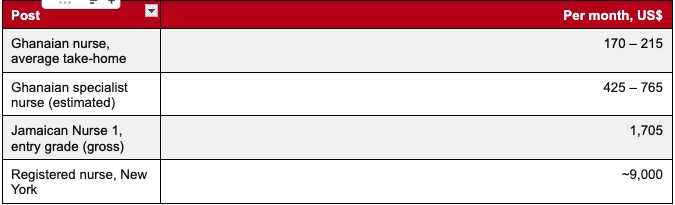
nurse earnings
Read the column. Ghana to Jamaica is a rung: a specialist roughly doubles her money, sometimes better. Jamaica to New York is a ladder in itself, five times over. The gradient going north is far steeper than the gradient coming east.
Ghanaians accept the offer because Jamaica is a promotion. Jamaicans decline it because Jamaica is the floor they are already standing on.
In January the Ministry asked the diaspora to come back. Dr Christopher Tufton’s public appeal — “We are saying to the diaspora, come back home” — accompanied advertisements placed in Britain, the United States and Canada, offering competitive salaries, relocation assistance and uniform, meal and taxi allowances, with a closing date of 13 February.
By late February the Ministry had received 134 responses. Twenty-six were Jamaican. Two of those twenty-six were nurses who had left for the United Kingdom as recently as 2023; one applicant was a British nurse who had previously worked here. By May, more than seventy candidates had been interviewed and the minister said he expected some would be offered posts.
Twenty-six out of 134 is not a recruitment drive. It is a market survey, and the market answered.
There is a fair counterpoint, made this month in the Gleaner by a contributor examining return migration: the headline gap overstates the real one. After income tax, National Insurance, pension contributions, council tax and rent, roughly three-quarters of a British nurse’s gross pay disappears.
The nurse who converted her NHS salary into Jamaican dollars before boarding meets a very different figure on arrival. That is true, and it is the strongest card the Government holds. It narrows the gap. It does not close it, and it says nothing whatever about Florida or Toronto.
Can we afford them?
This is the question the recruitment drive was designed not to answer. Jamaica loses roughly 500 specialist nurses a year to migration while carrying a deficit of about 400. In 2024 the Nursing Council of Jamaica processed more than 1,140 verification requests from foreign employers — close to a quarter of the entire nursing cadre asking, in effect, for its papers.
To reverse that flow, the Government would have to pay something approaching an international wage to several thousand nurses. Set that against a health estate in which Cornwall Regional Hospital, western Jamaica’s principal facility, has been under repair since 2016 at a cost that has climbed from an estimated J$2 billion to J$23.5 billion. The wage bill and the capital bill draw on the same account.
So the Ministry has done what any purchaser does when it cannot meet the local price: widened the search. A new International Recruitment Unit coordinates memoranda with Ghana, Nigeria and India, with a Philippine technical delegation expected.
One hundred specialist nurses complete local training this year; forty-eight nurses and thirty-three doctors are to be deployed under Barry Wint scholarships. None of this is illegitimate. All of it is an admission.
And the Cubans come back
Then the sequence closes on itself. In July the health minister confirmed that more than fifty Cuban nurses are returning to the Jamaican public system — this time on individual employment contracts. More than forty Cuban doctors had already declined to leave when the brigade was withdrawn.
Consider what that means. Jamaica dismantled a medical cooperation arrangement running since 1976, absorbed a year of ward-level disruption, sent delegations across four continents, and has arrived at rehiring the same Cubans under different paperwork. The relationship was never the problem. The form of the contract was — and the objection to that form was raised in Washington, not in Kingston.
It is worth recording what did not happen. No Jamaican constituency asked for the Cubans to go: no patients’ group, no union, no parish council. The doctors who stayed, stayed because they were wanted and wished to.
The nurses returning are returning because both sides want them. Whatever the merits of the American critique of Havana’s programme — and questions about salary handling and travel documents were not invented — the demand originated outside the relationship it broke.
What the arithmetic says
Put the two halves together and the regional picture resolves. Ghana cannot afford to employ the 105,000 trained health workers already on its books, so it exports them. Jamaica cannot afford to retain its own, so it imports Ghana’s. The United States, Britain and Canada can afford everybody, so they draw from both.
And Cuba, which trained more doctors per head than any of them and asked comparatively little for their labour, has been priced out of the arrangement by a third party with no patients on the ward.
The ladder is not a scandal. It is a price signal, and price signals are not immoral — they are simply indifferent. What deserves argument is whether a region that has spent half a century staffing the health systems of the North should keep describing each new import agreement as solidarity, when what it is purchasing is another country’s inability to pay.
The Ghanaian nurse on that ward is not the problem. Neither is the Jamaican one with the application open on her phone. They are reading the same set of numbers, and both of them are reading correctly.
— 30 —
