
JAMAICA | Wheels Down, Lips Sealed: The TCN Deal Parliament Was Never Allowed to Read
JAMAICA | Wheels Down, Lips Sealed: The TCN Deal Parliament Was Never Allowed to Read
As the first deportees from the United States head for Jamaica, Parliament still has not seen the agreement that brings them here — and the Government will not say who is paying whom.
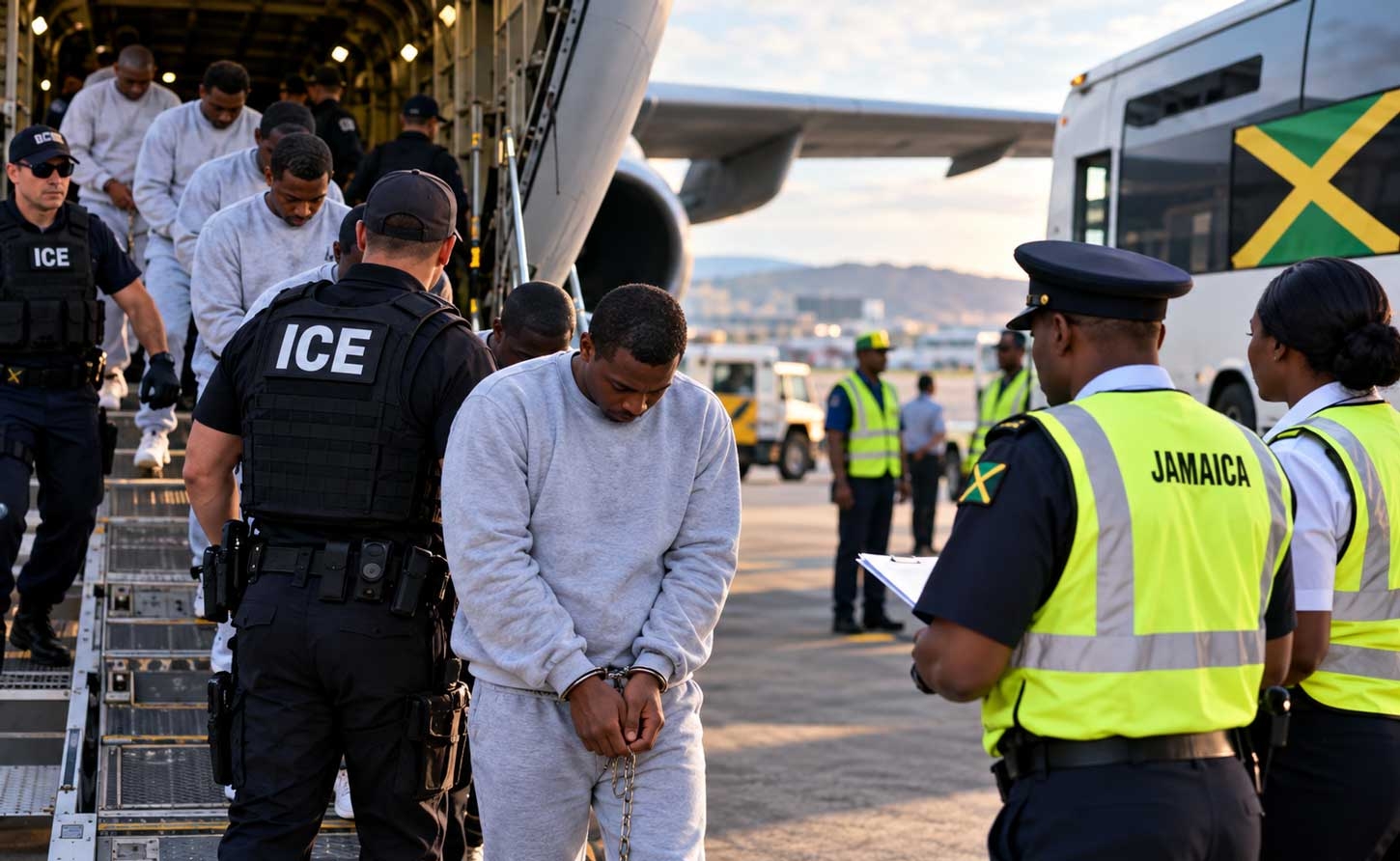
MONTEGO BAY, Jamaica, October 13, 2026 - Calvin G. Brown | The aircraft may already be on the tarmac by the time you read this. According to the Jamaica Observer, highly placed sources said the first batch of deportees from the United States under the so-called third-country nationals (TCN) arrangement was due on the island today, most of them believed to be South Americans.
A joint statement from the Ministry of National Security and Peace and the Ministry of Foreign Affairs and Foreign Trade on Monday confirmed only that the first flight was expected "shortly". What has not arrived — and, on the Government's own word, will not — is the document that governs it all.
Since June, when National Security Minister Dr Horace Chang confirmed he had signed a memorandum of understanding (MOU) with Washington, the 63 elected representatives of the Jamaican people have been asked to take its contents on trust.
In September, Foreign Affairs Minister Senator Kamina Johnson Smith said plainly that the MOU will not be released. The operating procedures are finalised. The International Organization for Migration (IOM) has been engaged. The flight is inbound. Parliament remains outside the room.
A word on language. The Government insists these people are "third-country nationals", not deportees. WiredJa will not adopt that euphemism. These are people being removed from the United States by its immigration authorities and sent to a country that is not their own. Gleaner columnist Michael Abrahams, who says he has read the MOU, reports that the document itself uses the word "deportee". We will call them what they are.
A deal the public learned of by leak
It is worth remembering how Jamaicans found out about this arrangement at all. Not from a ministerial statement to the House, but from The Gleaner, which on June 16 reported on a US Embassy document outlining the framework — including a diplomatic note claiming a Cabinet minister had once floated a figure of up to 10,000 deportees.
The Government has firmly and repeatedly rejected that number, and the minister named has said the note conflated the MOU with a separate skilled-worker proposal. But the episode set the tone: the public would learn the shape of this deal in fragments, and largely from Washington's side of the table.
Opposition Spokesman on National Security Fitz Jackson told the House that failing to table the executed MOU would be "blatant contempt to the people of Jamaica". Opposition Leader Mark Golding argued that the agreement saddles the island with immigration responsibilities that have nothing to do with it. "We've never had an MOU dealing with that," he said.
In September the People's National Party demanded that the MOU and its operating procedures be published, that all funding sources and any benefit to Jamaica be disclosed, and that Parliament debate the agreement before a single deportee lands. The Jamaica Council of Churches has called for a pause pending parliamentary debate.
That deadline, it appears, is about to pass unmet.
Follow the money — if you can find it
The Government's financial assurance is a single sentence, repeated in Monday's release: the arrangement "will not be funded by the Government of Jamaica". That tells taxpayers what they will not spend. It does not tell them what anyone else will spend, where it goes, or what Jamaica gets for its trouble.
Who pays for accommodation, meals, security and onward flights? Is money flowing to the IOM, to private landlords, to Jamaican state agencies? Is Jamaica receiving any payment, credit or concession in return — on visas, on security cooperation, on anything at all?
The Government has not said, and without the MOU, nobody outside Cabinet can check. Regional reporting on the leaked framework indicated that Washington would cover the associated costs. That is precisely the kind of detail that should be read in the text, not pieced together from leaks.
Do the maths
Strip away the diplomatic language and the numbers are simple. Twenty-five deportees a fortnight is 50 a month — roughly 650 a year if the programme runs for twelve months. Every one of them must be housed, fed, guarded, medically screened, vetted by the National Intelligence Bureau, processed by immigration officers and put on an onward flight. And if departures stall — as Antigua's own White Paper warns they can when home countries refuse to issue travel documents — those costs do not end. They accumulate.
None of that runs on friendliness and goodwill. Yet the Government has published no budget: not the cost per person, not the monthly bill, not who pays which line, not where the deportees will sleep, and not whether Jamaican police, soldiers and civil servants will be reimbursed for their time.
What Washington has paid others
Washington's own record shows these arrangements carry a price tag. A February 2026 report by Democrats on the US Senate Foreign Relations Committee found that the Trump regime had paid more than US$32 million to five countries to take roughly 300 deportees.
Rwanda received US$7.5 million for seven people — more than US$1 million a head once flights are counted. Equatorial Guinea got US$7.5 million for 29, Eswatini US$5.1 million for 15, and El Salvador at least US$4.76 million for about 250.
Those deals differ from Jamaica's: several involved detention or resettlement rather than transit, and the report came from the committee's minority party. But even the cheapest rate on that list — El Salvador's, at roughly US$19,000 per person — would put a single year of Jamaica's quota above US$12 million.
If Washington is spending on that scale here, Jamaicans are entitled to know how much, to whom, and on what terms. If it is not, they are entitled to know who is covering the gap.
A safeguard the public cannot read is a promise, not a protection.
The silence is all the more striking because elsewhere in the region the money question is being answered aloud.
The Antigua contrast
Antigua and Barbuda is not yet receiving deportees — but it is close. Speaking on his weekly radio programme, Prime Minister Gaston Browne said negotiations with Washington were nearing completion, the Caribbean Media Corporation (CMC) reports. As recently as mid-September, Ambassador Sir Ronald Sanders had said no final agreement had been reached and no transfer authorised.
How St John's has got here is the instructive part. The Browne administration published a White Paper on the US proposal and took a resolution to its House of Representatives laying out the principles and safeguards for any deal, including the right to approve or reject every individual case by case.
Browne has spoken of accepting perhaps ten people a year, and told legislators he would rather endure visa restrictions than take in criminals, warning that "accepting criminals will destroy our country".
Most telling is what he said about money. Compensation, Browne explained, will be settled in a separate agreement at Washington's request, with arrangements involving an international organisation handled apart from the main text — and Antigua will accept no one until the resources to support them are secured.
He went further, suggesting that some countries may have taken people in before making arrangements, and may not have received the support funding. "We want to make sure that we don't make that mistake," he said.
Browne named no country. But his words put a question to Kingston that it has never answered: is there a separate compensation agreement between Jamaica and the United States? If so, has it been signed, what does it say, and will Parliament be denied that document too? If not, why is the first flight landing before the money is settled?
One can debate whether Antigua will strike a good bargain. But its people know what is being negotiated, its Parliament wrote the terms, and its Prime Minister is talking openly about compensation. Jamaica's Parliament has not even been allowed to read the terms.
The Government's case
Fairness demands that the Government's argument be heard. Ministers insist this is a transit arrangement, not resettlement, and that those arriving are being returned home through the IOM's Assisted Voluntary Return programme. Jamaica says it negotiated hard limits: no more than 25 people per fortnight; no one with criminal antecedents; National Intelligence Bureau vetting before anyone lands; the right to refuse any individual; and suspension of the programme if ten deportees seek asylum.
Jamaica is also one of many countries in the hemisphere that the Trump regime has pressed into such arrangements, and ministers argue that a capped, conditional yes protects a relationship the island cannot afford to fracture.
Those are real safeguards — if they are in the text. That is the whole point.
What must happen now
Nothing in diplomacy forbids a Government from tabling an MOU, with genuinely sensitive operational annexes redacted if necessary. Antigua has shown that a small Caribbean state can negotiate with Washington and still bring its Parliament along. Jamaica can do the same, even now.
The minister should table the MOU and its operating procedures at the next sitting of the House. The Government should publish the monthly budget for this programme, line by line, and state who is funding each stage and whether Jamaica receives anything in return. And it should tell the country where the deportees will be housed, for how long, and what happens to anyone whose onward journey stalls.
The first flight will land with or without those answers. Jamaicans deserve them before the second.
— 30 —
