
JAMAICA | Byles Bows Out Holding BOJ Policy Rate at 5.5% Despite Headline Inflation at 7.5%
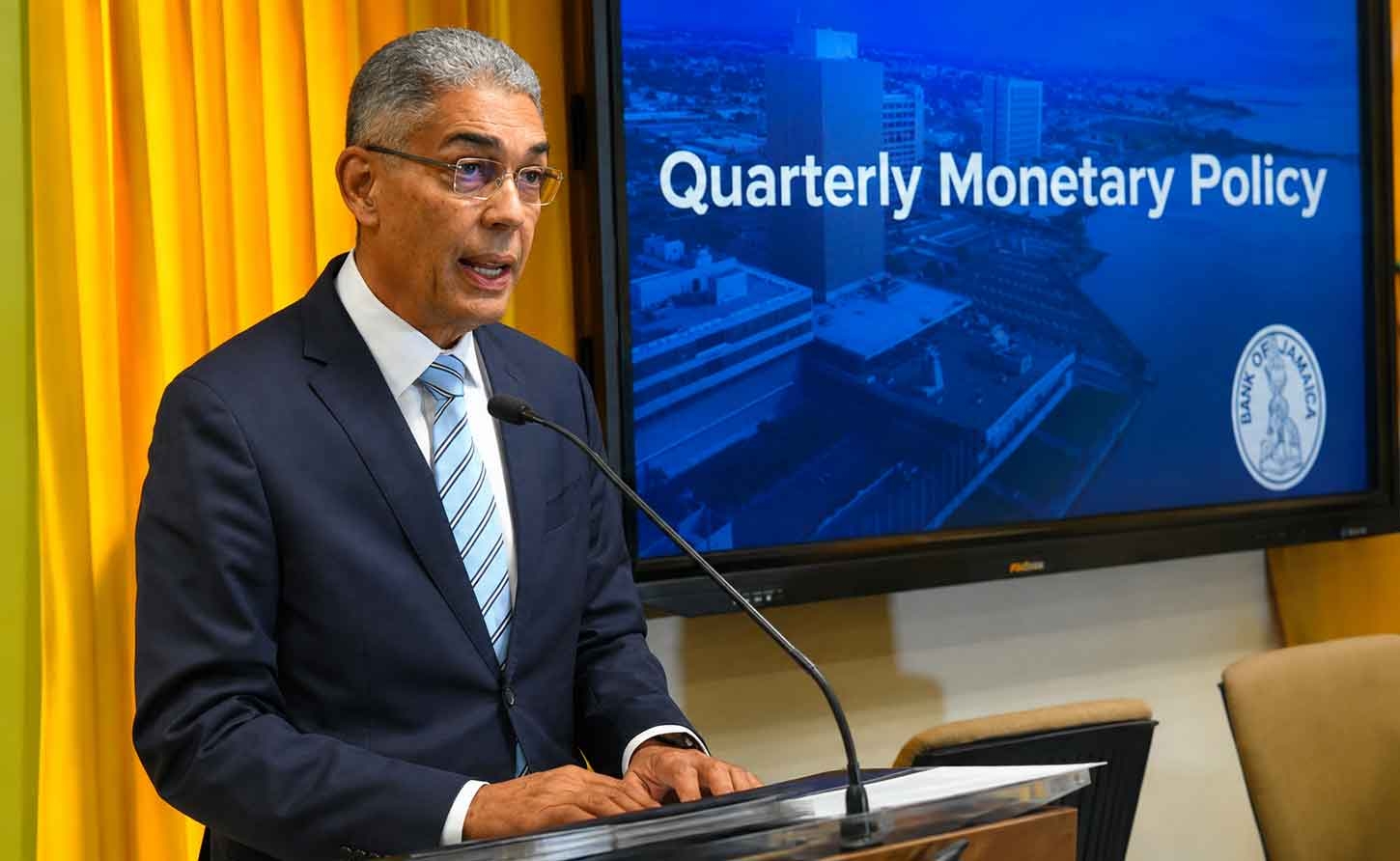
Outgoing Bank of Jamaica Governor Richard Byles
Two full percentage points now separate the benchmark rate from the prices it exists to suppress — leaving the exchange rate to do the work the policy rate is not.
KINGSTON, Jamaica Wednesday, 19 August 2026 |By Calvin G. Brown | There is a number missing from Bank of Jamaica’s latest monetary policy statement, and it is the only number that really matters.
Headline inflation at July 2026: 7.5 per cent. The policy rate, held unchanged this week: 5.50 per cent. Subtract one from the other and Jamaica’s benchmark interest rate now sits two full percentage points below the inflation it exists to suppress. Adjusted for prices, the Bank is not restraining money. It is discounting it.
The Monetary Policy Committee, meeting 14 and 17 August, voted unanimously to hold and to keep steadying the foreign exchange market. Chairman Richard Byles chaired his last MPC on August 18, with Dr. R. Brian Langrin taking over as the new BOJ Governor on August 19. He will be in the chair for the next announcement on 28 September which will be a harder call on this trajectory.
The Climb Nobody Called
Rewind six months. In February, with Hurricane Melissa’s price shock looking milder than feared, the MPC cut the rate by 25 basis points to 5.50 per cent. Inflation then stood at 3.9 per cent — below the floor of the Bank’s 4.0 to 6.0 per cent target band. What followed was a near-vertical ascent: 4.3 per cent in April, 5.5 in May, 6.7 in June, 7.5 in July. Inflation has almost doubled since the Bank last eased, and July was the second consecutive month above the ceiling.
In fairness, July’s outturn undershot the Bank’s own projection; BOJ had braced for worse. Thin consolation. Core inflation, which strips out fuel and agricultural food, climbed to 5.2 per cent from 5.0, and the Bank concedes what that signals: second-round effects, in its own careful phrase, are “emerging, though still limited.” Once a light bill and a taxi fare reach the price of a patty, the shock stops being external and starts being structural.
The Convenient Distance of Other People’s Wars
The statement opens where these statements now always open: unresolved hostilities in the Middle East, an intensifying war in Ukraine. The numbers support it. West Texas Intermediate crude rose 29.3 per cent in the June quarter alone; shipping costs jumped 35 per cent; grains added 4.1. Jamaica imports its energy, its wheat and much of its inflation, and no rate set in Kingston will reopen a shipping lane or end a war.
Missiles did not set the fare structure for a Hopewell-to-Lucea run. A Cabinet did.
But read the Bank’s own account of what pushed July’s number higher and two drivers are homegrown: the second phase of the route taxi and hackney carriage fare increase — the back half of a 16 per cent adjustment applied on 1 July — and the pass-through of fuel costs into electricity rates.
The Sentence Buried at Number Fifteen
Deep in the summary of the Committee’s discussions, fifteenth in a list of eighteen, sits a single unadorned line: the domestic fiscal policy stance continues to pose some risk to the inflation profile over the near term. In central-bank register, that is a raised eyebrow. Elsewhere the Bank is blunter, attributing part of its higher inflation projection to domestic demand pressures stemming from “an expansionary fiscal stance” supporting post-Melissa rebuilding.
None of which makes the spending wrong. The Independent Fiscal Commission put Melissa’s fiscal impact at 5.3 per cent of GDP through 2029/30; the fiscal rules stand suspended to end-March 2027, and the IMF called that appropriate. Rebuilding the west is not optional. But necessary and inflationary are not opposites: Jamaica is running loose fiscal policy and a negative real rate at once, in the teeth of a global supply shock. Someone pays for that arithmetic.
What the Dollar Is Carrying
The load, for now, is borne by the exchange rate. The Jamaica dollar has held firm — marginally stronger for the calendar year to 14 August — and reserves remain healthy. Currency stability is the most effective anti-inflation instrument the Bank now commands, and it is doing the work the policy rate is not. It is not free: holding that line means selling hard currency, and BOJ has been an active seller. Stability that must be bought can run out.
There is a further constraint, and it sits in Washington. The Federal Reserve held its target range at 3.50 to 3.75 per cent in July, against US inflation of 3.5 per cent — an American real rate hovering near zero while Jamaica’s runs at minus two. The nominal spread still favours the Jamaica dollar. The real spread does not.
Growth — and Who Absorbs the Cost
GDP growth for FY2026/27 is projected between 1.0 and 3.0 per cent, risks tilted downward: tourism’s exposure to geopolitical disruption, higher input costs, reconstruction running long. Beneath the headline, the credit data tells a quieter story. Business borrowing decelerated sharply to 6.5 per cent from 10.0 a year earlier, while lending to individuals accelerated to 7.9. Firms are pulling back; households are borrowing more. That combination is rarely a signal of confidence.
The Bank’s own forecast offers no reprieve: headline inflation is projected to keep breaching the ceiling through the September quarter. The Committee says it stands “prepared to adjust” should upside risks materialise. It said much the same in May, and in June. Meanwhile drought and heat are driving farmgate prices higher, and those absorbing all of it are precisely the Jamaicans the Bank itself names — the vulnerable, on whom rapidly rising prices inflict, in BOJ’s words, “considerable negative impact.”
Bank of Jamaica cannot end a war in the Middle East or in Ukraine. What it decides is who carries the cost while others fight. On 28 September, it decides again.
— 30 —
