
CARIBBEAN | The Door CARICOM Opened and Never Walked Through
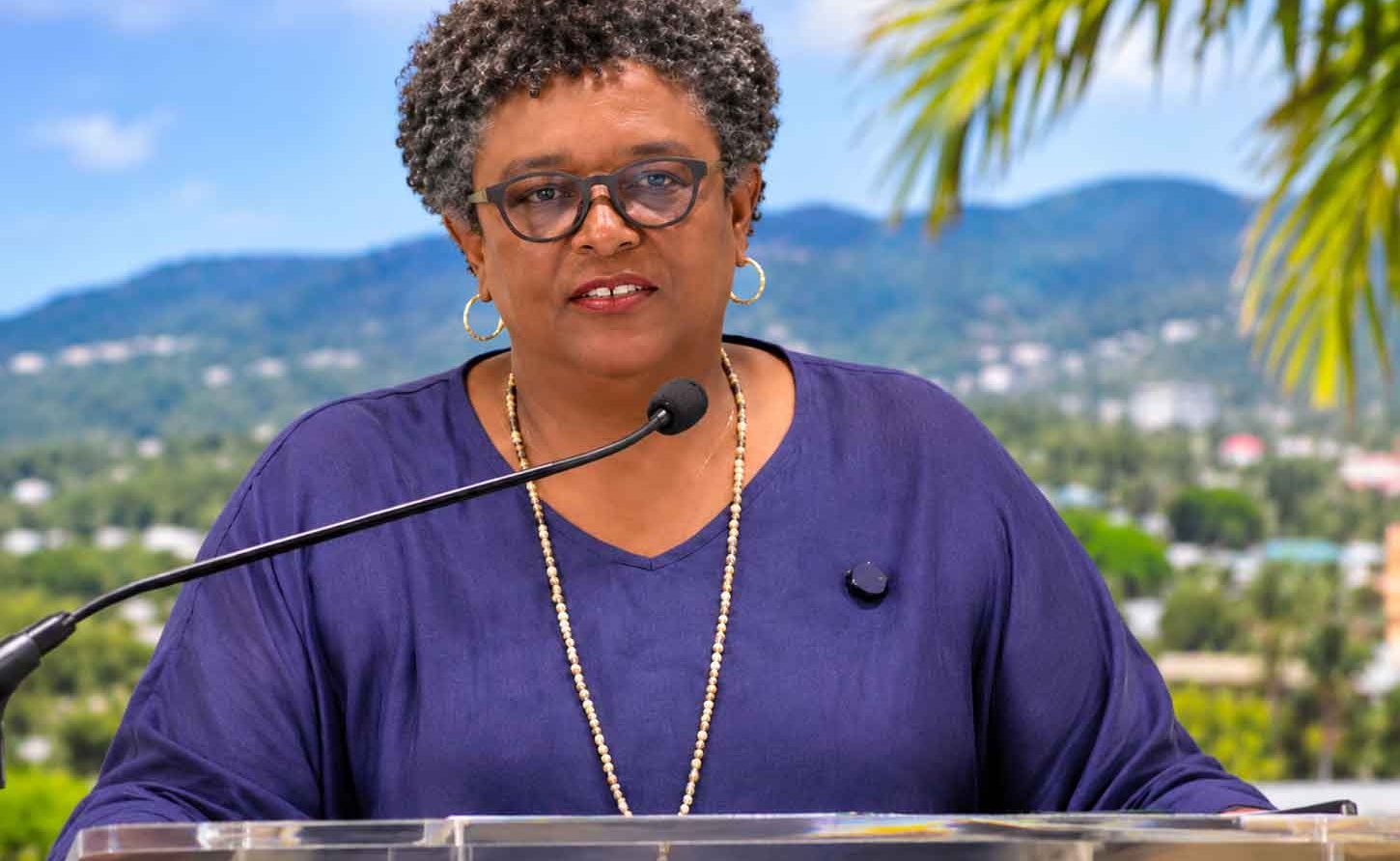
Barbados Prime Minister Mia Amor Mottley
Mia Mottley says the region fought at the United Nations for the right of blocs like itself to speak with one voice, then spent 15 years declining to use it. Her remedy: a political head for CARICOM with a mandate longer than six months.
MONTEGO BAY, Jamaica, NOVEMBER 17, 2026 — Every September, fourteen Caribbean Community leaders take their turn at the rostrum of the United Nations General Assembly. They speak, Barbados Prime Minister Mia Amor Mottley says, “often powerfully”. And when the last of them sits down, the Community itself has said nothing at all.
That silence was the hinge of Mottley’s address on Sunday at the University of the West Indies, Mona, where she launched Caribbean Integration: The Patterson Doctrine, the 386-page study by former Governor-General Professor Sir Kenneth Hall and Myrtle Chuck-A-Sang. Before an audience that included former prime ministers P.J. Patterson and Bruce Golding, she put a blunt question — “Who must speak for the Caribbean?” — and gave a blunter answer: at present, nobody with a mandate to do so.
Her prescription is a political head for CARICOM, holding office for longer than the six months a rotating chairman now gets, and an amended Revised Treaty of Chaguaramas giving the Community the legal personality to be heard in its own name. “Without a political head,” she said, “we will not go much further.”
A fight won, a prize unclaimed
The most arresting part of her case was a piece of diplomatic history the region has largely forgotten. When the European Union, newly rearranged by the 2009 Lisbon Treaty, went to the General Assembly in September 2010 seeking the right for its own officials to speak in the general debate, it was CARICOM that stopped it. Suriname, on the Community’s behalf, moved to adjourn the debate. The motion carried 76 to 71, with 26 abstentions.
The Caribbean’s objection, Mottley recalled, was one of principle: in a body of sovereign equals, no regional bloc should enjoy privileges closed to the rest. Eight months of negotiation followed. When Resolution 65/276 finally passed on May 3, 2011 — 180 in favour, none against, Syria and Zimbabwe abstaining — it carried a third paragraph extending the same possibility to any regional organisation with observer status whose member states have agreed arrangements allowing its representatives to speak for them. The Bahamas, speaking for CARICOM, placed the Community’s interpretation on the record.
“The Caribbean community fought to leave that door open, but 15 years later we have not walked through it.”— Prime Minister Mia Amor Mottley
Why the door stays shut
She did not pretend the reasons are trivial. Most Caribbean legal systems are dualist: a treaty binds nobody at home until Parliament legislates. Constitutions entrench the powers of cabinets and parliaments, some provisions movable only by special majorities or referendums. And Article 236 of the Revised Treaty requires that amendments be agreed unanimously and ratified by every party before taking effect, so that, in her words, “one delayed parliament or one change of government” can hold the whole Community in place.
Then there is the office asked to fill the gap. Hall’s book lists the Secretary-General’s roles: chief executive, principal policy adviser, senior diplomat, institutional strategist, guardian of the Community’s constitutional processes. How many more things, Mottley asked, can one official be expected to do? Her point was structural. The Secretary-General’s authority is constitutional, not political. The chairmanship, which is political, changes hands every six months. “One man’s preference might not be the next person’s desire,” she said.
Europe, she noted, had the same defect until Lisbon created a permanent Council president and a high representative for foreign affairs, 52 years after the Treaty of Rome. CARICOM is 53. Speaking in the country of the world’s fastest man, she suggested the region need not match his pace to get there.
Not Brussels
Mottley was careful about what she was not proposing. She endorsed Hall’s insistence that the Patterson Doctrine is no argument for European-style supranationalism. Caribbean sovereignty is “young and hard won”, she said, and its people will not hand it to a distant authority “at this stage” — a qualifier she underlined by promising a “part two” on political integration for another day.
Her method is narrower: pool sovereignty in defined areas, keep parliaments in control, let the willing move first and leave the door open for the rest. She offered two home-grown precedents. Under the Revised Treaty of Basseterre, signed in 2010, the Eastern Caribbean states gave their organisation legislative competence in specified fields including the common market, trade policy and civil aviation.
And under CARICOM’s own enhanced cooperation protocol, adopted by Heads in Belize in 2022, three or more members may proceed where the whole Community is not ready. That mechanism allowed Barbados, Belize, Dominica and St Vincent and the Grenadines to introduce full free movement among themselves on October 1, 2025.
Neither precedent, she conceded, delivers a single Caribbean voice in New York. Together they show how the competence that paragraph three demands could be built.
The hard questions
The proposal arrives with history against it. At Rose Hall in Montego Bay in 2003, Heads agreed in principle to a CARICOM Commission or comparable executive mechanism to implement their decisions. Twenty-three years on, it does not exist. The region, Mottley acknowledged, “does not lack diagnosis”; what it has lacked is the machinery and the will.
Nor is the present climate encouraging. A Community that proposes to agree on one political voice has spent much of this year unable to agree on its chief administrator. Trinidad and Tobago objected to the process by which Secretary-General Dr Carla Barnett was reappointed in February, and in July the Heads resolved to seek an advisory opinion from the Caribbean Court of Justice on the treaty provisions involved.
If a reappointment can produce that, sceptics will ask, what would the selection of a political head produce — and to whom would that person answer when capitals see the world differently?
Mottley’s answer is that Europe lives with exactly that: a Union voice that exists “without prejudice” to what the French, German or Polish foreign minister may say. But the unanswered details are considerable: how such a head would be chosen, for how long, and with what authority over a Secretariat whose bills, by her own account, member states often pay late. She tied the two together herself, arguing that without a political head and automatic financing the region is “spinning top in mud”.
Others on the platform were less sanguine about the region’s appetite. Golding, according to the Gleaner’s report of the launch, observed that the Eastern Caribbean has travelled much further than the wider Community, and put the difference down to insularity. Patterson, the same report says, lamented a region still haunted by “the Federal ghost”.
Mottley’s wager is that the world has changed enough to exorcise it. Trade, she argued, is increasingly governed by leverage rather than law, and “in a world of power, size matters a great deal.” The door at the United Nations has stood open since 2011. The question she left with her Jamaican audience is whether the region lacks the key, or merely the nerve.
— 30 —
