
CARIBBEAN | Mottley Answers Burnham: An Apology Is a Beginning, Not a Settlement
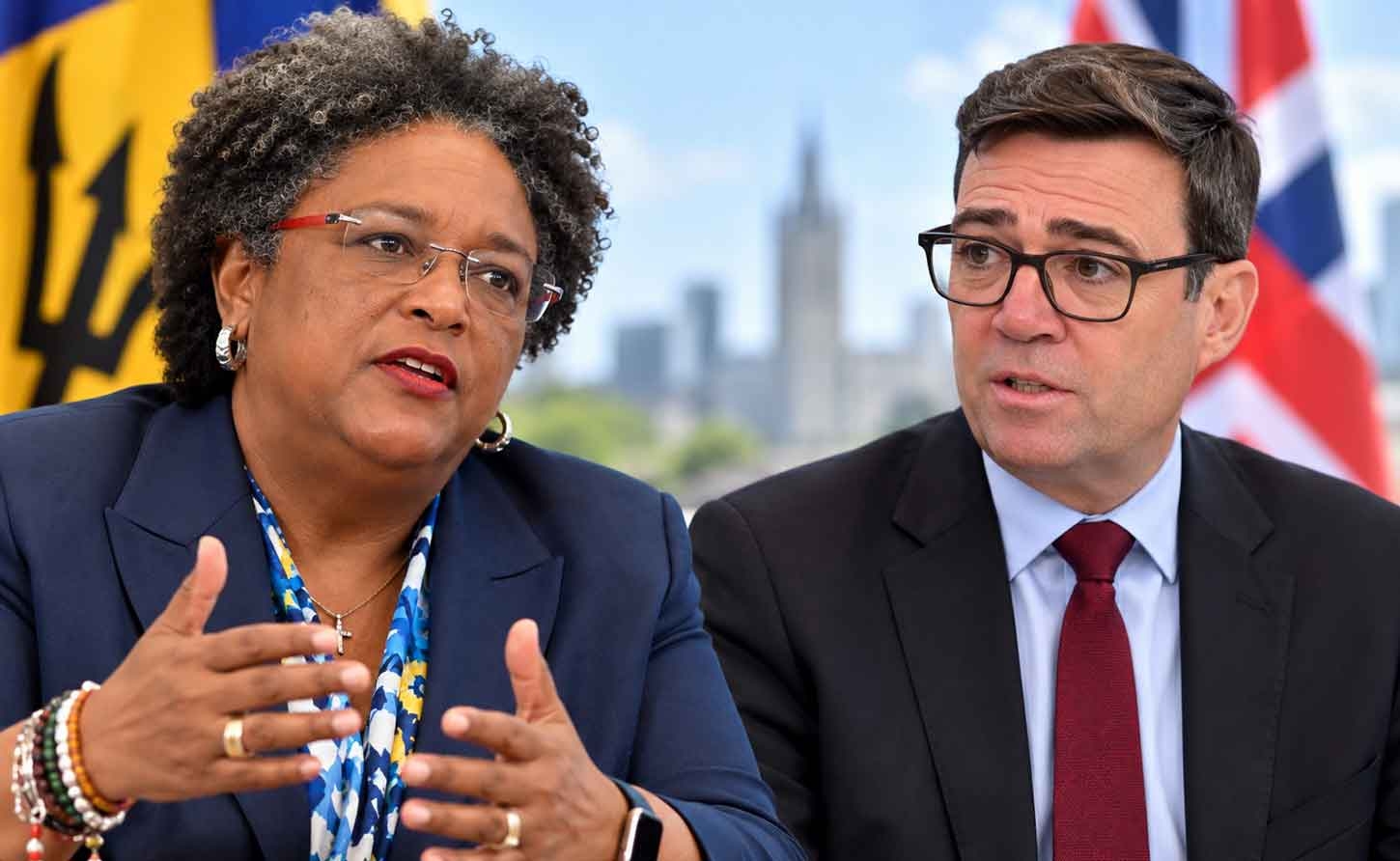
AI-generated editorial illustration, not a photograph of an actual meeting of Barbados Prime Minister Mia Mottley and UK Prime Minister Andy Burnham.
Barbados' Prime Minister welcomes Britain's historic openness to a formal apology for slavery — and in the same breath refuses to let London redraw the terms of reparatory justice, days before Commonwealth leaders gather in Antigua.
MONTEGO BAY, Jamaica, October 30, 2026 | Calvin G. Brown | Caribbean Affairs |Andy Burnham wanted credit for going further than any British prime minister before him. Mia Mottley gave it to him — then reminded him exactly how far he still has to travel.
Within hours of the UK prime minister's Guardian article on Friday, in which he declared himself "open" to a formal apology for Britain's role in the transatlantic slave trade while flatly ruling out financial reparations, the Barbados prime minister issued a statement that was gracious in tone and unyielding in substance.
Barbados, she said, "recognises and appreciates" Burnham's acknowledgement that the trade was "a brutal and barbaric violation of human beings," and will enter his proposed structured dialogue "in good faith as a member of CARICOM."
Then came the sentence London will have read twice. "On reparations in particular, our views differ, and we will say so plainly and respectfully."
It is the diplomatic equivalent of accepting a handshake while declining to let go of the invoice.
The 1661 problem
Mottley did not reach for abstraction. She reached for a date. In 1661, she reminded Burnham, "under English colonial authority, the first comprehensive slave code in the English-speaking world was regrettably passed on our soil." The Barbados Slave Code defined African men, women and children as "non-human property" and became the template exported across the region and beyond.
“That system was built by law and enforced by the State.”
— Prime Minister Mia Amor Mottley
That single line goes to the heart of Burnham's argument. The prime minister told Guardian readers that "British people today" cannot be held liable for "historical wrongs, however heinous." But Barbados is not suing the British people. It is addressing the British state — the same continuous legal entity that sanctioned the code, policed the plantations, and in 1833 borrowed £20 million to compensate the enslavers rather than the enslaved.
Mottley made the same point earlier this year when she dismissed as "asinine" Suella Braverman's suggestion that the former colonies owed Britain money for the privilege of having been colonised.
Dialogue, yes. Substitution, no.
Burnham's counter-offer is a debt-restructuring drive for the poorest Commonwealth states, to be led by former prime minister Gordon Brown and eventually drawing in the IMF. It is not nothing. By Downing Street's own figures, more than 40 per cent of the most vulnerable Commonwealth countries spend more on interest than on health.
Mottley's response was to fold that offer into her own framework rather than accept it as a replacement. She listed where "understanding can be reached and settled": an apology; a commitment to eradicate "a mindset that is anchored in Afrophobia and against all things 'black'"; investment in health and education; development partnership against systemic poverty; and "fairer terms on debt for vulnerable states as called for by the Bridgetown Initiative."
Debt relief, in other words, is the Caribbean's idea — the tenth and final item of the CARICOM Ten Point Plan, which she said "remains a clear guide for the parameters of dialogue."
The message is unmistakable: Britain does not get to rebrand a Caribbean demand as a British alternative to reparations.
Reading the region's mood
Mottley is the moderate voice here, and that should worry Whitehall more than comfort it. The Antigua and Barbuda Reparations Support Commission, chaired by Dorbrene O'Marde, welcomed Burnham's statement but said bluntly: "We reject the decision that financial reparations will not be on the table."
Former St Vincent prime minister Ralph Gonsalves called an apology "necessary" but "insufficient." Denis O'Brien of The Repair Campaign demanded that Britain "stop obfuscating."
Jamaica, meanwhile, has stopped asking and started litigating. Its petition, lodged in London on September 7 by Culture Minister Olivia Grange, has been referred to the Judicial Committee of the Privy Council, which will now consider whether the enslavement of Africans in Jamaica was ever lawful and whether Britain bears a legal duty of redress.
Burnham's own spokesman answered that with "the UK does not and will not pay reparations" — words that sit awkwardly beside a prime minister now professing openness to apology.
Only Sir Hilary Beckles, chair of the CARICOM Reparations Commission, offered Burnham real cover, observing that he "is carrying the broad middle of British opinion" and that money need not block progress. Mottley's statement echoes that pragmatism — but as strategy, not concession.
The road to St John's
All of this lands days before the Commonwealth Heads of Government Meeting opens in Antigua and Barbuda on November 1, with King Charles in attendance fresh from a Bahamas visit where, as the Nassau Guardian reported, he acknowledged "the great suffering and injustices of the past" while Rastafarian protesters chanted for payment.
Two years ago in Samoa, Keir Starmer was forced to negotiate the communiqué wording on reparations in front of his peers. Mottley pointedly thanked Starmer for that Samoa concession — a reminder that the door Burnham is now walking through was opened under duress.
She closed with a line she has used before: "we are not necessarily expected to complete the task, but neither are we at liberty to resile from it." It is the ancient rabbinic maxim by way of Bridgetown — patient, relentless, and entirely unmoved by the prospect of a British prime minister saying sorry without saying how much.
Burnham has offered a beginning. The Caribbean has accepted it as precisely that. What happens in St John's next week will show whether London understood the difference.
-30-
