
AFRICA | Miami’s Empty Chair: Africa’s Only G20 Nation Shut Out on the Caribbean’s Doorstep
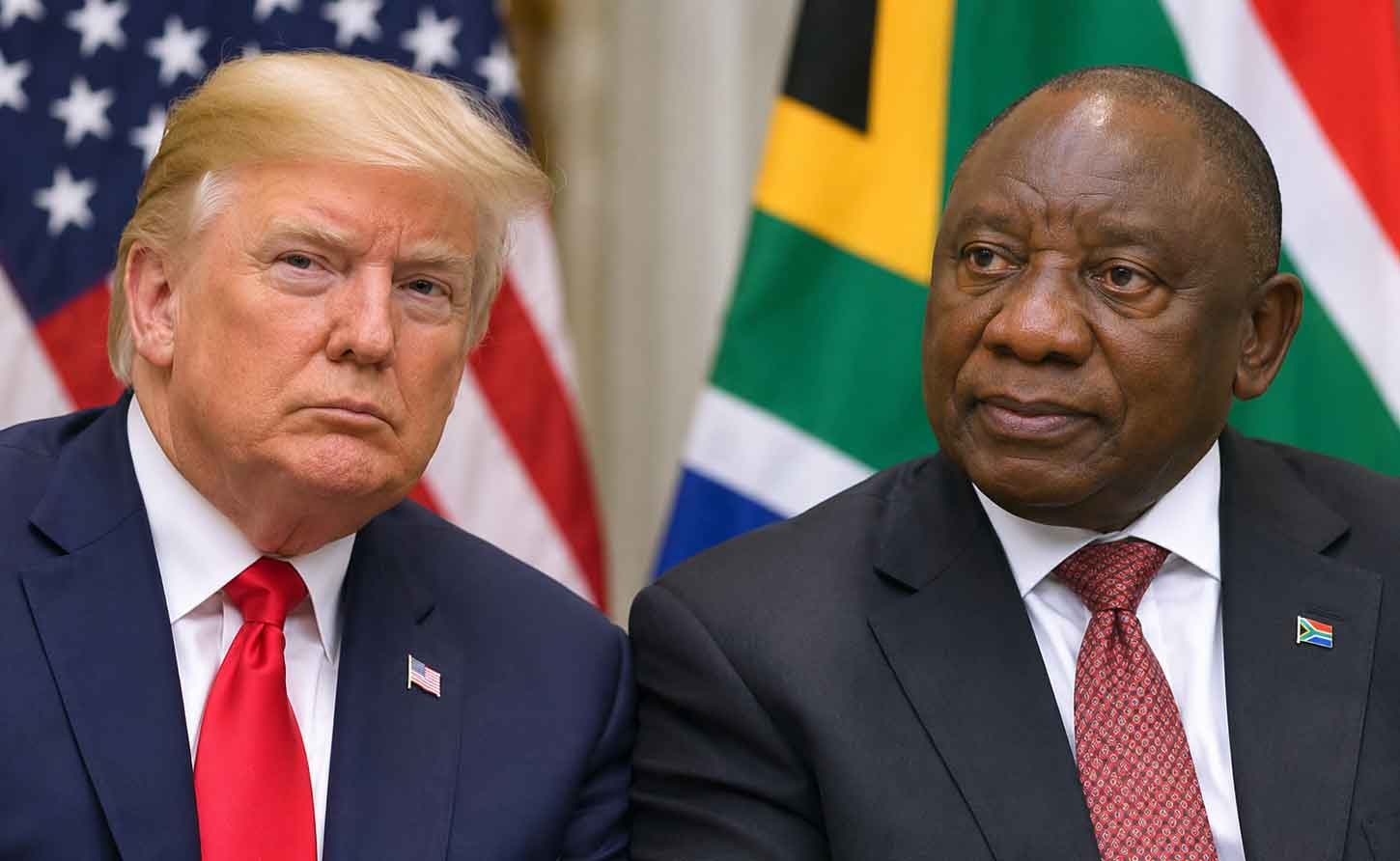
A composite image of US President Donald Trump and South African President Cyril Ramaphosa.
Washington has struck South Africa from the Miami summit list and seated Poland among the members. For a Caribbean that sits less than two hours away and nowhere on the guest list, the question is who speaks for small states when the host decides who counts.
MONTEGO BAY, Jamaica, November 10, 2026 — When the leaders of the world’s largest economies gather at Trump National Doral on December 14 and 15, nineteen national flags will stand behind the table, as they always have. One of them will be new. One, South Africa, will be missing.
The official website of the United States’ G20 presidency lists Poland among its nineteen “state participants”. South Africa, a founding member and the only African country with a seat in its own right, does not appear. The African Union and the European Union are listed as regional organisations, and twelve other countries, from Azerbaijan to Vietnam, as invitees.
No host has previously barred a member from a leaders’ summit. It is happening less than two hours’ flying time from Montego Bay, in a city with one of the largest Caribbean diaspora communities in the United States, and without a single Caribbean government in the room.
How the chair was emptied
The rupture dates to Johannesburg in November 2025, the first G20 summit held on African soil. The Trump regime boycotted it, with President Donald Trump alleging human rights abuses against white Afrikaners. Pretoria rejects that claim, as do some Afrikaner leaders.
When the summit closed, Trump said South Africa had refused to hand the presidency to a senior US Embassy representative. Pretoria’s account is that, because no American delegation attended, the instruments of the presidency were handed to an embassy official at its foreign ministry afterwards.
Days later Trump posted that “South Africa will NOT be receiving an invitation to the 2026 G20”. In December, Secretary of State Marco Rubio put the decision in writing, accusing Pretoria of using its presidency to push what he called radical agendas over American objections.
The regime has been as good as its word. South Africa was left out of the preparatory sherpa meetings and then the foreign ministers’ meeting in Atlanta on October 30 and 31, which ended without a joint communiqué. Russia’s Sergey Lavrov was in the room. Ukraine, a guest at earlier meetings, was not.
Why South Africa is a full member
South Africa’s membership is not in dispute, even in Washington. It has held a permanent seat since the G20 was formed in 1999, and it sits in its own name, not as the guest of whichever country holds the chair.
The G20 is an informal, leader-led forum. It has no founding treaty, no legal charter and no permanent secretariat. Because nothing is codified, there is no expulsion clause and no procedure by which one member, or one presidency, can remove another. Membership rests on the consensus of all.
That is Pretoria’s position. Foreign Minister Ronald Lamola replied to Rubio that “no single member of the G20 has a unilateral right to exclude South Africa”.
The host’s power, and its limits
What the United States does hold is the host’s hand. The presidency controls venues, logistics and accreditation for every official meeting, and the US government has sovereign discretion over who receives a visa to enter its territory. Hosts have always had latitude over guests, and Washington has not claimed to expel anyone. This is administrative control, not legal removal, and it lapses when the presidency passes to London.
Washington has used that control. In April it declined to accredit Finance Minister Enoch Godongwana and Reserve Bank Governor Lesetja Kganyago for the G20 finance chiefs’ meeting in Washington. Godongwana, who in January had confirmed a temporary step back at American request, told Bloomberg that South Africa remained a member but was taking “a holiday from the G20” until the British presidency.
After Atlanta, Lamola’s spokesperson Phindile Kunene was blunter: “our nonparticipation is not voluntary”.
President Cyril Ramaphosa has declined to call for a boycott, saying only that South Africa wants to be treated as “an equal, sovereign country”. Late last month his ambassador in Washington, Roelf Meyer, said the government was “no longer troubled” by Miami and was already talking to the United Kingdom, which takes the presidency next.
Lamola has argued that a boycott would only hand Washington the solitude it seems to want, and that the Americans have to be engaged instead. Pretoria wrote to every G20 embassy last December to put its exclusion on record, then left each capital to make its own decision.
The Poland substitution
Poland attended Atlanta as a guest. On the Miami list it is a state participant, and a US official has said Washington fully supports full Polish membership. Russia is opposed.
Rubio’s argument is arithmetic: Poland now ranks among the world’s twenty largest economies. South Africa does not. But the G20 was never a league table. South Africa was seated in 1999 so that a continent of more than a billion people would not be discussed entirely in its absence. Swap it out on GDP and the forum becomes a club whose membership is whatever the chair says it is that year.
Others have noticed. China has said publicly that it supports South Africa’s continued participation, and German Chancellor Friedrich Merz backed its attendance in Atlanta. Neither government stayed away.
Who speaks for the Caribbean?
A table where a founding member can be un-invited by social media post is a table where small states’ concerns can be un-invited too.
No Caribbean state is a G20 member. The region gets in only when a host opens the door. In 2018 Argentina did. Andrew Holness, then chairman of CARICOM, sat in Buenos Aires as a special invitee, Jamaica took part in the year’s preparatory meetings, and he used the floor to urge leaders to move from “climate talk to climate action”.
Miami’s twelve invitees include no Caribbean state, no Pacific island state and no African country. The nearest the region comes is the Netherlands, whose kingdom includes Aruba, Curaçao and Sint Maarten.
The hemisphere’s seats belong to the United States, Canada, Mexico, Brazil and Argentina. None holds a mandate from Kingston, Bridgetown or Castries, and the host least of all. A regime that has imposed tariffs on Caribbean exports and dismantled USAID cannot credibly claim to carry the region’s brief.
South Africa’s seat matters here because of what Pretoria did with it. The Johannesburg declaration, adopted by consensus over American opposition, singled out Small Island Developing States as disproportionately hit by disasters they cannot afford to recover from, and named high debt as a barrier to investing in resilience. It was adopted less than a month after Hurricane Melissa tore through western Jamaica.
Debt, disaster finance and the cost of capital are the arguments Barbados’s Mia Mottley has pressed through the Bridgetown Initiative. In Johannesburg an African presidency put them in a G20 text. Rubio has framed the American presidency as a correction to an agenda he says strayed from the forum’s economic mission.
The precedent is the danger. Small states do not rely on multilateral rules out of sentiment; they rely on them because rules are the only leverage they have. If the seat of a founding member can lapse at a host’s pleasure, then so can any commitment that host finds inconvenient, including the ones on debt and disaster finance that the Caribbean spent years getting onto the page.
At the time of writing, WiredJa could locate no public statement from the CARICOM Secretariat on South Africa’s exclusion.
What to watch
The African Union will be in Miami; the chair of its Executive Council sat beside Rubio in Atlanta. But a continental body is not a country, and the Caribbean does not have even that.
Three things will show whether the empty chair is an episode or a precedent: whether any leader raises it at Doral, whether Poland’s seat is made permanent, and whether London restores South Africa in 2027. A fourth is for the region itself: whether CARICOM asks the British presidency for the invitation Buenos Aires once extended.
The United States can decide who comes to dinner at Doral. It cannot decide who speaks for the Caribbean. That post remains vacant.
— 30 —
