
JAMAICA | The Price of a Room Above the Sea
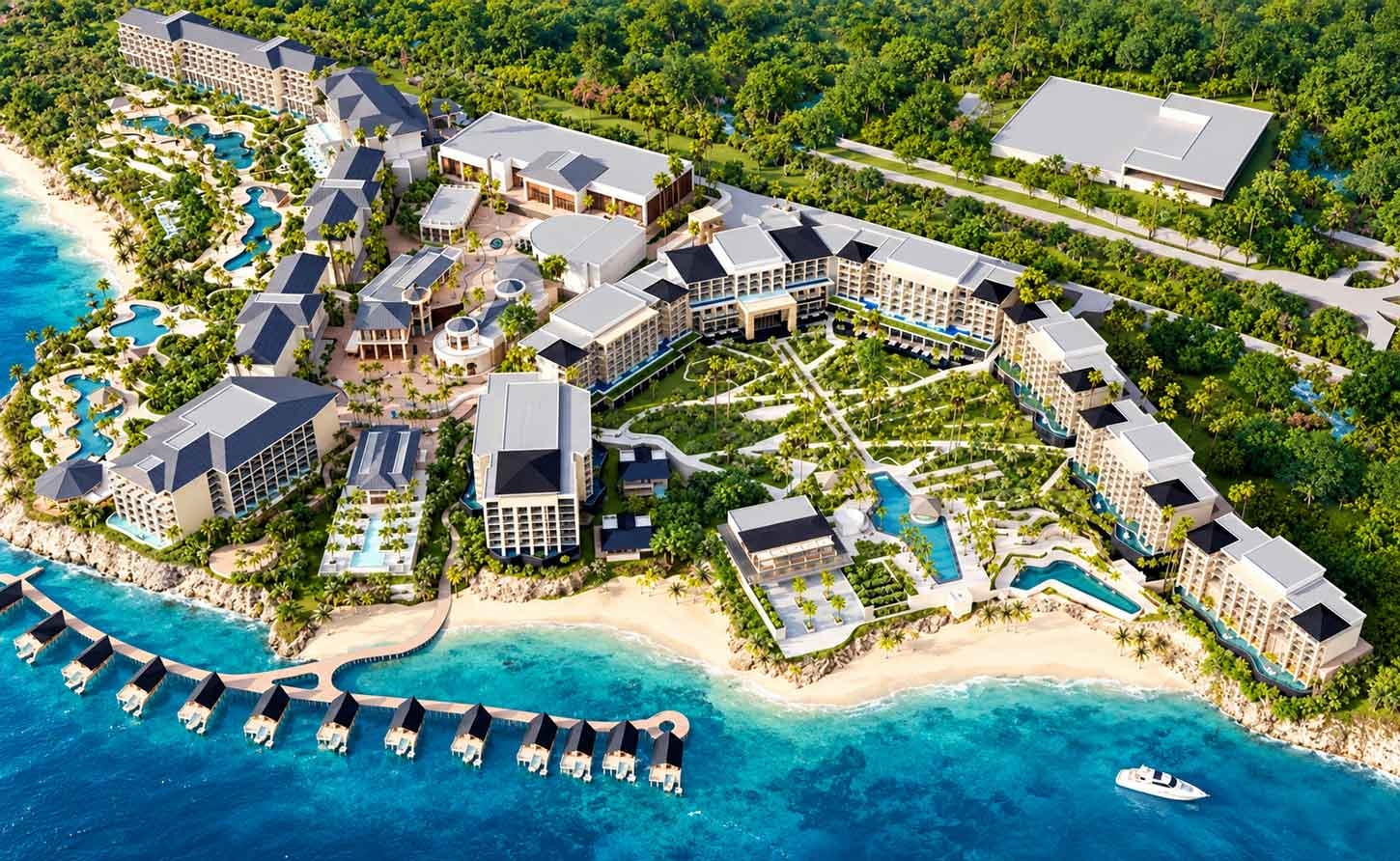
Artist's rendering of the planned Grand Palladium phase two at Point, Hanover, with a row of overwater suites on piles
At Point, Hanover, plans for overwater suites have reached a living seabed. The regulator wants a plan to move the coral and seagrass. Jamaica is still waiting for a public explanation of how those works would fit the climate promises the State made last year.
MONTEGO BAY, Jamaica, October 25, 2026 — Calvin G. Brown
An overwater suite offers a seductive promise: a room above the Caribbean, with the sea spread beneath it. At Point, Hanover, part of the price of that promise is being worked out on the seabed.
There is coral in the way. There is seagrass. And before Fiesta Jamaica Limited, the company behind Grand Palladium, can proceed with the marine works now before the regulator, it must explain where that living material will go.
On 15 September 2026, the Natural Resources Conservation Authority deferred the company’s beach-licence application. The reason recorded in its decision, as quoted by the Gleaner, was spare: “Resource Relocation Plan required for review.”
A few words in a file. A consequential decision still to come. A deferral leaves the door open: once an acceptable plan is submitted, the licence can be granted.
Fiesta’s application is lawful. The harder question belongs to the State considering it. Barely a year before this decision, Jamaica promised the world that it would map its nearshore seagrass and assess the carbon it holds. It also made a conditional pledge to conserve all seagrass within gazetted protected areas. Now it is considering permission to remove seagrass for construction, without any published account setting the proposed works beside those commitments. Whether the works at Point fall inside a protected boundary remains unestablished on the public record.
The September decision surfaced in the Gleaner on 16 October, a month after it was taken. Queries to FINN, Palladium’s public-relations firm, went unanswered. No NRCA official has been quoted explaining the decision. What is clear is the scale of the application: three revetments, two submerged breakwaters, six groynes, two temporary access roads, piles for overwater suites, and the removal of seagrass and coral.
Much of the expansion already has official approval. On 19 November 2024, a joint sitting of the NRCA and planning authority granted Fiesta environmental permits for a hotel complex of 501 to 1,000 rooms and for “Overwater rooms”, outline planning permission for a 949-room hotel, and a beach licence for one groyne, one revetment and one submerged breakwater. The deferred application would take the marine works further: six groynes instead of one, three revetments instead of one, and the piles and habitat removal that the earlier licence did not cover.
Residents of Point had heard the project’s ambitions at an October 2024 environmental impact assessment town hall. Dr Carlton Campbell of CL Environmental Consultants presented phase two as a 475-room family resort and a 473-room adult resort, including 16 overwater rooms. The Gleaner reported that week that the choice of “14, 16 or 20 overwater bungalows” was still being finalised. Alongside the room counts, the EIA carried a warning: “degradation and loss of natural habitats”.
That meeting is the only public hearing on the record. It belonged to the environmental permit. The beach licence travels through a different process—one in which the law makes no provision for public notice before the decision.
The Beach Control Act is seventy years old. It vests the foreshore and the floor of the sea in the Crown and allows the Authority to license commercial use “upon such conditions … as they may think fit”. Grants and refusals must be published in the Gazette; an aggrieved person then has six weeks to appeal to the Minister. By that stage, the decision has already been made.
For structures over the water, even the applicable policy is difficult for the public to inspect. The only final guideline Jamaica has issued specifically for them is “Planning Guideline – Overwater Structures 01/2016”, dated August 2016. WiredJA could not find its text published. In a letter carried by the Gleaner on 28 August 2026, the Environment Trust said the 2016 guidelines “do not permit overwater structures in marine protected areas”. Proposed 2025 guidelines, which it said appeared still to be in draft, would allow them “where an EIA demonstrates that there will be no adverse and irreversible impacts”.
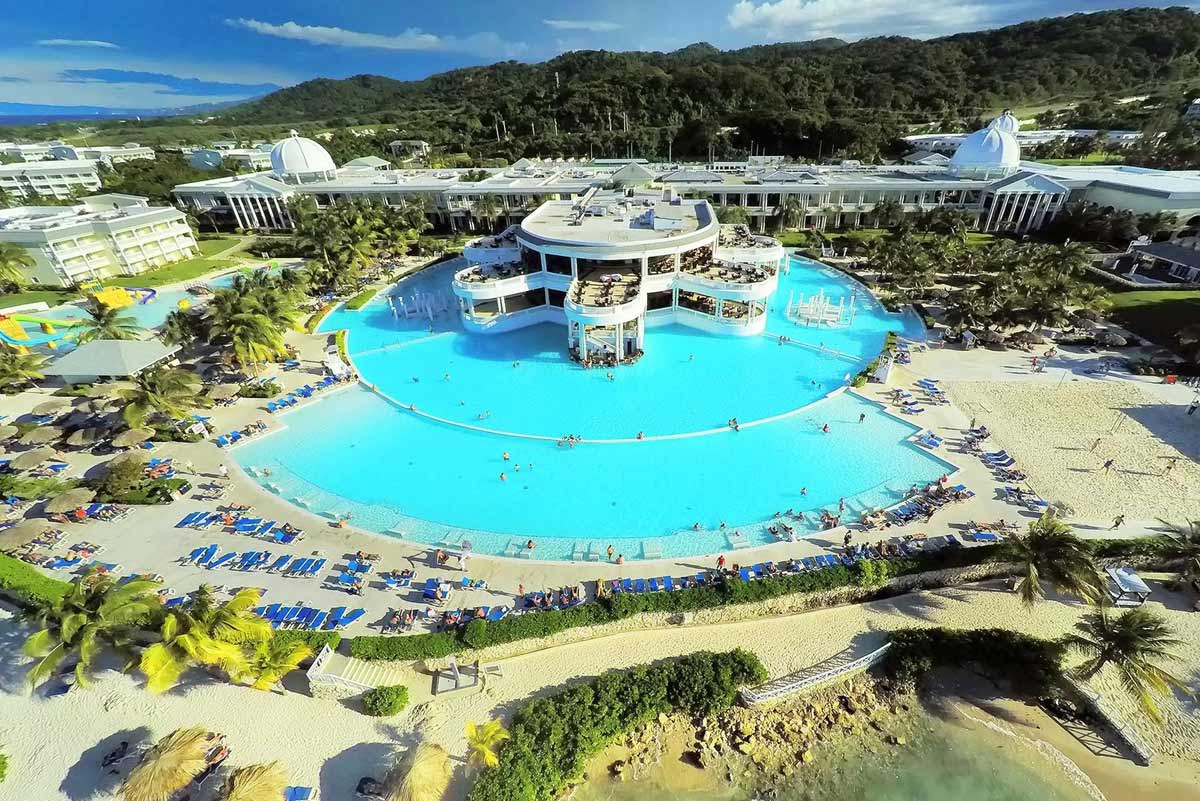
grand palladium
The promised replacement for the old beach-access regime has reached Parliament as policy, not legislation. A 2020 green paper identified overwater structures as an exception to its proposed bar on exclusive use of the foreshore, citing possible security considerations. The 2026 Beach Access and Management Policy was tabled in March. In his Budget Debate speech on 19 March, Prime Minister Andrew Holness said the 1956 Act and its 1973 amendment “did not adequately address beach access issues” and would have to be replaced. JaBBEM reads the tabled policy as preserving exclusive licensing for overwater bungalows.
While the rulebook remains unsettled, the decisions accumulate. Seventeen overwater structures on 340 pylons were approved for Sandals Royal Caribbean’s Kokomo Island in St James in June 2016. Twelve rooms on 186 H-piles followed at Sandals South Coast in 2017. Three proposals are now before the regulator: 18 bungalows and 10 villa suites at Sandals Montego Bay, 18 villas at Sandals Dunn’s River in Mammee Bay, and Fiesta’s project at Point. None has been reported decided on its marine works.
One decision in the record shows why the seagrass matters. On the very day in November 2024 that the Authority approved Fiesta’s first marine licence, it refused Sandals Whitehouse Management Ltd permission to relocate seagrass. Removal, the Authority said, would likely cause beach erosion. The site was also inside the Sandals Whitehouse Fish Sanctuary, where the work would destroy habitat and feeding ground for protected fish.
Hanover, too, has a fish sanctuary. Palladium is among its sponsors. The Gleaner described the Lucea Fish Sanctuary’s gazetted boundary as extending from the former molasses shipping pier at Elgin Town east to a cove opposite OceanPointe. Grand Palladium’s general manager, Andrew Wright, said the resort had been “an active participant since the sanctuary’s inception in 2018”. The Observer placed the proposed second phase between the existing resort and the Caribbean Molasses Company port.
That brings the story to a line on a map the public still needs to see clearly: are the proposed piles, groynes and seagrass removal inside the gazetted sanctuary, or beside it? The available record does not establish the answer. It is a question central to judging which protections and conservation commitments apply.
There is another uncertainty that the reassuring language of relocation can obscure. Living coral can be moved. Its survival is a separate test.
At the Falmouth cruise pier in 2009–10, contractors reported moving 147,947 organisms. Their report said 86 per cent of monitored colonies remained attached after 18 months and described the undertaking as “potentially the largest coral relocation project known to date”. A 2013 CL Environmental study for the Port Authority found survival below 15 per cent at three test sites. Those figures concern different sites and measures; they cannot be read as one continuous survival record. But they give reason to examine what a relocation plan can promise—and what later monitoring actually shows.
In the Jamaica Environment Trust’s 2015 review, Diana McCaulay reached a blunt conclusion: “It is difficult not to see the coral relocation as a failure.” CL Environmental is also the consultancy that presented Fiesta’s 2024 EIA. The Falmouth experience makes the proposed safeguards, survival targets and monitoring at Point questions of public consequence.
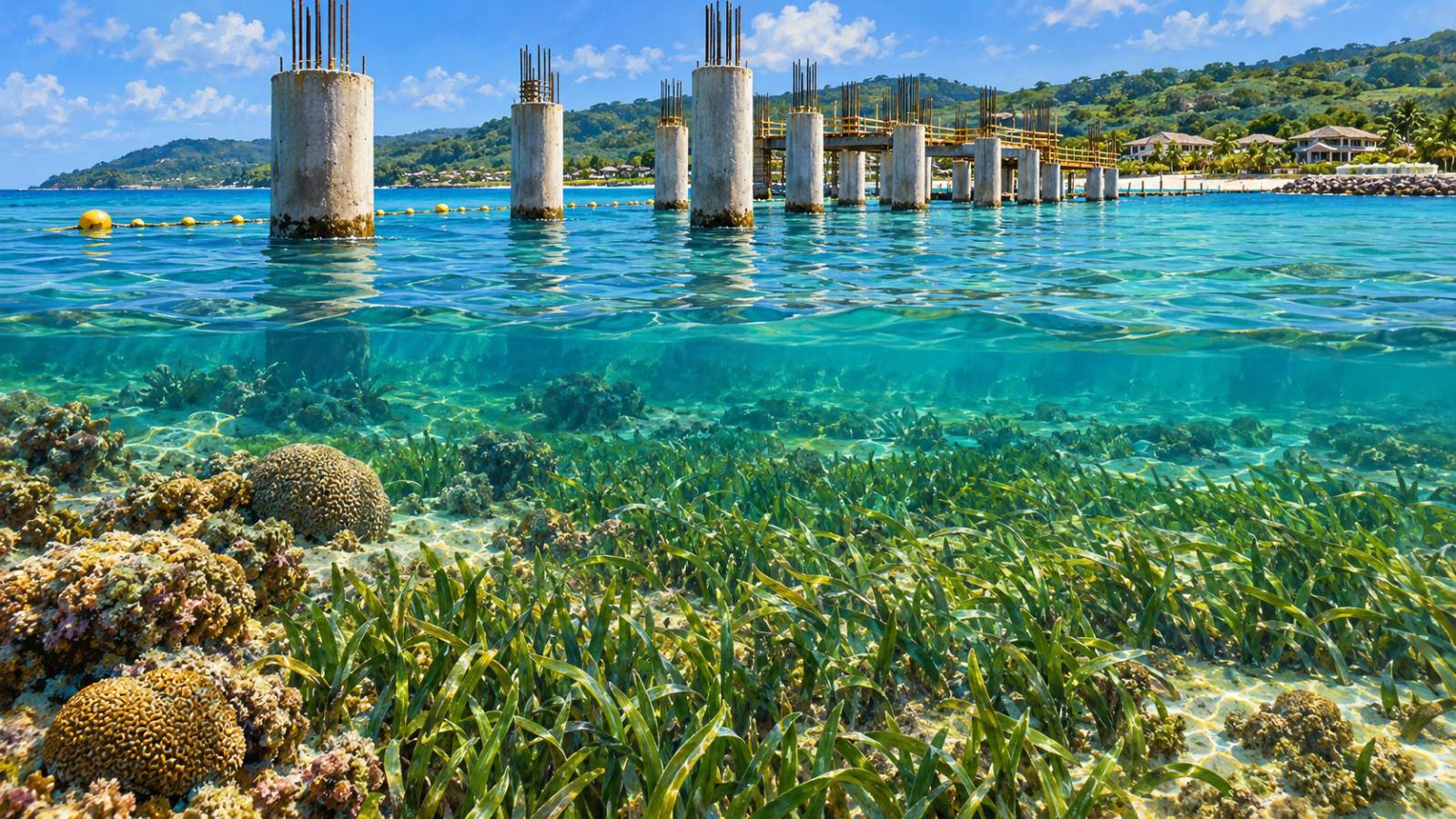
Illustration of a turtle-grass seagrass meadow with coral heads in a shallow Caribbean bay, with a row of concrete pilings for overwater suites rising from the water
Then there is the promise Jamaica made in September 2025. Its NDC 3.0, submitted to the UN climate convention, commits the country to complete mapping and a carbon-stock assessment of nearshore seagrass ecosystems by 2030. It also makes a conditional commitment to “conserve 100% of seagrass ecosystems within gazetted protected areas by 2035”. For mangroves, the commitment is to protect approximately 67 per cent of the island’s forests by 2033. Minister of Water, Environment and Climate Change Matthew Samuda calls mangroves and seagrass “critical to Jamaica’s climate priorities”.
Those commitments do not, by themselves, establish that Fiesta’s application breaches a rule. They do require an explanation of how individual licensing decisions fit the country’s stated direction. The public record has yet to supply that explanation for Point.
The wider coast offers a warning about the cumulative cost of individual approvals. Mangroves are not in the footprint of these proposed works, although a 2019 UWI and World Bank assessment lists Point among Hanover’s mangrove areas. The Forestry Department says tourism pressure has been the main driver of Jamaica’s mangrove loss over the past decade. Its management plan records four hectares lost to tourism at Green Island and Industry Cove between 2017 and 2021. It names no developer. The Princess Hotel site there was cleared from April 2021 under NEPA permits and municipal approval; Lucea Mayor Sheridan Samuels said, “those permits came from NEPA, and they are the experts.” In St James, the plan records losses of 0.56 hectares at Mahoe Bay and four hectares at the MBJ airport runway.
The economic stakes are beginning to acquire a price, though carbon markets offer no automatic payday. Ecosystem Marketplace’s 2024 blue-carbon report put average mangrove-credit prices at US$10.50 a tonne in 2021, US$28.15 in 2022 and US$26.03 in 2023. Over that period, traded volumes collapsed by more than 95 per cent. The market’s promise comes with substantial uncertainty.
Using the Blue Carbon Initiative’s average of six to eight tonnes of CO₂ per hectare per year, WiredJA’s illustrative calculation equates 100 protected hectares to 600 to 800 annual credits: US$6,300 to US$8,400 at the 2021 price, or US$15,600 to US$20,800 at the 2023 price. Those figures are neither a valuation of Point nor a guarantee that credits would be issued. The much larger inheritance is the carbon already stored: reported stocks range from 373 to 1,492 tonnes per hectare, with a mean of 933, typically held mostly in the soil.
Other countries are already testing the route from climate policy to payment. In July 2025, Ghana issued 11,733 Article 6 credits from a rural cookstove programme to a Swiss foundation—the first such issuance in Africa. Dominica has an implementing agreement with Switzerland and the Dominican Republic one with Sweden, but a UNFCCC-hosted regional review through December 2025 recorded no transferred credits from either. It recorded none for Jamaica, whose only project in the Article 6 pipeline tracked by that review was a Trelawny solar park. In Pakistan, deals signed in 2022 by Microsoft, Trafigura, Respira and Carbon Growth Partners could see up to three million credits traded from Delta Blue Carbon’s 350,000 hectares of mangroves.
Jamaica has yet to settle who would be paid. Samuda said in April 2026 that the Government intended to finalise its carbon-markets framework this year. Nothing published establishes who owns carbon in a Crown foreshore or a private wetland. The Forestry Department describes the rights of private landowners and the role of private conservation as “a largely unresolved issue”. The 1956 Act tells us who owns the seabed. It does not answer every question about the wealth it holds.
Palladium has been part of Point’s landscape for years. Its chairman broke ground in 2006 for the hotel that opened in July 2008. Its application now seeks permission through the system Jamaica has provided. The responsibility for explaining that system’s choices rests with the State: the owner of the seabed, the issuer of licences and the author of the climate pledge.
JaBBEM’s Dr Devon Taylor expresses the public claim without qualification: “The sea belongs to Jamaica. The beach belongs to Jamaica. The foreshore belongs to Jamaica.” Ownership of that kind carries a responsibility to make the decisions visible—to show the boundary, explain the safeguards, account for the habitat and say how the proposed works fit the promise made a year earlier.
The next document in Fiesta’s file may explain where the coral and seagrass could be taken. Before a licence is granted, Jamaicans deserve a public account of what would be removed, what is expected to survive and what the country would be giving up.
A view can be sold by the night. A country has to live with what is left beneath it.
