
JAMAICA | The Passport Gap: Jamaica’s Global Brand Travels Further Than Its Travel Document
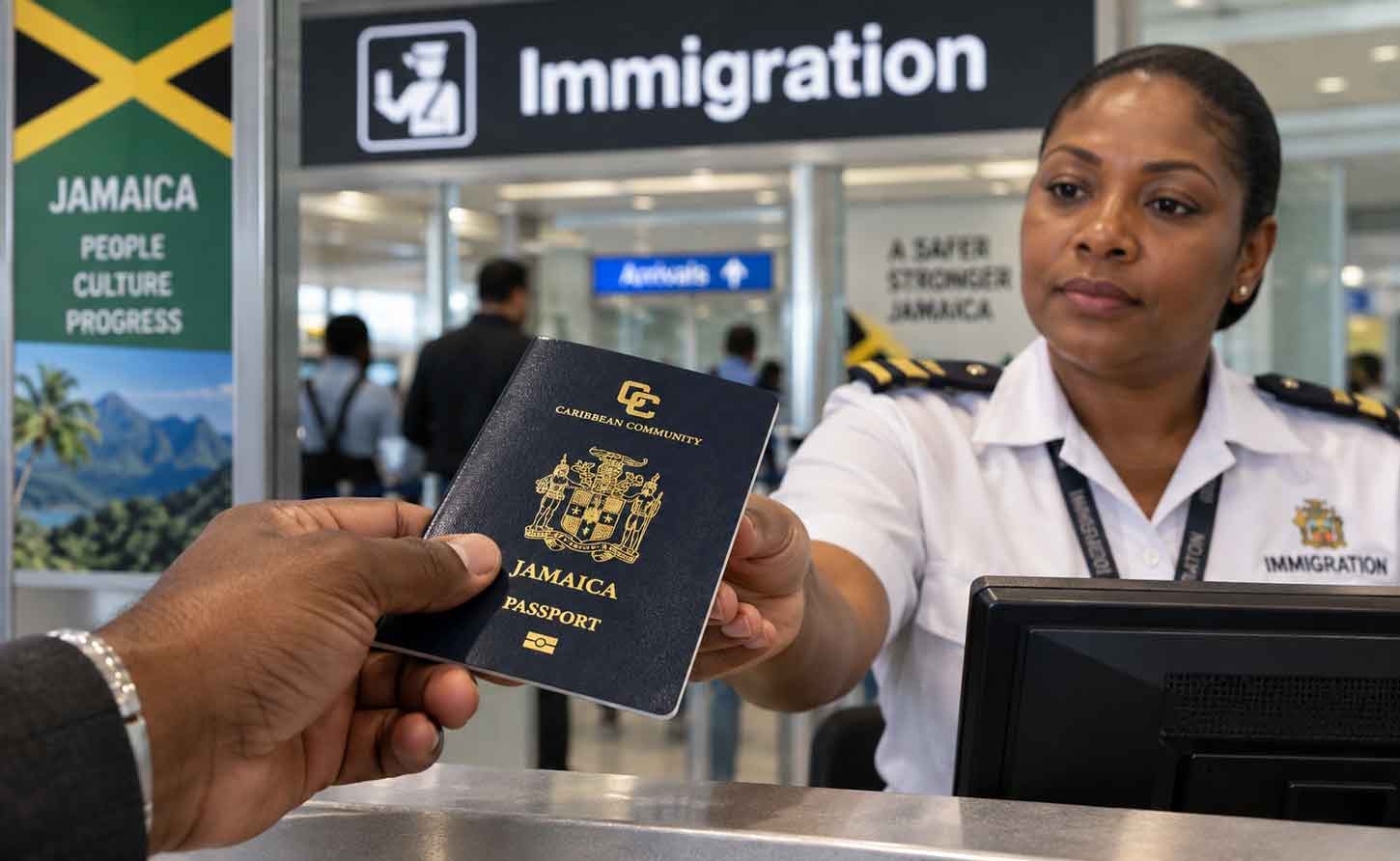
JAMAICA | The Passport Gap: Jamaica’s Global Brand Travels Further Than Its Travel Document
Jamaica sits 56th in the world on the Henley Passport Index and third from bottom in CARICOM — behind eight Eastern Caribbean states with a fraction of its population. The number deserves scrutiny. So does the index that produced it.
MONTEGO BAY, Jamaica, Sept.9, 2026 - Few countries punch as far above their weight as Jamaica. Two-point-eight million people, a flag recognised on every continent, an accent that sells beer in Berlin, and a track team that stops the world every four years. Yet when a Jamaican presents that country’s passport at a foreign border, the document opens fewer doors than the one carried by a citizen of Dominica — population sixty-six thousand.
The Henley Passport Index, in its edition of 9 January 2026, ranks the Jamaican passport 56th in the world, with visa-free or visa-on-arrival access to 86 of 227 destinations. Within the Caribbean Community, that places Jamaica twelfth of the fourteen member states that issue their own travel document. Only Suriname and Haiti rank lower. Montserrat, a British Overseas Territory, issues none.
The regional ladder is steep. Barbados leads at 19th with 162 destinations, followed by The Bahamas (20th, 158), St Vincent and the Grenadines (22nd, 156), St Kitts and Nevis (23rd, 155), Antigua and Barbuda (24th, 154), Grenada (27th, 147), Trinidad and Tobago (28th, 146), and Dominica and St Lucia tied at 29th with 145 each. Belize sits at 49th, Guyana at 54th. Then Jamaica.
Stated plainly: the Jamaican passport ranks below that of every other independent English-speaking country in CARICOM.
The half of the table we were shown
When the January index landed, Jamaican coverage led with the finding that our passport outranks those of the Dominican Republic, Cuba and Haiti. That is true. The Dominican Republic sits 65th, Cuba 77th, Haiti 85th. It is also the flattering quarter of the page.
Nothing in that framing was false. Everything about it was partial — a comparison drawn against the three neighbours we were always going to beat, while eight smaller CARICOM states above us went unmentioned. A national conversation about mobility cannot begin from the section of the table we find most comfortable.
Who ranks the rankings
A caveat is owed before the argument goes further. Henley & Partners is not a neutral statistical agency; it is a residence-and-citizenship advisory firm. Five of the CARICOM states ranked above Jamaica — St Kitts and Nevis, Antigua and Barbuda, Dominica, Grenada and St Lucia — operate citizenship-by-investment programmes, and a high visa-free score is the central selling proposition of that product.
This is not an allegation of manipulation. The underlying data comes from the International Air Transport Association and is what it is. But an index compiled by a firm that sells access to strong passports functions as a marketing instrument as well as a policy metric, and Caribbean readers are entitled to hold both facts at once.
The spread between competing figures is not error so much as different arithmetic — and readers deserve to know which one is being used.
Methodology compounds the confusion. Henley scores an e-Visa as zero, on the reasoning that pre-departure government approval is not free movement. Count the e-Visas back in, as one Kingston visa agency did, and Jamaica reaches 127 “accessible” destinations and a rank near 67th. Wikipedia carries 99 destinations and 53rd. One Jamaican outlet reported 54th. Henley’s own January document says 56th and 86.
Why the small islands win
Eight small states outrank Jamaica for one reason above all others: Schengen and the United Kingdom. Barbados, The Bahamas and the OECS states hold both waivers. Jamaicans have required a UK visa since 2003, and require visas for the Schengen area, Canada, the United States and China.
The uncomfortable part is that those waivers are priced on perceived overstay and migration risk, and scale is not Jamaica’s friend. A country with a diaspora rivalling its resident population, a migration corridor into Britain and North America running back three generations, and a well-publicised crime profile is assessed differently in consular planning rooms than an island of sixty-six thousand.
That is not a moral verdict on Jamaicans. It is an actuarial one, made in other capitals, and it is largely beyond the reach of any Jamaican foreign minister.
Jamaicans, however, have never been a people who treat a closed door as a settled answer. This is a country that argued its way out of colonial status, that built a labour movement out of a strike, that forced Britain to confront Windrush, and whose diaspora has litigated, organised and shouted its way into the public life of three metropolitan nations.
A visa queue is not experienced here as a neutral administrative fact. It is experienced as a judgement to be contested. That instinct is worth something at the negotiating table — and it is precisely the instinct our foreign policy has been least willing to deploy. Waivers are won by governments prepared to make a nuisance of themselves in the right rooms, persistently and on the record. Jamaicans do that reflexively as citizens. The state has been the quiet one.
Nor is the small-island advantage risk-free. Brussels has pressed OECS governments hard on citizenship-by-investment due diligence, and the standing implication of that pressure is unmistakable: a Schengen waiver granted is a Schengen waiver that can be suspended. Rankings built on sold citizenship rest on somebody else’s continuing tolerance.
Jamaica’s slow lane
Some of the gap, however, is entirely our own pace. Jamaica began issuing electronic passports on 31 March 2023. By the Passport, Immigration and Citizenship Agency’s own account at the time, that brought the country into line with more than 150 nations worldwide — and with eleven of its fifteen CARICOM neighbours. We were not early.
The same pattern appears in regional integration. On 1 October 2025, Barbados, Belize, Dominica and St Vincent and the Grenadines implemented full free movement among themselves under the Enhanced Cooperation Protocol to the Revised Treaty of Chaguaramas, granting their nationals the right to enter, reside, work and remain indefinitely. Jamaica was not among them.
In May, the Gleaner’s editorial page characterised Kingston’s progress as a “snail’s pace” and asked openly whether the administration remains committed to the principle. Barbados and Guyana have since gone further still, agreeing that their citizens may cross between the two countries on national identification cards alone.
What is actually moving
Not everything is stalled. On 24 February 2026, Brazil added Jamaica to its visa-exemption list, granting Jamaicans thirty days without a visa — a concrete gain in the largest economy in the hemisphere south of the United States, and precisely the kind of bilateral win that moves a Henley score. It is evidence that the instrument works when it is used.
The sovereignty question
Henley’s chairman, Christian Kaelin, argues that passport strength has become one of the clearest expressions of a country’s geopolitical capital — that mobility measures, in the end, how much other states value the relationship. If he is right, 56th is a diplomatic scorecard, and a middling one.
If he is wrong — if the index largely measures population size and perceived migration risk dressed in the language of diplomacy — then Jamaica’s rank says less about the competence of the foreign ministry than about the structural position of a mid-sized, high-emigration, middle-income state in a world that prices movement by risk.
The honest answer is almost certainly both. And both halves are actionable. Bilateral waiver negotiation is a foreign-policy function that can be resourced or neglected; Brazil shows what resourcing looks like. Regional integration is a choice Kingston keeps deferring while four smaller states get on with it.
Brand Jamaica needs no visa. It clears customs at the speed of a bassline. The document our citizens carry moves at the speed of a queue outside a foreign consulate — and closing that gap is a job for diplomacy, not marketing.
— 30 —
Sources: Henley Passport Index Global Ranking, 9 January 2026 (Henley & Partners); CARICOM Secretariat; Passport, Immigration and Citizenship Agency (PICA); Jamaica Gleaner; Jamaica Observer.
