
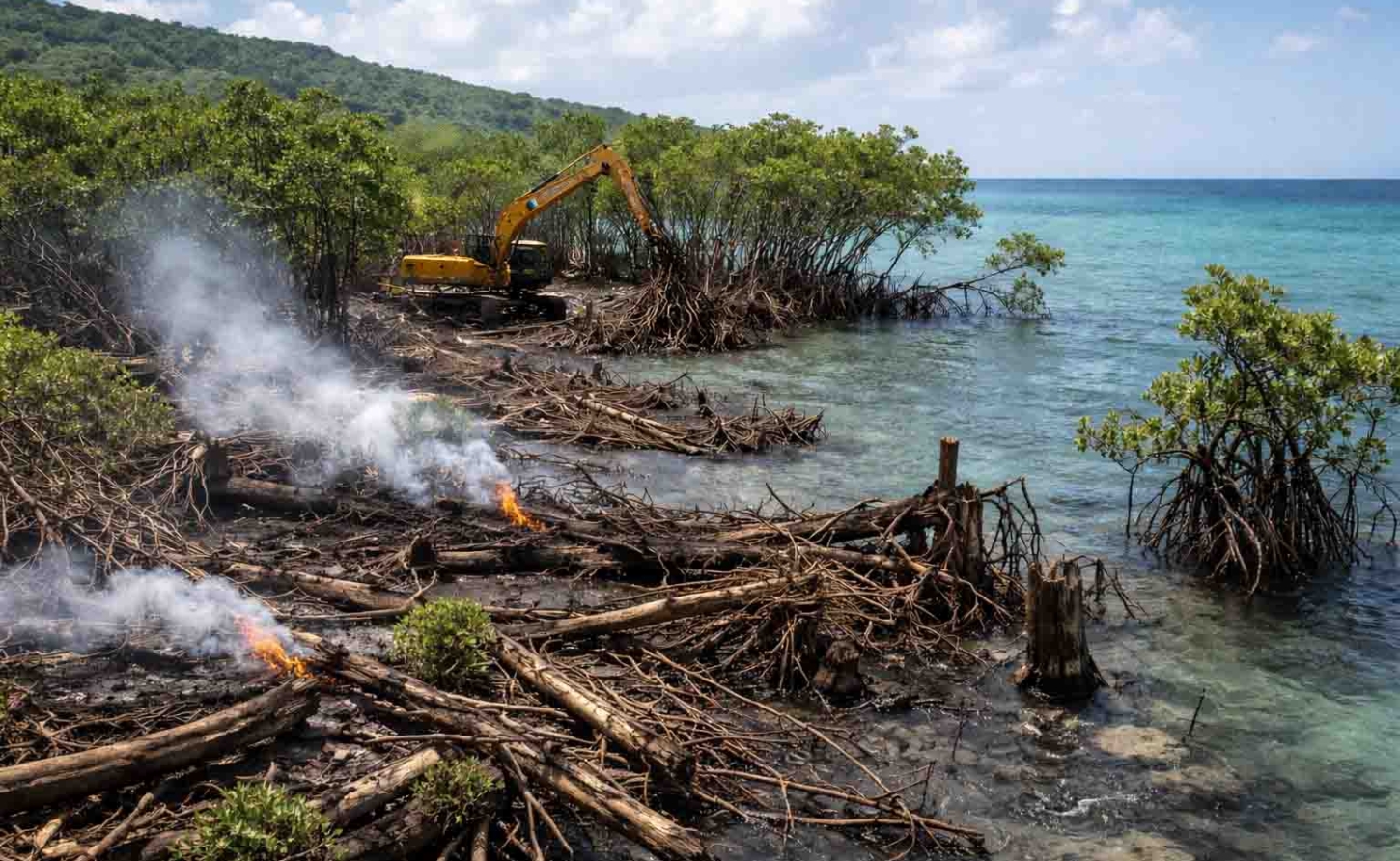
Jamaica's mangroves are being torn down by foreign hands — just as the world is preparing to pay billions for exactly what we're allowing to disappear.
MONTEGO BAY, Jamaica — From the rolling coast of St. Ann, past the cliffs of Trelawny, through the bays of St. James and into the parishes of Hanover — something is happening along Jamaica's shoreline that most Jamaicans haven't yet registered as a crisis. But it is.
Expatriate Chinese nationals are acquiring coastal land along Jamaica's north and northwest coastline — and in their wake, the mangrove forests that have stood for centuries are being cleared. Quietly. Systematically. Without the public outrage these acts deserve.
What makes this doubly scandalous is the timing. At the very moment these ecosystems are being destroyed, the global economy has placed an extraordinary premium on exactly the kind of coastal assets Jamaica is losing. In the emerging world of carbon credits, our mangroves are not just trees in the sea. They are currency. And someone else is spending it for us.
⚠ What Is Being Destroyed — And Where
St. Ann → Trelawny → St. James → Hanover:
Mangrove forests along the northwest coastal corridor are being cleared as expatriate Chinese nationals acquire beachfront and coastal land, reportedly for commercial development and aquaculture operations.
Mangrove forests along the northwest coastal corridor are being cleared as expatriate Chinese nationals acquire beachfront and coastal land, reportedly for commercial development and aquaculture operations.
What's a mangrove worth?
One hectare of mangrove sequesters five times more carbon than a hectare of tropical forest. Healthy mangroves trade on the international carbon market at above US$20 per tonne of CO₂ removed. They also shelter coastlines from hurricane storm surge — a fact every Hanover resident knows firsthand.
One hectare of mangrove sequesters five times more carbon than a hectare of tropical forest. Healthy mangroves trade on the international carbon market at above US$20 per tonne of CO₂ removed. They also shelter coastlines from hurricane storm surge — a fact every Hanover resident knows firsthand.
What is being lost beyond the trees:
Fish nurseries. Storm buffers. Sediment filters. Nesting grounds. And increasingly, the income-generating carbon assets that should be financing Jamaica's green economic future.
Fish nurseries. Storm buffers. Sediment filters. Nesting grounds. And increasingly, the income-generating carbon assets that should be financing Jamaica's green economic future.
What Exactly Is a Carbon Credit?
Think of it like this: the world has a pollution problem, and some companies are prepared to pay good money to offset what they cannot yet stop producing. A carbon credit is a certificate that says one tonne of carbon dioxide has been removed from — or kept out of — the atmosphere. Companies, airlines, and tech giants like Microsoft buy these certificates to balance their emissions.
The credits that command the highest prices are nature-based: mangroves, seagrass meadows, forests, wetlands. Not because of sentiment, but because nature sequesters carbon at scale, permanently, and with rich co-benefits — biodiversity, coastal protection, fisheries habitat. These are the credits Jamaica could be producing. These are the credits being destroyed.
"Mangroves store five times more carbon per hectare than tropical forest. The global market pays premiums above US$20 per tonne for protecting them. We are letting foreign interests tear them down for free."
US$1.4B Market value today
US$35B Projected by 2030
US$250B Projected by 2050
US$20+ Per tonne, nature-based
The Numbers Jamaica Is Walking Away From
One hundred hectares of protected and restored mangrove, generating 2,500 tonnes of carbon credits annually, would earn approximately US$50,000 per year — every year, for up to thirty years — while simultaneously protecting the coastline from the next hurricane season.
Now ask yourself: how many hectares of mangrove have already been cleared between St. Ann and Hanover? And who gave permission for that to happen?
Where Jamaica's Policy Stands
Jamaica is not asleep on this issue — but it is moving too slowly for a market that will not wait.
- Climate Change Legislation: Under preparation, with drafting instructions targeted for April 2026. Without it, Jamaica cannot formally authorise carbon credits for international sale.
- Blue Carbon and the NDC: The Nature Conservancy and UWI's Centre for Marine Sciences are mapping Jamaica's mangroves and seagrass beds to support inclusion in the country's updated climate commitments under the Paris Agreement. That inclusion is the legal gateway to trading these assets internationally.
- Article 6 of the Paris Agreement: At COP29 in 2024, the world finalised the rules for international carbon credit trading between countries. Over 97 bilateral agreements have been signed globally. Jamaica has signed none.
- The JSE Green Bond Plus: Launched in 2024, Jamaica's Stock Exchange now has a platform for trading green financial instruments. The plumbing is there. The carbon product is not yet on it.
The policy foundations are being laid. What is missing is the urgency — and the political will to treat the destruction of mangroves not as a planning issue, but as an act of economic sabotage against Jamaica's future.
How Jamaicans Can Claim Their Share
This is not just a government story. The carbon credit economy creates real, concrete opportunities for Jamaican entrepreneurs, farmers, fisherfolk, and investors right now.
6 Ways Jamaican Entrepreneurs Can Enter the Carbon Economy
1. Become a Carbon Project Developer
Identify degraded coastal or forest land, bring it through international certification (Verra or Gold Standard), and sell the resulting credits to global buyers. Projects earn revenue for up to 30 years.
Identify degraded coastal or forest land, bring it through international certification (Verra or Gold Standard), and sell the resulting credits to global buyers. Projects earn revenue for up to 30 years.
2. Carbon Farming
Farmers earn carbon credits by adopting agroforestry, regenerative practices, or biochar. Shade-grown coffee under native canopy, silvopasture in cattle parishes, and reduced-tillage farming all qualify. Credits trade at US$10–30 per tonne.
Farmers earn carbon credits by adopting agroforestry, regenerative practices, or biochar. Shade-grown coffee under native canopy, silvopasture in cattle parishes, and reduced-tillage farming all qualify. Credits trade at US$10–30 per tonne.
3. Build an Aggregation Business
Bundle farmers and landowners together into a single carbon programme, handle the verification, and take a percentage of revenues. This is the co-operative model applied to the green economy.
Bundle farmers and landowners together into a single carbon programme, handle the verification, and take a percentage of revenues. This is the co-operative model applied to the green economy.
4. Carbon Consulting and Verification
Every project needs baseline measurement, monitoring, and third-party verification. Scientists, GIS specialists, environmental lawyers, and financial advisors who speak the language of carbon markets will be in high demand.
Every project needs baseline measurement, monitoring, and third-party verification. Scientists, GIS specialists, environmental lawyers, and financial advisors who speak the language of carbon markets will be in high demand.
5. Tourism–Carbon Hybrid Models
Hotels and tour operators under pressure to prove sustainability credentials can fund local mangrove or forest projects. Entrepreneurs can develop verified 'carbon neutral' tourism packages, guided restoration experiences, and blue carbon eco-tours.
Hotels and tour operators under pressure to prove sustainability credentials can fund local mangrove or forest projects. Entrepreneurs can develop verified 'carbon neutral' tourism packages, guided restoration experiences, and blue carbon eco-tours.
6. Carbon Finance and Investment
Structure carbon offtake agreements as project collateral. Develop domestic carbon funds. Broker deals between Jamaican project developers and international institutional buyers. List carbon-linked instruments on the JSE Green Bond Plus as the framework matures.
Structure carbon offtake agreements as project collateral. Develop domestic carbon funds. Broker deals between Jamaican project developers and international institutional buyers. List carbon-linked instruments on the JSE Green Bond Plus as the framework matures.
Where to Start — Right Now
- Identify land with carbon potential: degraded mangroves, upland forest, coastal wetlands, or farmland suitable for agroforestry
- Access carbon measurement training through PADF, the Caribbean Biodiversity Fund, and UWI's Centre for Marine Sciences
- Choose a certification standard: Verra's Verified Carbon Standard and Gold Standard are the most recognised globally
- Engage early with international buyers via platforms such as Xpansiv, South Pole, and Anew Climate
- Monitor and participate in Jamaica's Climate Change Legislation consultations — the authorisation framework will determine what can legally be sold internationally
The Verdict
Someone is getting rich off what belongs to Jamaica. That is the simple truth buried beneath the diplomatic language and bureaucratic timelines. While our policymakers prepare concept papers, foreign nationals are clearing the very ecosystems that the global market is prepared to pay us to protect.
The carbon credit economy is not a distant future. Countries are signing bilateral trading agreements. Corporations are securing 30-year offtake deals for nature-based credits. Entrepreneurs in Kenya, Indonesia, and Brazil are already building carbon aggregation businesses that generate millions of dollars annually.
"What we are watching along the coast of Hanover and St. James is not just environmental damage. It is the destruction of Jamaica's green economic inheritance."
The question is whether we wake up in time to defend it — and to profit from what is still standing.
