CARICOM | Dr. Drew Puts Agriculture 'Front of the Line' as CARICOM Launches Regional Farm Insurance Programme

CARICOM Chair and Prime Minister Dr. Terrance Drew
With the launch of REAP in St. Kitts and Nevis, CARICOM signals that food security is no longer an aspiration — it is a survival strategy. The question now is whether governments will match the rhetoric with resources. By Calvin G. Brown -
BASSATERRE| St. Kitts and Nevis / Turkeyen, Guyana | Wednesday, 18 March 2026 | The Caribbean has long treated agriculture as an afterthought — a romantic attachment to a pre-industrial past rather than the strategic lifeline it has always been. On Tuesday, that began to change, or at least someone at the top said so with conviction.
Speaking at the launch of the Regional Economical Agri-Insurance Programme (REAP) in St. Kitts and Nevis, CARICOM Chair and Prime Minister Dr. Terrance Drew drew a line in the soil: agriculture is not a "by the way activity." It must be brought "into the mainstream" and placed at the "front of the line" in the fight for food security and national sustainability.
These are not throwaway words from a regional chairman warming up a podium. They represent a fundamental reordering of priorities — one that the Caribbean's 16 million citizens have been waiting decades to hear articulated with this degree of political urgency.
WHAT REAP ACTUALLY DOES
The Regional Economical Agri-Insurance Programme is a public-private partnership, offered through Lynch Caribbean Brokers Ltd. and a consortium of partners. It pays out directly when an extreme weather event damages crop production — covering cost of production and business interruption. For registered farmers and fisherfolk, it means that one catastrophic hurricane or flood need not erase years of investment and livelihood overnight.
The St. Kitts and Nevis launch was the third, following earlier launches in Guyana and Saint Lucia, positioning REAP as a genuinely region-wide instrument rather than a pilot programme serving only the wealthiest Member States.
"Imagine one event can wipe out millions of dollars in investment with no guarantee that you will receive some form of compensation." — PM Dr. Terrance Drew, CARICOM Chair
A REGION THAT CANNOT AFFORD TO IGNORE THIS
Prime Minister Drew's words land with particular weight against the backdrop of CARICOM's 25x25+5 food security initiative — an ambitious commitment to reduce the region's food import bill by 25 per cent by 2030. That target is not academic. The Caribbean spends billions annually importing food it could, in large measure, grow itself. Every natural disaster that wipes out a farming season pushes that target further out of reach and deepens regional dependency on external supply chains that have proven fragile.
Climate vulnerability is not an abstraction in this region. It is a recurring existential threat. REAP's de-risking architecture gives farmers a credible reason to stay in agriculture rather than abandon it at the first sign of climate disruption — which, in the Caribbean, comes with increasing frequency and ferocity.
CARICOM DELIVERING WHERE IT COUNTS
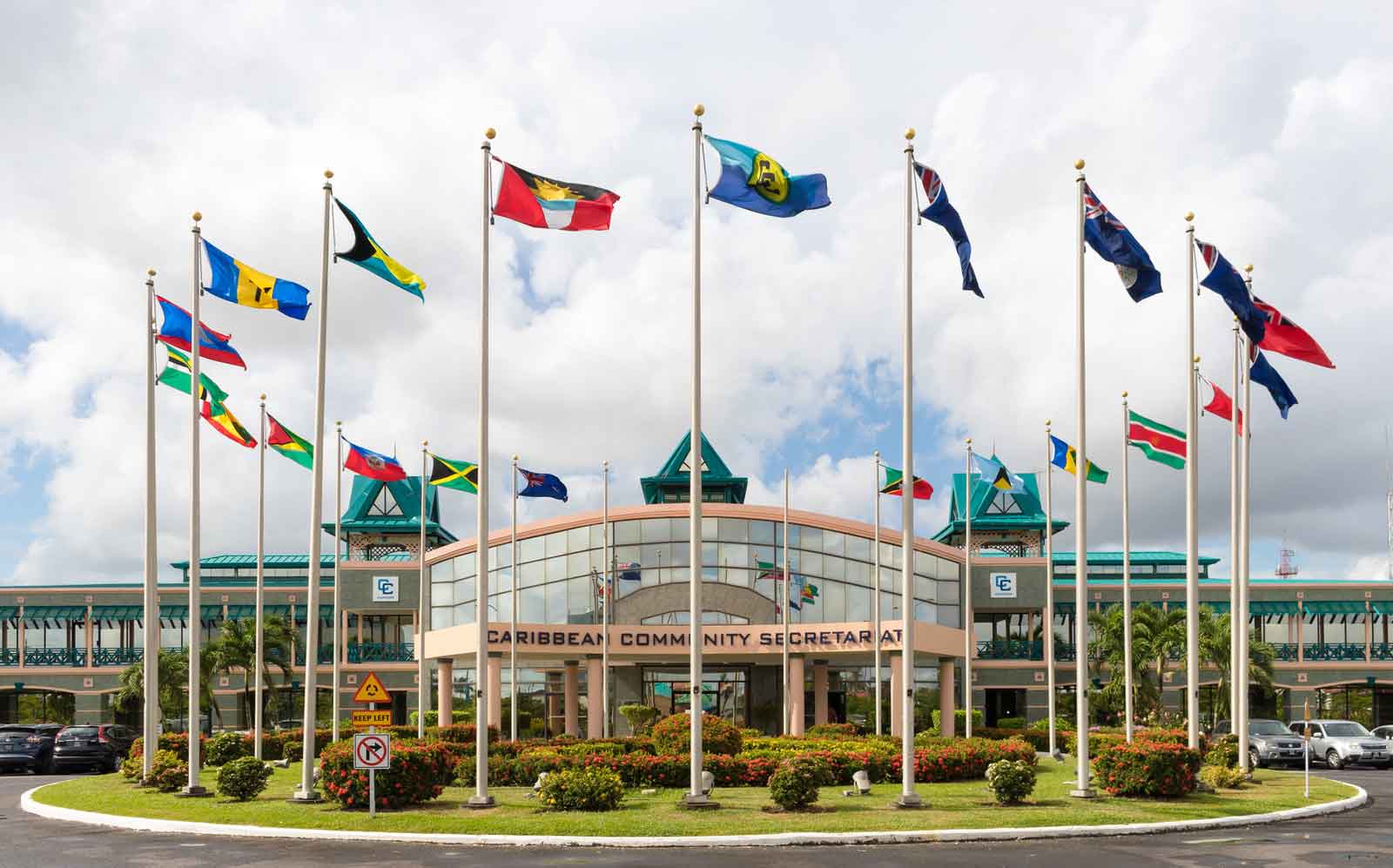
CARICOM Headquarters at Turkeyene, Georgetown in Guyana
That sentence should be carved into the entrance of every Ministry of Agriculture across the region. Regional solidarity, when applied to practical, livelihood-altering programmes, is not a luxury — it is an economic necessity.
THE TEST AHEAD
The launch is the easy part. Implementation, farmer enrolment, and timely payouts when disaster strikes — those are the measures by which REAP will ultimately be judged. A well-designed insurance product means nothing if bureaucratic friction, awareness gaps, or underfunding prevents farmers from accessing it when the storm passes and the damage is counted.
CARICOM's 50th Regular Meeting — convened just days before in St. Kitts and Nevis — set a stage of regional momentum. Whether REAP becomes a transformative instrument or another well-intentioned framework that fades in the absence of follow-through now falls to Member States, agriculture ministries, and the farming communities this programme is designed to protect.
Dr. Drew has drawn the line. The test of Caribbean leadership is whether the region crosses it together.
-30-
