
GUYANA | A Nation on the Line: Guyana Opens Historic ICJ Case Against Venezuela
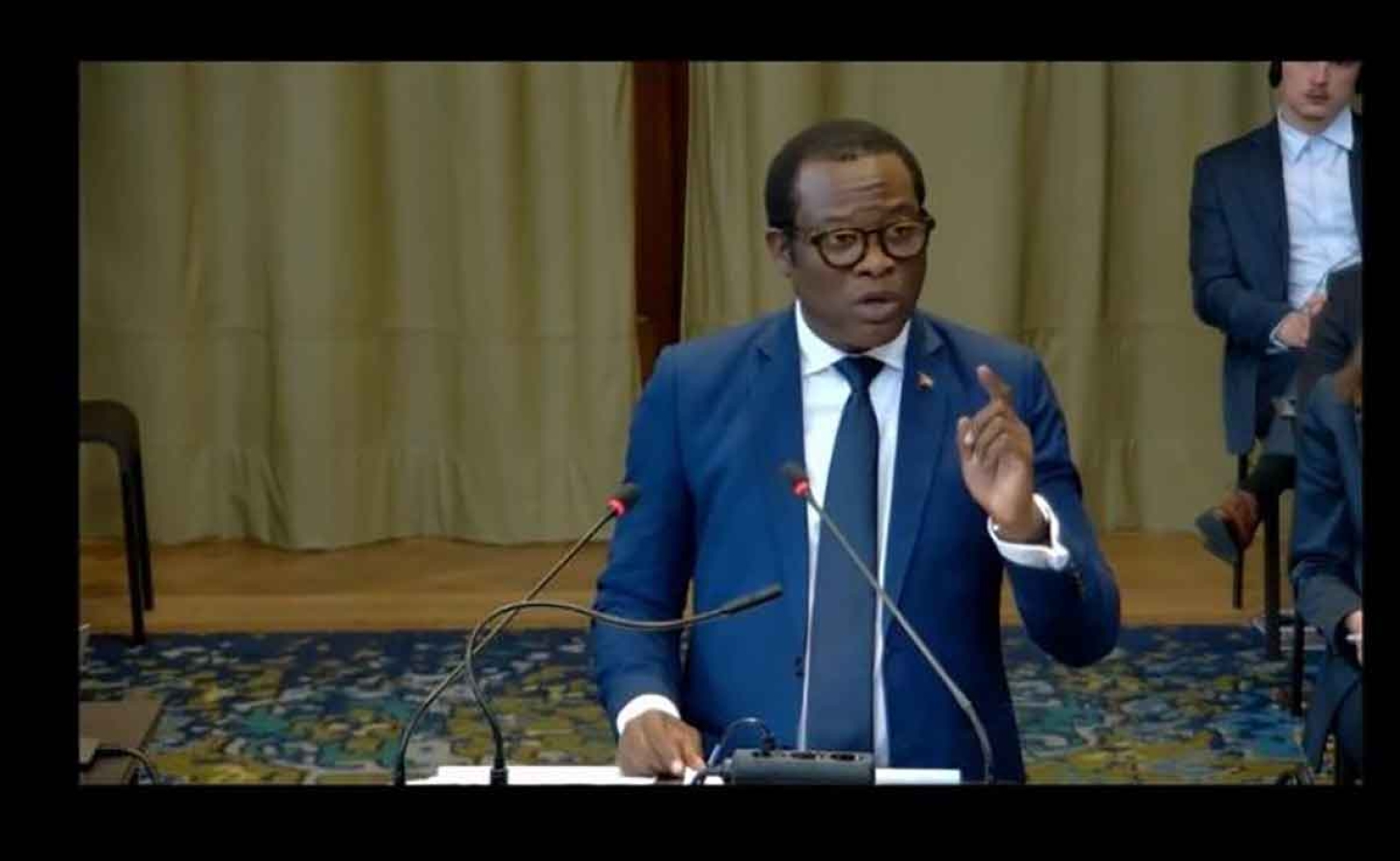
Guyana's Foreign Affairs Minister Hugh Todd, before the International Court of Justice in the Hague
In The Hague, Guyana's Foreign Affairs Minister tells the International Court of Justice that more than 70 per cent of his country's sovereign territory hangs in the balance — in a case six decades in the making
THE HAGUE — Calvin G. Brown | Caribbean Affairs | WiredJa | May 5, 2026 - There are courtrooms, and then there are moments in history that happen to take place in courtrooms. Monday's opening at the International Court of Justice was unambiguously the latter.
With quiet but unmistakable gravity, Guyana's Foreign Affairs and International Cooperation Minister, Hugh Todd, stood before the world's highest judicial body and presented a case that is, as he put it, "existential" — not merely for a government, not merely for a political party, but for the Guyanese nation itself.
The dispute at the centre of these proceedings is over the Essequibo — a vast, resource-rich territory that makes up roughly the western two-thirds of Guyana, spanning some 61,600 square miles. Venezuela claims it as its own. Guyana says that claim is not only wrong, but more than a century too late to be entertained.
An Award Accepted, Then Repudiated
The legal foundation of Guyana's case rests on the 1899 Arbitral Award — the product of an exhaustive process that involved more than 5,000 pages of written arguments, over 200 hours of oral submissions, and 54 four-hour sessions before a panel of five of the most eminent jurists of that era.
The award drew the international boundary between British Guiana and Venezuela with finality. Venezuela accepted it. For more than six decades, it respected and complied with that boundary without protest.
Then, in 1962, Caracas declared the award null. A border settled by law and observed in practice for generations was suddenly, and retroactively, contested. Guyana formally brought the matter before the ICJ in 2018, seeking affirmation that the 1899 award remains legally valid and binding.
After surviving Venezuela's objections to the court's jurisdiction — soundly rejected in December 2020 — and further challenges to the admissibility of Guyana's claims, the case has now arrived at its final, decisive stage: oral hearings on the merits.
"For the Guyanese people, it is tragic even to think about having our country dismembered — stripping from us a vast majority of our land, together with its people, its history, its trade, and its customs." — Minister Hugh Todd, addressing the ICJ
Venezuela's Brazen Defiance
What makes Venezuela's conduct in this matter particularly alarming — and what Todd placed squarely before the court — is not simply that Caracas contests the 1899 award. It is that Venezuela has, repeatedly and deliberately, defied the ICJ itself.
In late 2023, Venezuela staged a national referendum seeking popular backing for rejecting the court's jurisdiction and formally incorporating the Essequibo into Venezuelan territory. The ICJ, acting on Guyana's request, issued provisional measures prohibiting exactly that.
Venezuela proceeded anyway — issuing executive decrees and national legislation that not only rejected any forthcoming judgement but formally annexed the disputed territory on paper.
The military dimension is no less troubling. Todd described a landscape of escalating Venezuelan military activity along the border — new bases, new airfields, aircraft deployments, heavy weapons, and troops. The message from Caracas, he told the court, is unmistakable: Venezuela intends to acquire this territory.
Sixty Years to This Moment
The weight of those six decades was audible in Todd's address. He described Venezuela's claim as "a blight on our existence as a sovereign state from the very beginning of our existence" — one that has frightened off foreign investors, slowed development, and held a young nation hostage to its larger neighbour's territorial ambitions.
The Essequibo's oil wealth — now among the most consequential energy discoveries in the Western Hemisphere — has only sharpened the stakes.
For the Caribbean, this case transcends its immediate geography. It is a test of whether international law and its institutions can protect small, sovereign states from the raw power of larger neighbours who choose defiance over compliance.
Guyana is a CARICOM nation, and the regional bloc has a clear stake in the outcome. If the 1899 award can be unilaterally repudiated after six decades of acceptance, no boundary in the developing world is truly secure.
Todd closed his address with measured confidence. Guyana's submission is clear: the 1899 Arbitral Award is legally valid, the 1905 boundary agreement is binding, and Venezuela's challenges — filed, in his words, "decades, no, a century too late" — have no merit in international law. Both sides will complete their first round of oral presentations this week, after which the ICJ will deliberate and issue its judgement.
The Essequibo has been Guyana's for more than 126 years, since before independence, since before memory. The court's answer will determine whether it remains so — and whether the rule of international law still means something for the small nations of this hemisphere who have no other shield but it.
— 30 —
