
DIASPORA | Hartford Salutes a Caribbean Media Giant: Derrick Scott’s Four Decades of Storytelling Earn Honours in Connecticut
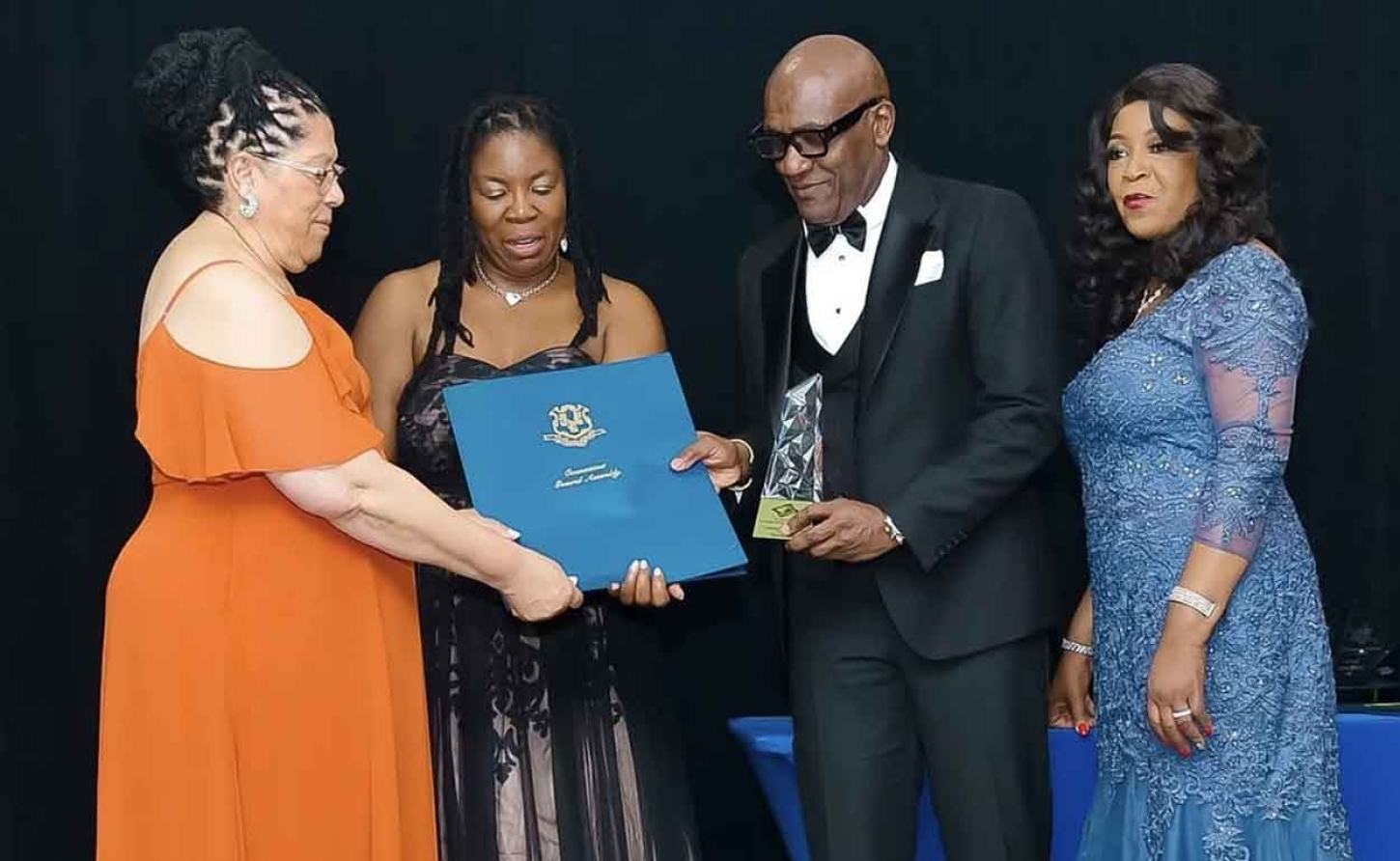
Information Attaché at the Embassy of Jamaica Derrick Scott (center) receives the 2026 Community Service Award and citation from West Indian Social Club of Hartford President Beverly Redd (left), assisted by Vice President Tanya Dorman and Claudett Graham, during WISCOH’s 76th Anniversary Gala in Hartford, Connecticut, on Saturday, April 18, 2026.
A community service award from WISCOH. Citations from Hartford’s Court of Common Council, the Connecticut General Assembly, and the Mayor’s office. Four decades of journalism. One proud son of Trelawny. The night confirmed what the Caribbean has long known: Derrick Scott’s voice has never just reported history — it has helped write it.
HARTFORD, Connecticut — April 18, 2026 - There are rooms where Caribbean people go to be seen, and then there are rooms where they go to be reckoned with. On the evening of April 18, the ballroom of the West Indian Social Club of Hartford (WISCOH) was unambiguously the latter.
At its 76th Anniversary Gala — themed “Honouring Our Journey. Igniting Our Future” — the club bestowed its community service award on a man who has spent four decades ensuring the Caribbean story is told with precision, pride, and power: Derrick Scott, Information Attaché for the Embassy of Jamaica in Washington, DC.
But WISCOH was not the only institution at the table that evening. The Court of Common Council of the City of Hartford, the Connecticut State General Assembly, and the office of Hartford Mayor Arunan Arulampalam each presented Scott with formal citations — a triple institutional salute that rarely descends on any individual, let alone a Caribbean journalist working in the diplomatic trenches of Washington.
In the context of a diaspora community that has historically been recognised too little and too late, these honours landed with the weight of long overdue reckoning.
A Bridge Between Jamaica and the World
Martin Looney, President Pro Tempore of the Connecticut General Assembly, did not traffic in polite generalities when he addressed Scott’s four decades in media. His citation cut directly to the marrow of what consistent Caribbean journalism represents in spaces that have long been hostile or indifferent to the region’s narrative.
For Looney, Scott was not merely a journalist — he was “a bridge connecting Jamaica to the world, one story at a time.”
Thomas J. Clarke, President of the Court of Common Council, echoed that assessment with institutional clarity, recognising Scott as a brand advocate whose work “amplified the Caribbean voice and strengthened diaspora connections.”
That a sitting civic council president would use the phrase “Caribbean voice” in a formal citation is not incidental — it is a measure of the cultural and diplomatic ground the diaspora has fought to claim.
“The media keeps communities connected. It builds bridges, informs and inspires the public. Derrick understands this very well.”
— Major General (Ret’d) Antony Anderson, Jamaica’s Ambassador to the United States
Forty Years in the Trenches
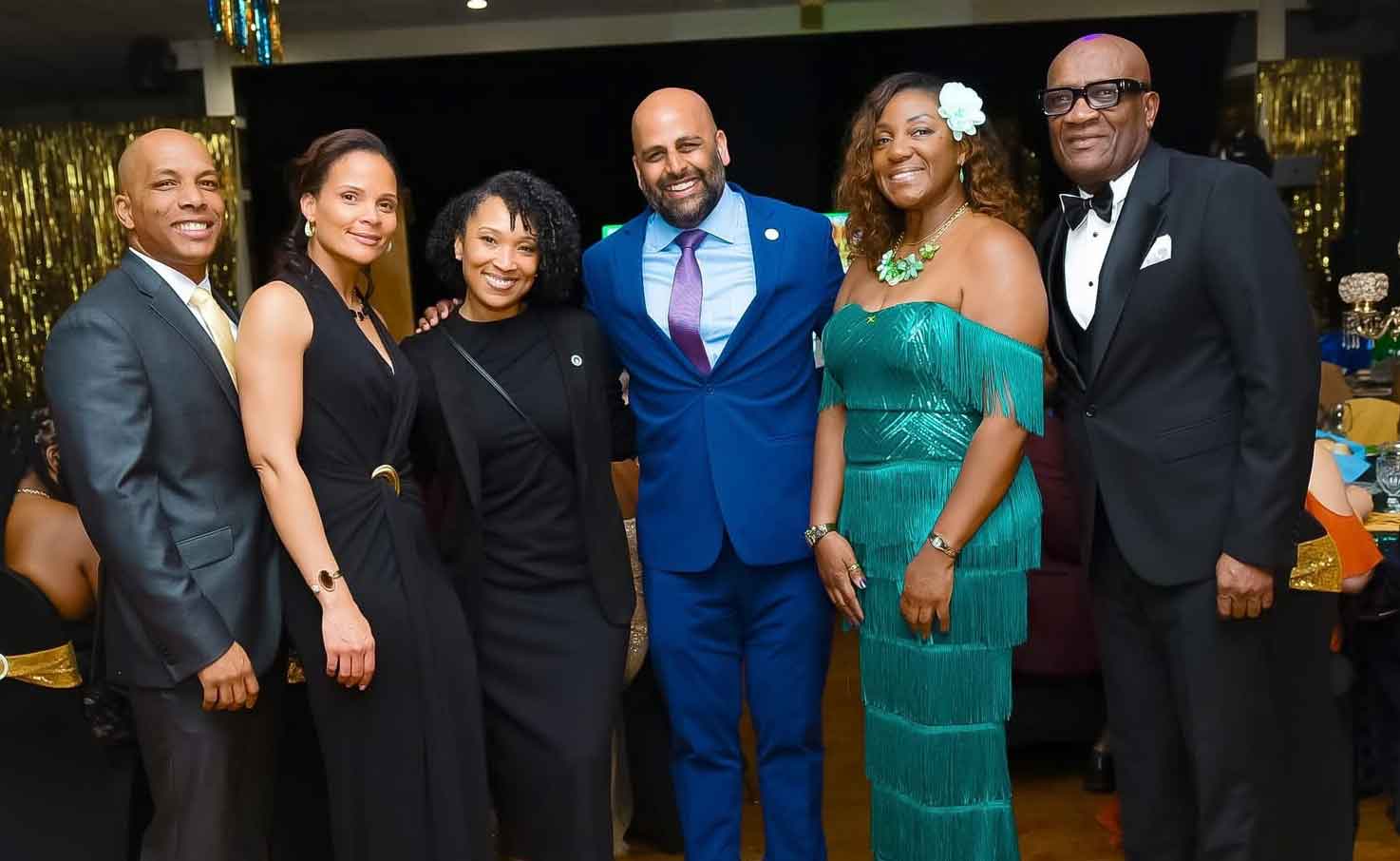
Hartford Mayor Arunan Arulampalam (center) and West Hartford Councilwoman Lisa Lazarus (third left) share a light moment with Gordon Ellison (second left), husband of Embassy of Jamaica Security Attaché2rd left Tanisha Ellison; President of the Jamaica Nurses Association of New Jersey Celia O’Gilvie; and 2026 Community service awardee Information Attaché Derrick Scott at WISCOH’s 76th Anniversary Gala
“He makes his presence felt,” Anderson said, and in that simple observation lay a profound truth about what the most effective diaspora communicators do: they do not merely occupy a room, they transform it.
Anderson’s remarks underscored that Scott’s latter two decades of service, conducted from within the Embassy walls, represent a rare fusion of journalistic instinct and diplomatic discipline — two impulses that do not always coexist comfortably.
That Scott has navigated both with credibility speaks to a professional character forged over four decades of authentic community service. The proud son of Trelawny has never allowed titles or protocol to smother the storyteller’s instinct that got him into this work in the first place.
A Club with a Vision Larger Than One Night
The gala was itself embedded in a larger declaration of intent. WISCOH Chair Beverly Redd used the occasion to announce that 2026 marks a decisive step toward the Caribbean Cultural Heritage Alliance and the launching of a Caribbean Heritage Museum — both to be housed at the club’s historic Hartford headquarters.
For 76 years, WISCOH has been precisely what Redd described: “a beacon of Caribbean culture, unity, and service.” The museum, she promised, will preserve and share Caribbean stories for generations not yet born.
In that context, honouring Derrick Scott was not merely a ceremony — it was a statement of institutional values. That the Caribbean community chooses to celebrate a journalist, a storyteller, a man who spent his professional life amplifying others’ voices, tells you everything about what WISCOH believes the next 76 years must be built upon: the unapologetic documentation of who we are, where we came from, and what we have contributed.
Scott himself, never a man for theatrical self-aggrandizement, responded with characteristic grace. He shared the honour with every collaborator and believer who had invested in his work, and he saluted the club for its three quarters of a century of cultural stewardship.
But make no mistake about what April 18 represented: the night Hartford stopped to say — on record, in citation, before an erupting room — that the Caribbean press matters, Caribbean diplomacy matters, and the men and women who carry that work forward deserve not just applause, but permanent institutional recognition.
Derrick Scott earned every word of it.
-30-
