
TRINIDAD | Echoing Washington: Kamla’s Cuba Stance Leaves Region Speechless
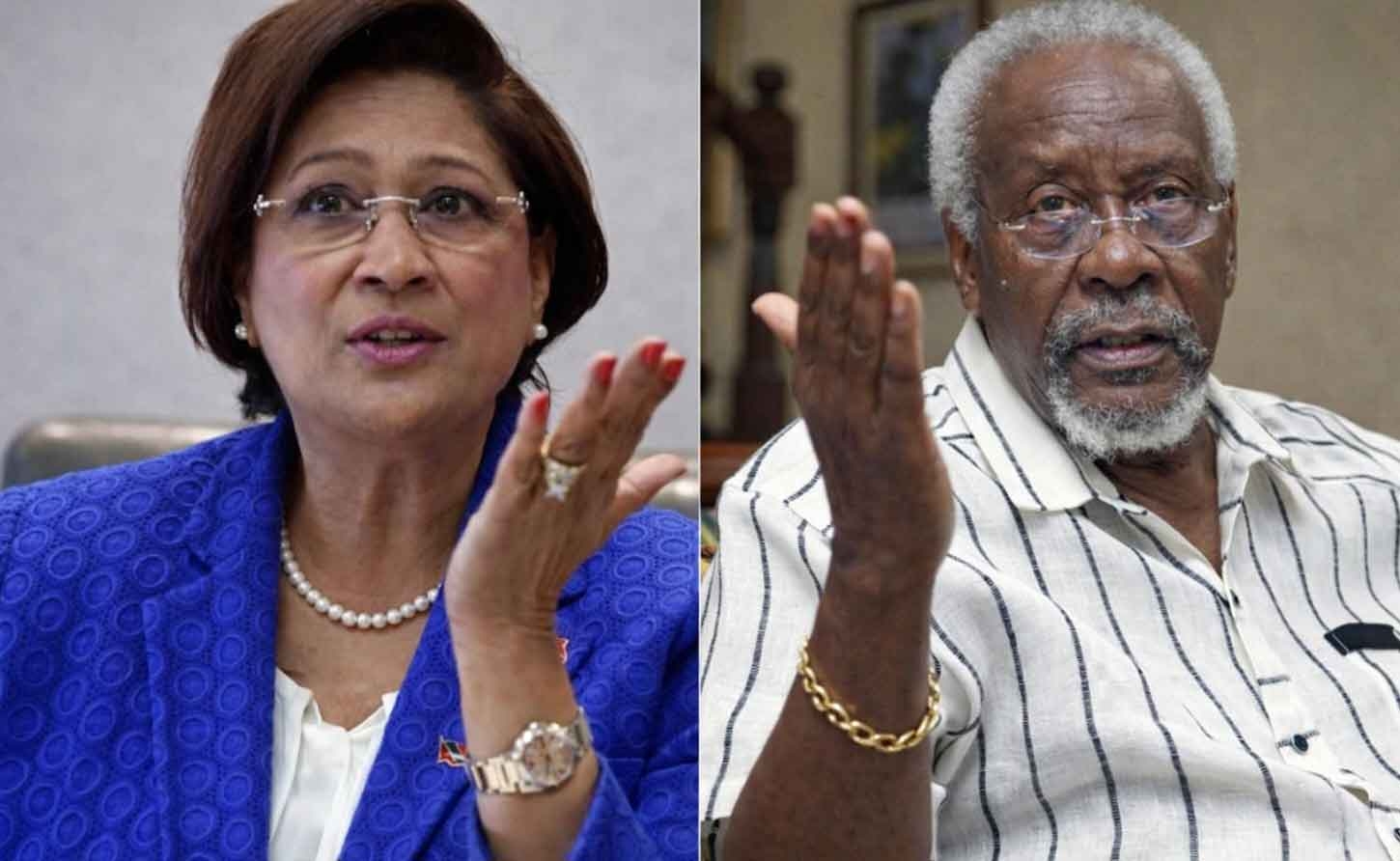
Trtinidad and Tobago's prime minister Kamla Persad-Bissessar and former Jamaican Prime Minister PJ Patterson
By Calvin G. Brown
MONTEGO BAY, Jamaica, February 23, 2026 - Prime Minister Kamla Persad-Bissessar has drawn sharp regional criticism after a Trinidad Express report by journalist Anna Ramdass revealed her response to a humanitarian appeal by eight former Caribbean heads of government — language critics say mirrors anti-Cuba talking points crafted in Washington rather than any authentic Caribbean foreign policy tradition.
The statement by the eight former leaders — issued in response to Donald Trump’s executive order cutting fuel supplies to Cuba — called the embargo “an inhumane weapon of mass destruction” inflicting “catastrophic” suffering on eleven million Cuban civilians.
Among the signatories: former Jamaican prime ministers PJ Patterson and Bruce Golding, former Barbados PM Freundel Stuart, former Guyana President Donald Ramotar, and Persad-Bissessar’s predecessor in Port-of-Spain, Dr. Keith Rowley.
Their appeal was unambiguous: this is a humanitarian crisis, and the Caribbean cannot stay silent.
Persad-Bissessar’s response, published in the Trinidad Express in a report by journalist Anna Ramdass, was equally unambiguous — but in an entirely different direction.
Rather than engaging with the substance of the humanitarian concern, the Prime Minister suggested the former leaders were hypocrites for living in democratic societies while “vociferously supporting dictatorship and communism.” She posed the question of whether Cuban citizens deserved the right to democratic elections. She listed eight democratic principles she personally endorses — capitalism among them.
What she did not address was the fuel shortage. Or the medicine scarcity. Or the rationed public transport. Or the eleven million people.
Former Jamaican Prime Minister PJ Patterson, responding on behalf of the group, was unsparing in his rebuttal. He opened by making clear that the statement carried no contradiction: “There is no irony or contradiction in the Statement issued originally by 8 Former Heads to which Former Prime Ministers Baldwin Spencer (Antigua & Barbuda), Said Musa (Belize) and Dr Ralph Gonsalves (St Vincent & The Grenadines) have now subscribed.” Then Patterson turned to the human stakes at the centre of the dispute.
“There can be no justification for the imposition of a fuel embargo which could extinguish 11 million civilian lives,” he stated. “Our concern now is about human survival. Exposing the citizens in any country to starvation, disease and extinction by the denial of energy resources poses a mortal danger that transcends any consideration of ideology.”
Patterson and his co-signatories also pushed back directly on the suggestion that their appeal represented any abandonment of democratic values. “We have never wavered in our practice of democratic pluralism, nor failed to demand respect and universal obedience to international law,” they stated — a pointed rebuttal to Persad-Bissessar’s characterisation of their position.
What makes the Prime Minister’s response particularly difficult to square is her own record. The former leaders noted, pointedly, that during her previous tenure as Prime Minister, Persad-Bissessar actively supported UN resolutions demanding an end to the U.S. embargo against Cuba — including as recently as October 2025, when 165 nations renewed that call. Trinidad and Tobago was among them.
The Caribbean’s relationship with Cuba is not a matter of ideology — it is a matter of history. On December 8, 1972, the prime ministers of Barbados, Guyana, Jamaica and Trinidad and Tobago collectively defied U.S. pressure to establish diplomatic relations with Havana, asserting the region’s sovereign right to determine its own foreign relationships. That decision has anchored Caribbean foreign policy for more than fifty years.
Critics say Persad-Bissessar’s response not only breaks from that tradition — it actively echoes the framing of U.S. Secretary of State Marco Rubio and an administration that has made Cuba a domestic American political weapon rather than a legitimate foreign policy concern. For a Caribbean head of government to adopt that framing uncritically, they argue, is a significant and troubling departure.
The group of eleven former leaders closed their response with a pointed appeal for regional unity: “The critical hazards and turbulence which confront us demand that our considerable vocal firepower as past, present and future leaders be directed against the hegemonic economic aggression which threatens havoc and death in our Caribbean space — and not at each other.”
The 50th Regular Meeting of CARICOM Heads of Government convenes in St. Kitts and Nevis from February 24 to 27. Cuba’s crisis is expected to be on the agenda. Persad-Bissessar has confirmed she will attend.
The Caribbean will be watching to see which script she brings to that table.
© 2026 WiredJa | Caribbean News & Analysis | wiredja.com
