ANTIGUA | Browne Calls Antigua Elections Within 90 Days — But the UPP Is Not the Reason
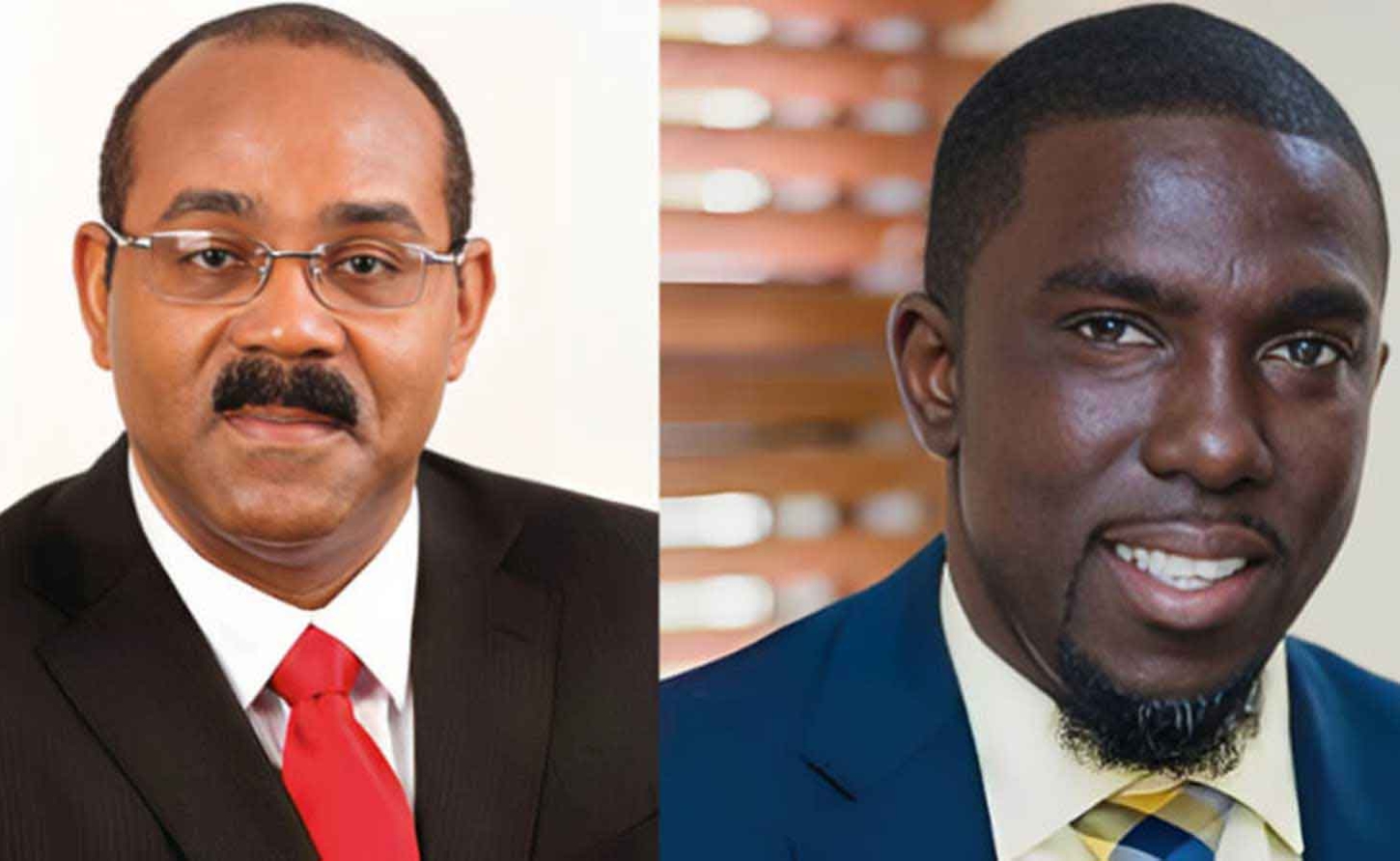
Prime Minister Gaston Browne and Opposition Leader Jamale Pringle
Fresh off a by-election win that was never in doubt, Antigua's Prime Minister reaches for an early poll — driven not by opposition weakness, but by gathering storms from Washington, London, and a US courtroom.
Calvin G. Brown |
ST. JOHN'S ANTIGUA, March 22, 2026 - Gaston Browne is in his ackee. Riding the wave of the Antigua and Barbuda Labour Party's commanding by-election victory in St. Philip's North last Sunday — where ABLP candidate Randy Baltimore crushed UPP Senator Alex Browne by a margin of roughly 924 votes to 407 — the Prime Minister wasted no time reaching for a bigger prize.
Speaking on Pointe FM on Saturday, Browne told the nation: "I am saying now that there will be a general election within 90 days."
The only problem with celebrating this particular triumph is that there was never any real contest. Sir Robin Yearwood held St. Philip's North for exactly fifty years — from the day he was first elected on February 18, 1976, to the day he retired on February 18, 2026.
The ABLP has never surrendered that seat. Baltimore improving on Sir Robin's nail-biting 2023 margin — when the late legend barely held on by fewer than 100 votes — says less about Browne's political genius and more about the UPP's chronic inability to mount a serious challenge in a constituency it has historically treated as lost territory.
A Convenient Launchpad
The more honest reading of Browne's election announcement is that the by-election provided cover for a decision already made on other grounds. The Prime Minister is not calling an early election because the UPP poses no threat.
Though political analyst Peter Wickham's suggestion that UPP leader Jamale Pringle consider stepping aside may seem that the opposition remains deeply fragmented, Pringle has command of approximately 60% of the UPP's grass roots that trust him implicitly.
Anyone who wants to lead the UPP, including Harold Lovell and his financiers, will have to take that into consideration. In any new political configuration, "Single Pringle" and his "Garrison" All Saints East & St. Luke constituency continues to be a real consideration.
Browne is moving because the external environment is deteriorating rapidly, and the window for a favourable contest may be closing faster than the electoral calendar suggests.
The Trump administration's mercurial approach to hemispheric relations has placed Caribbean governments in an increasingly precarious position. The United States is Antigua and Barbuda's single largest tourism source market and its most important bilateral partner for security and financial services.
Washington's erratic posture — from aggressive tariff threats to unpredictable visa and deportation policies — has introduced real turbulence into the forecasts of every small island economy in the region.
Add to that the fiscal tightening underway in Britain and the unresolved uncertainties hanging over the European Union, and you have a trio of external shocks bearing down on a tourism-dependent economy that has no buffer against sustained storms.
Browne understands, as any competent political operator would, that economic conditions in late 2026 and 2027 may be considerably less forgiving than they are today. The calculus is straightforward: strike now, before the numbers turn ugly.
The Yacht in the Room
Then there is the matter of the Alfa Nero.
The 266-foot Russian superyacht, seized by the Antiguan government after being abandoned in Falmouth Harbour following international sanctions linked to the Russia-Ukraine conflict, has become one of the most consequential legal headaches in Browne's political career.
The government sold the vessel for US$40 million in 2024 — a figure that Yulia Guryeva-Motlokhov, daughter of sanctioned Russian oligarch Andrey Guryev, claims was approximately US$80 million below market value. Her legal team at the prominent US firm Boies Schiller Flexner has pursued the case aggressively across multiple jurisdictions.
In April 2025, US District Judge Jesse M. Furman of the Southern District of New York rejected the Antiguan government's attempts to quash subpoenas and ruled that financial wire transfer records linked to Browne, his wife Minister Maria Browne, and seventeen associated individuals and entities must be disclosed to the court.
Browne has responded by threatening a US$10 million defamation lawsuit against the US attorneys involved, maintaining that the allegations are entirely without merit.
"If Browne is going to face an election, he would rather face it with his coalition intact and his mandate freshly renewed — not midway through a damaging legal news cycle."
Then there is the matter of Gregory Georges. In the first week of January 2026 — days after US forces captured Nicolás Maduro in Caracas — the CEO of Antigua's state-owned West Indies Oil Company was detained and questioned by US authorities while travelling in the United States. His laptop and mobile phone were seized, examined, and later returned.
The trigger: Venezuela's historical 25 percent shareholding in WIOC through its state oil company PDVSA — a stake the Browne administration had deliberately structured into the company when it acquired majority control. Browne publicly confirmed the incident and insisted there had been "absolutely no violation whatsoever."
But the optics of a Caribbean head of government whose state oil company CEO is being pulled aside by US federal agents — in the same week Washington was processing Maduro in a New York courtroom — are not the kind of optics any prime minister wants hanging over a general election campaign.
Whatever the ultimate legal outcome, the optics of a sitting prime minister's financial records being pried open by a US federal court are not helpful to any electoral campaign. Early elections remove that vulnerability from the table — at least temporarily.
If Browne is going to face Antiguan voters, he would rather do so with his coalition intact and his mandate freshly renewed, not midway through a damaging transatlantic legal news cycle.
The UPP's Uncomfortable Truth
None of this is to suggest that Browne is without genuine political advantages. The UPP under Pringle has struggled to consolidate support, lost the St. Peter's constituency, and seen internal tensions spill publicly into view.
Harold Lovell, who lost his seat and resigned the party leadership after the 2023 general election, has returned to active politics and will contest All Saints West — a subplot that raises its own questions about UPP unity going into a general election.
The ABLP has also completed its slate with the selection of Dr. Philmore Benjamin for St. Mary's North, signalling that the machinery is already in motion. Browne did add a characteristic caveat to his announcement: "Even though I said 90 days it could be before." That is not the language of a leader biding his time. It is the language of one reaching for the trigger.
The Verdict
Antigua heads toward a general election carrying the full weight of its external vulnerabilities — a volatile US relationship, uncertain British and European conditions, and a courtroom drama in New York that has not reached its final act. Browne's calculation is that he is better positioned to navigate all of that from a freshly renewed mandate than from the last year of a worn third term.
He may be right. But Antiguan voters deserve to understand what is actually driving the rush to the polls — and it has considerably less to do with the UPP's readiness to govern than the Prime Minister's radio broadcast would suggest.
-30-
© 2026 WiredJa Media & Education Division | wiredja.com
