JAMAICA | Jamaica’s Autism Emergency, Part I: The Children the System Cannot Find
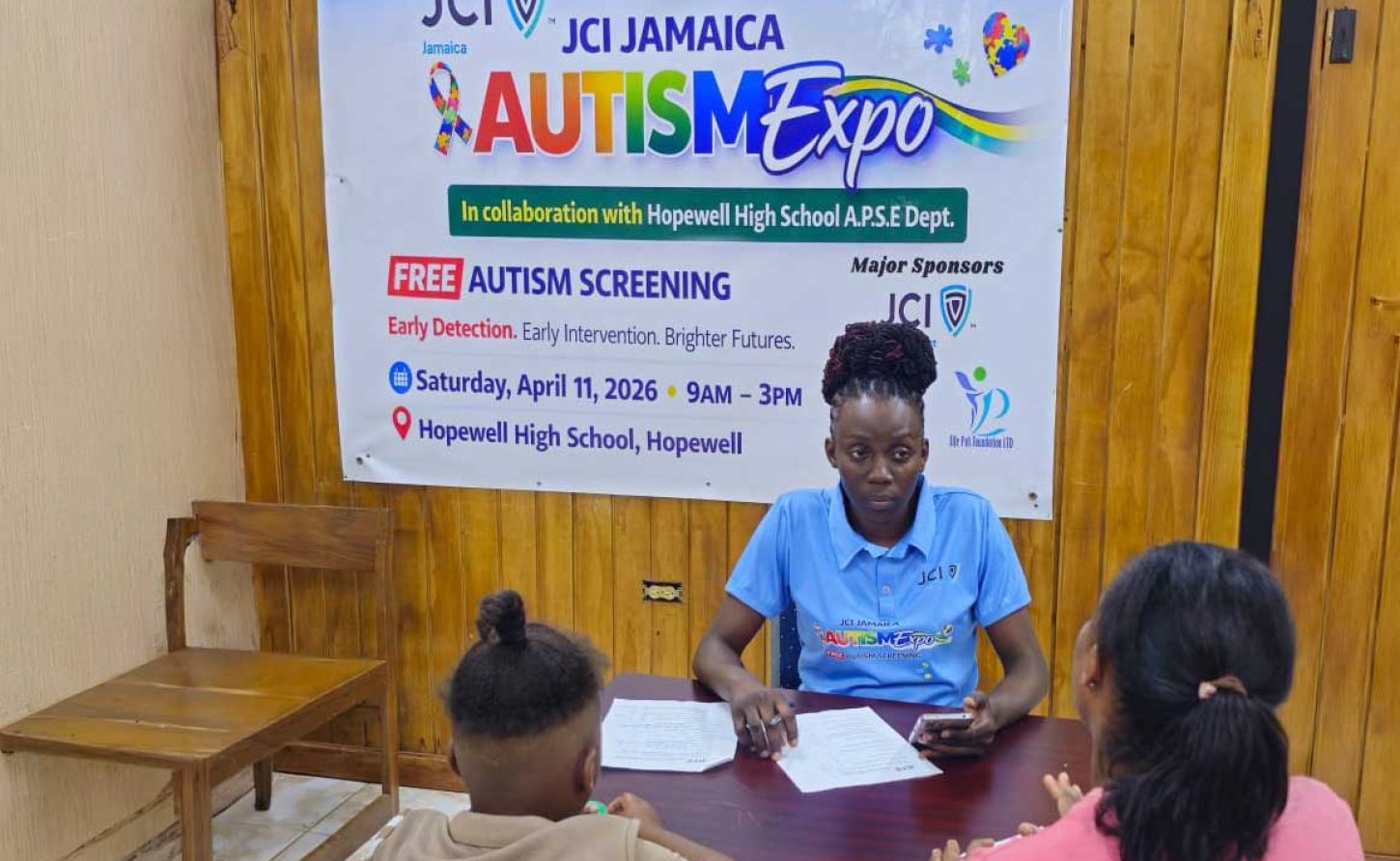
Dr. Yochel Samuels-Williams, Immediate Past President of JCI Hopewell, formerly Hopewell Jaycees with a parent and her child at the JCI Jamaica Autism Expo in Hopewell, Hanover.
An Autism Expo in Hopewell, Hanover last Saturday drew 400 people from across Jamaica — and proved in a single afternoon what government data has long obscured: tens of thousands of children are living with autism in this country, undiagnosed, locked out of school, and invisible to the two ministries that should be fighting for them. So overwhelming was the demand that scores of families left without the diagnosis they came for. JCI Hopewell is already planning to do it again.
Part I of II — Part II: “The Foreign Diagnosis Trap and the Ministries That Must Act” publishes tomorrow.
MONTEGO BAY, Jamaica, April 14, 2026, Calvin G. Brown & Dr. Yochel Samuels-Williams - On Saturday, April 11, something quiet extraordinary happened in Hopewell, Hanover. Four hundred people — parents, teachers, caregivers, advocates, and individuals living on the autism spectrum — converged on Hopewell High School for an Autism Expo staged by JCI Jamaica through JCI Hopewell, under the sponsorship of Kingston JCI Trust and the leadership of Dr. Yochel Samuels-Williams, Immediate Past President of JCI Hopewell, formerly Hopewell Jaycees.
They came from across Jamaica. They came in numbers that surprised even the organisers. And many of them came with one urgent, specific need: to have their child diagnosed.
Not all of them got what they came for. The demand overwhelmed the available diagnostic capacity on the day — a moment of painful, visible irony that encapsulates the broader national crisis with brutal precision.
Families who had travelled hours to Hopewell High School left without the diagnosis that would unlock their child’s access to school, to therapy, to a future. The Expo could only afford to diagnose 181 children.
The waiting list had followed them into the one space that had tried, for a single Saturday, to offer relief.
Dr. Samuels-Williams is now in discussions about seeking corporate sponsorship to stage another Autism Expo within the coming months .
Because what April 11 in Hopewell proved, beyond any policy paper or parliamentary debate, is that the need is not theoretical. It walked through the doors. It filled the hall. And it went home unsatisfied.
“The level of need that showed up on Saturday shocked us,” Dr. Samuels-Williams told WiredJa. “These are children who are ready, willing, and able to learn.
But they cannot get into school because the system requires a formal diagnosis before placement — and that diagnosis is beyond the reach of most Jamaican families.
Not because autism is rare, but because the infrastructure to diagnose it simply does not exist at the scale we need. This is not a health crisis. This is a national emergency.”
The Numbers That Indict
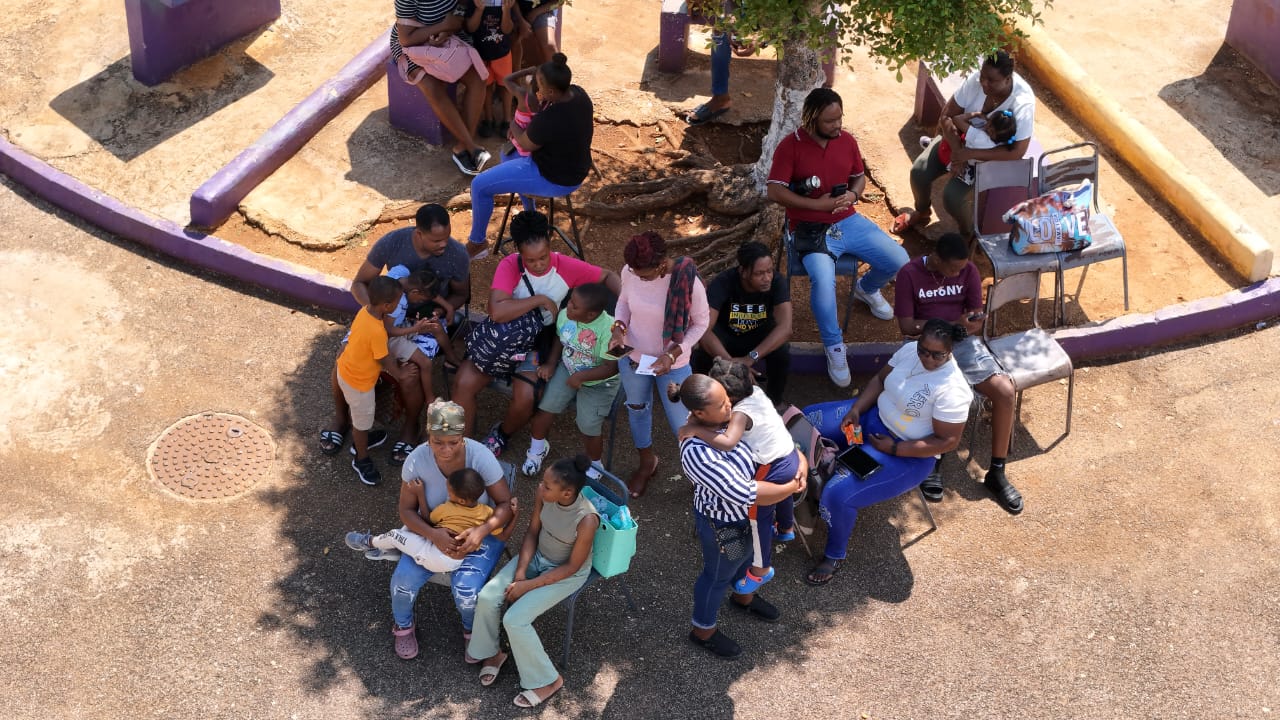
A small section of the parents and children who sought diagnostic help from this ground breaking expo which has exposed the serious nature of the autism challenge facing Jamaica.
Approximately 678 to 700 children are born with autism spectrum disorder (ASD) in Jamaica every year — one in every 68 births, according to Professor Maureen Samms-Vaughan of the University of the West Indies, the country’s foremost researcher on the condition.
Autism is four to five times more prevalent in boys than in girls. Across a population with roughly 40,000 annual births and decades of accumulated diagnoses, the estimated total of children living with autism in Jamaica stands at approximately 45,000.
That is not a fringe statistic. That is a constituency — larger than the populations of entire Caribbean territories — that the Jamaican state has comprehensively failed to serve.
Yet against that figure, the Ministry of Education reports that only approximately 6,800 students with diagnosed special education needs are currently enrolled in the national education system — 5,989 in public institutions and 811 in private ones.
The distance between 45,000 and 6,800 is not a data anomaly. It is the measure of a system that has failed to find, assess, and serve the children it is constitutionally obligated to protect.
The Early Childhood Commission’s 2024 school readiness data deepens the indictment: of 29,729 four-year-olds assessed through the Jamaica School Readiness Assessment, 38 per cent — some 11,291 children — were referred for secondary developmental screening.
Only 54.4 per cent of assessed children fully met the developmental milestones expected at their age. That secondary screening requires evaluation by specialists. Those specialists, as the evidence below makes plain, barely exist.
“Three years is not a backlog. Three years is abandonment. A child who could have been in early intervention at age two is now five, and the window that neuroscience tells us is the most critical for development has quietly closed.”— Dr. Yochel Samuels-Williams.
One Centre. Two Doctors. The Whole Country.
Jamaica has exactly one public-sector institution equipped to conduct a full, objective diagnosis of autism spectrum disorder: the Child and Family Centre at the University of the West Indies’ Department of Child and Adolescent Health in Kingston. One centre.
For an island of nearly three million people. For an estimated 45,000 children who need to be seen.
At that centre, just two developmental paediatricians carry the entire public-sector diagnostic burden for autism.
While general paediatricians and a handful of psychologists across the island can form a clinical impression of ASD, they are not trained to use the gold-standard diagnostic tools — the Autism Diagnostic Observation Schedule (ADOS-2) or the Autism Diagnostic Interview-Revised (ADI-R) — required for formal classification.
Every case of suspected autism in this country must ultimately funnel through two specialists in Kingston. And Kingston does not have enough hands.
The Early Stimulation Programme (ESP), operated through the Ministry of Labour and Social Security, provides an additional intervention pathway for children aged zero to six.
But it operates from just four centres nationwide: two in Kingston, one in Portland, and one in St. James. Eleven of Jamaica’s fourteen parishes have at least one hospital with general paediatric services — but none of those hospitals are equipped for objective ASD diagnosis.
The diagnostic infrastructure of an entire nation is, in effect, one building on the Mona campus.
The result is a waiting list measured not in weeks but in years. Parents in Hanover, Westmoreland, and St. Elizabeth face compounding burdens: travel costs, lost wages, and a queue stretching three years into the future, while their children age through the critical early intervention window.
That window, researchers consistently show, is roughly the first five years of life. A three-year wait beginning at age two means intervention — if it ever arrives — at age five, when the most formative neurological development has already occurred without support.
“Three years is not a backlog,” Dr. Samuels-Williams said. “Three years is abandonment. A child who could have been in early intervention at age two is now five, and the window that neuroscience tells us is the most critical for development has quietly closed. The government has to own that.”
The Therapeutic Desert
Even for the fortunate few who navigate the diagnostic gateway, what awaits on the other side is a landscape of near-total therapeutic scarcity.
Jamaica has fewer than ten speech-language pathologists serving the entire country — adults and children combined. The Mico University College Child Assessment and Research in Education (CARE) Centre is the only public-sector institution offering speech-language pathology in Jamaica.
As Mico’s own speech pathologist Brittney Aiken has stated publicly: the majority of Jamaican children with language delays may never access these services in their lifetime.
In 2019, only three speech therapists were working with autistic children in Kingston, each carrying waiting lists exceeding one year.
Since then, only two more practitioners have opened private offices — leaving a national total so inadequate it would barely serve a single parish.
The occupational therapy position is equally stark. There are ten working occupational therapists serving the entirety of Jamaica — ten, for an estimated 45,000 autistic children.
A ratio so extreme it renders accessible occupational therapy functionally meaningless for the vast majority of families. Critically, there is no local training pathway for occupational therapists; students must travel abroad to qualify, and the majority do not return.
The brain drain does not simply deplete the therapeutic workforce. It prevents it from being built in the first place.
Applied Behaviour Analysis (ABA) therapy — widely regarded as the most effective behavioural intervention for autism — is concentrated almost entirely in Kingston’s private sector.
Fifty-two per cent of Jamaicans with disabilities live in rural areas. The therapeutic infrastructure, meagre as it is, barely reaches them.
The School Gate Is Closed
The cruelest dimension of Jamaica’s autism crisis is its circularity. To access school placement, a child needs a formal diagnosis.
To get that diagnosis, a family must navigate a system with two public-sector specialists and a three-year queue. And even once diagnosed, the schools that can appropriately serve autistic children are vanishingly few.
Jamaica’s first — and still only — public inclusive school, Savanna-La-Mar Inclusive Academy (Sav Inclusive), opened in 2017.
It serves approximately 250 students from age three through fifth grade, sustained in large part by a philanthropic partnership with NC State University’s College of Education and over one million US dollars in donor funding.
That a fully inclusive public school required international charity to function speaks volumes about where the Jamaican state has positioned autism on its national priority list.
The Ministry of Education’s shadow support programme offers some structural relief. As of May 2025, 712 shadows had been engaged to assist special needs students at a government stipend of $60,000 per month — the equivalent of the then-weekly minimum wage.
The rate is so inadequate that many parents are forced to supplement it privately. Since July 2024, the Special Education Unit received applications for over 500 children with ASD: 310 requesting shadow support and 197 seeking school placement.
These are the children the system has formally encountered. The tens of thousands it has not constituted the real national crisis.
Of Jamaica’s 23,000-strong teacher cohort, only 313 are trained in special education — roughly one in every 74.
A significant proportion of public schools do not cater to autistic students at all, driving families toward homeschooling by necessity rather than choice.
And for some families, the desperation of that closed gate has driven them to an extreme measure — one that has led not to relief, but to a new and even more infuriating wall.
That story, and the science that demolishes the government’s justification for it, forms the core of Part II.
“We staged this expo because we believed in the need. What we did not fully anticipate was the scale of it. People came from all over Jamaica. They sat in that hall, they waited — and some of them had to go home without an answer. That told us everything.” — Dr. Yochel Samuels-Williams.
— End of Part I —
Calvin G. Brown is Publisher and Editor of WiredJa. Dr. Yochel Samuels-Williams is Immediate Past President of JCI Hopewell and co-organiser of the April 11, 2026 Autism Expo at Hopewell High School, Hanover.
-30-
