CARIBBEAN | Blood in the Water: Is Trump Opening a New Caribbean Front?
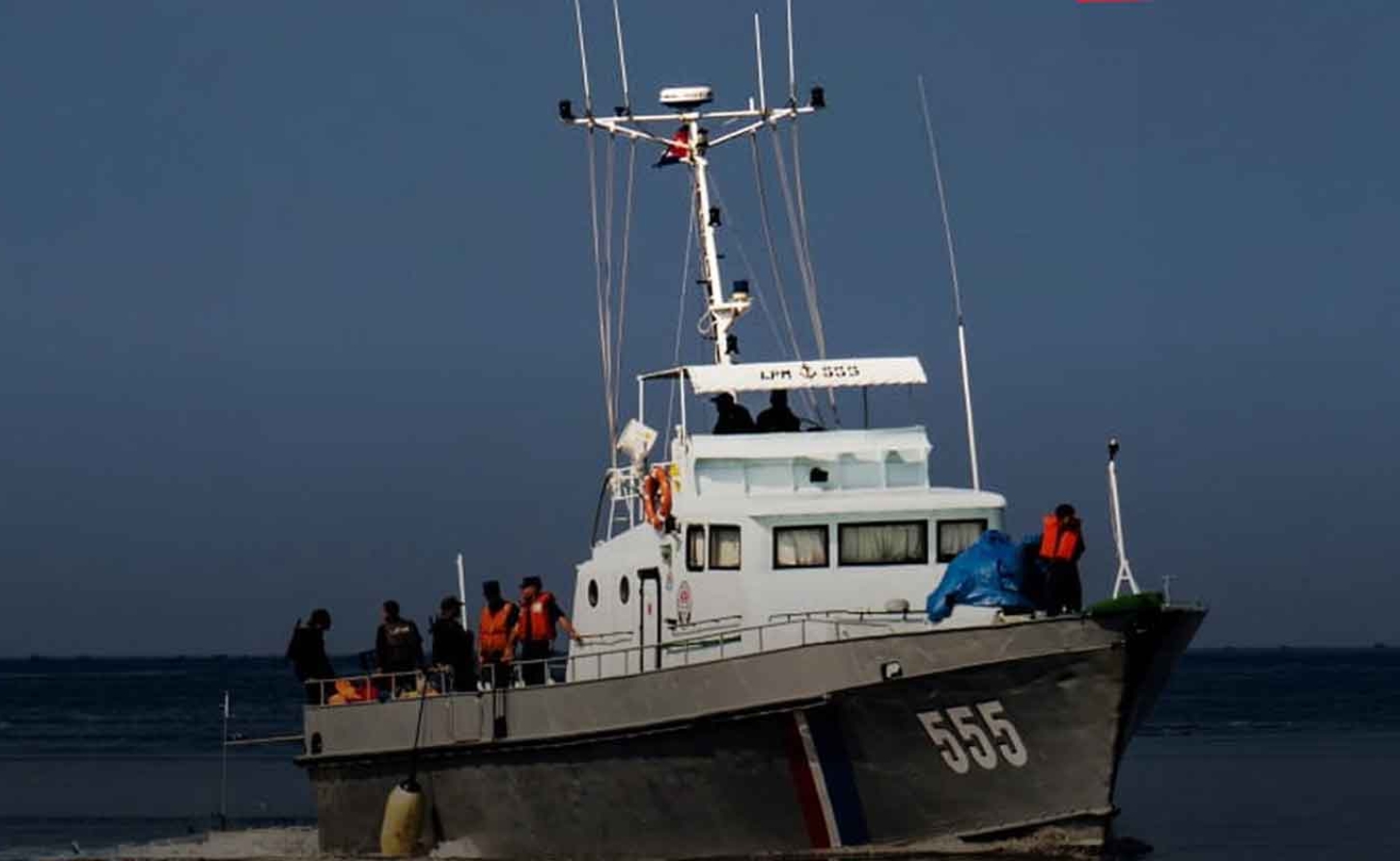
Four Passengers on US Speedboat shot dead by Cuban Coast Guard
A Florida-registered vessel fires on Cuban Border Guards in Cuban waters. Forty Caribbean fishermen are killed by U.S. drone strikes. A U.S. warship sits in St. Kitts harbour. Marco Rubio smiles for the cameras. This is not coincidence — this is a pattern.
On the morning of February 25, 2026, a speedboat registered in Florida, United States — registration number FL7726SH — penetrated Cuban territorial waters off Cayo Falcones in the municipality of Corralillo, Villa Clara province. It came within one nautical mile of the El Pino channel.
When a Cuban Border Guard vessel carrying five service members moved to intercept and identify the intruder, the crew of the Florida-registered boat opened fire. The commander of the Cuban vessel was wounded in the attack. Before the confrontation ended, four members of the aggressor crew were dead and six more were injured.
Cuba’s Ministry of the Interior issued a formal communiqué within hours. The Cuban Embassy in Washington disseminated it immediately. The message was composed and deliberate: this was a violation of Cuban sovereign territory, met with the force that sovereignty demands.
“Cuba reaffirms its determination to protect its territorial waters,” Havana stated, “based on the principle that national defense is a fundamental pillar of the Cuban State.”
Read that geography carefully. A vessel out of Florida fires on uniformed Cuban military personnel inside Cuban waters — the day after United States Secretary of State Marco Rubio attended the 50th CARICOM Heads of Government Conference in Basseterre, St. Kitts, preaching regional security cooperation.
The regime Rubio represents had weeks earlier removed Venezuela’s Nicolás Maduro by military force. And somewhere between Havana and Basseterre, in waters that Caribbean nations have long declared a Zone of Peace, something is stirring that the region cannot afford to misread.
This may not be coincidence. This may be the opening salvo of the next Trump campaign in Caribbean waters.
The Pattern CARICOM Cannot Ignore
To treat the Cuban incursion as an isolated incident — drug runners, perhaps, or reckless adventurers — would be a failure of regional intelligence. Caribbean heads of government meeting in Basseterre are looking simultaneously at two crises with the same return address: the United States of America.
The first is already documented in grief. Some forty Caribbean fishermen — from Trinidad and Tobago, St. Lucia, and St. Vincent — were killed by American military drone strikes on their fishing boats in Caribbean waters, under the accusation of drug trafficking. No evidence was produced. No formal accountability followed.
And rather than offering condolence or explanation, President Donald Trump stood before the world at his State of the Union address and boasted: “We even destroyed their fishing industry.” He said it with pride. He said it as achievement. The Caribbean heard it as a declaration.
The second is unfolding now, its full dimensions still emerging. A paramilitary-style operation launched from Florida territory, penetrating the sovereign waters of a Caribbean nation and exchanging fire with its uniformed military.
Whatever the boat’s ultimate purpose — and investigations are ongoing — the provenance is unmistakable. Post-Venezuela, with the Trump administration flushed with the confidence of a military operation that reshaped hemispheric power, the question CARICOM must now ask is not whether this is connected to a broader strategic posture. The question is how connected, and what comes next.
Tonnage as Diplomacy
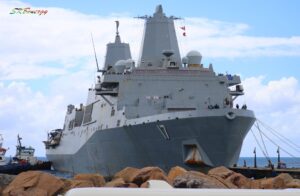
the USS San Antonio (LPD-17) — a U.S. Navy amphibious transport dock
No official explanation was offered for the warship’s presence. No link to the Secretary’s visit was confirmed.
None needed to be. In the Caribbean — a region whose political consciousness was forged under the shadow of American naval power, from the gunboat diplomacy of the early 20th century to the interventions that punctuated the Cold War — a warship in harbour communicates without speaking.
The message, intended or not, was clear: Washington does not only come with words. It comes with tonnage.
That tonnage now has context. Rubio brought cooperation. Trump’s State of the Union brought a boast about destroyed fishing industries.
A Florida boat brought gunfire into Cuban waters. And the USS San Antonio sat at anchor, watching.
A Zone of Peace Under Siege
The Caribbean’s designation as a Zone of Peace — formally adopted by CELAC in 2014 and embraced by CARICOM as foundational — was never merely aspirational language. It was a political assertion: that these waters, these nations, and these people would not become the theatre of great power competition and military adventurism.
It was a declaration born of historical memory, from the missiles of 1962 to the invasions and coups that defined too many decades of Caribbean political life.
That declaration is now under direct challenge from the most powerful military force on earth. The Trump administration has demonstrated in Venezuela that it is prepared to use military means to achieve hemispheric objectives. It has demonstrated in the fishermen’s deaths that Caribbean lives are acceptable collateral in its operations.
It has demonstrated in the State of the Union that it views the destruction of Caribbean livelihoods as a boast-worthy outcome. And on the morning after Rubio’s diplomatic visit, a vessel from its territory was firing weapons inside a Caribbean nation’s sovereign waters.
The arc of these events does not bend toward coincidence.
What CARICOM Must Demand
The 50th Conference of Heads of Government is not merely a diplomatic milestone — it is a moment of reckoning. Caribbean leaders cannot receive Rubio’s olive branches with one hand while their fishermen are being killed, their waters are being violated, and a gunboat sits in their harbour. The region must speak with one voice, and that voice must be loud enough to reach Washington, the United Nations, and the International Court of Justice if necessary.
CARICOM must demand full accountability for the forty fishermen killed by American drone strikes. It must demand a formal explanation for the Florida-registered vessel’s incursion into Cuban waters and the deaths and injuries that resulted. It must demand explicit American recognition of Caribbean sovereignty over regional seas.
And it must place the Trump administration on notice that the Zone of Peace is not a suggestion — it is a commitment that the Caribbean will defend through every multilateral and legal mechanism available.
The fishermen of Trinidad and Tobago, St. Lucia, and St. Vincent did not die so that their governments could smile politely at the Secretary of State. The Cuban Border Guards did not take fire in their own waters so that the incident could be footnoted in a diplomatic communiqué.
The Caribbean Sea is not an American operational theatre. And CARICOM’s 50th summit must say so — plainly, formally, and without apology.
Trump’s boast echoed around the world. The shots fired in Cuban waters echoed across the Caribbean basin. CARICOM’s response must echo louder still.
— WiredJa Editorial
