
BARBADOS | The Red Record on Trial: What Bajans Should Weigh Before February 11
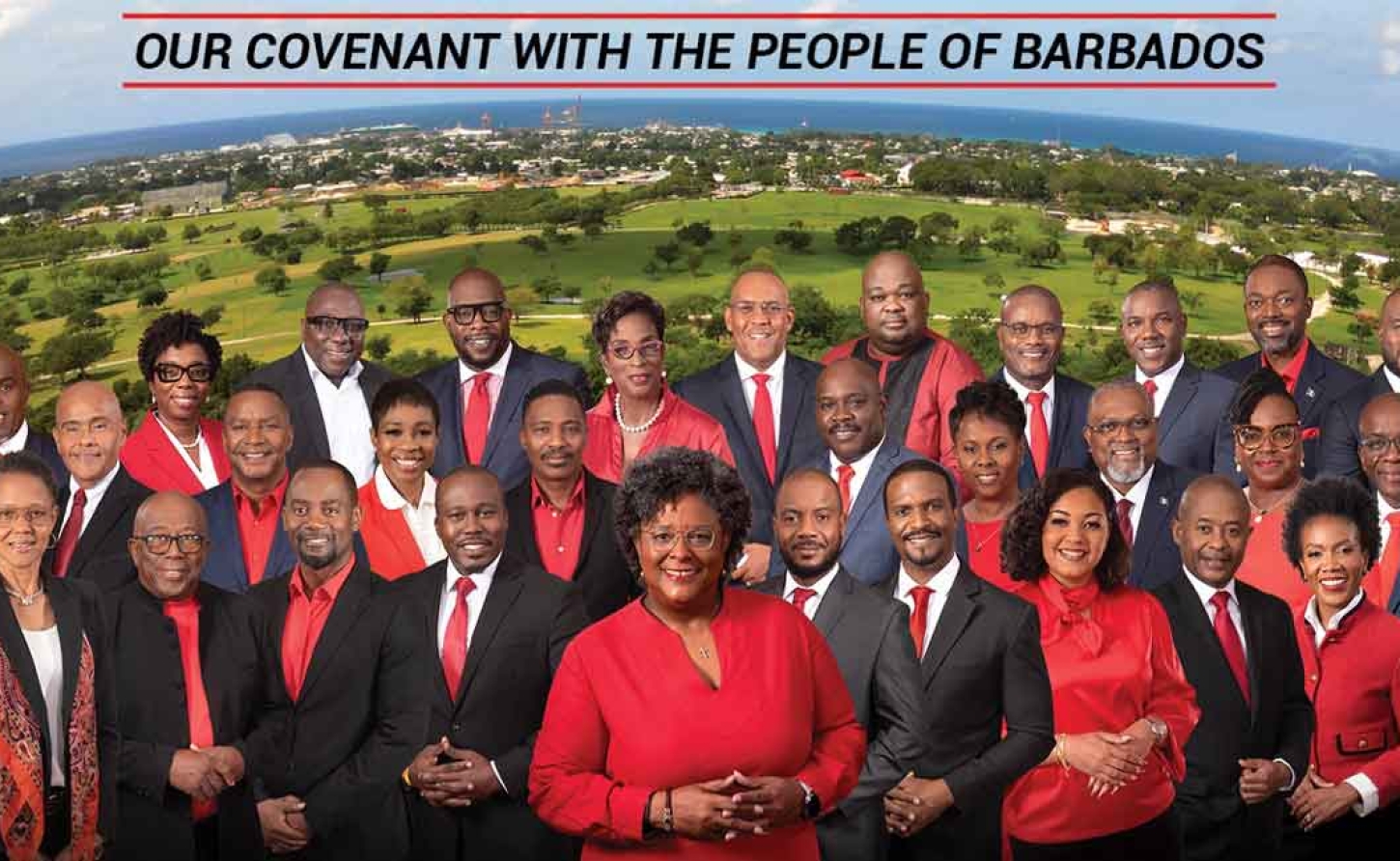
Leader of the Barbados Labour Party, (BLP) Prime Minister Mia Amor Mottley and her candidates for the February 11 national elections.
As Barbadians heads to the polls, the ruling BLP presents its record—but voters must separate achievement from aspiration
BRIDGETOWN, Barbados, January 31, 2026 -WiredJa | On February 11, 2026, Barbadians will render judgement on seven years of Barbados Labour Party governance. Prime Minister Mia Mottley’s administration has laid its case before the electorate in the form of the “Red Record”—a catalogue of claimed achievements spanning economic management, social investment, and worker protections. The document reads like a manifesto of accomplishment. But manifestos are written by governments; verdicts belong to voters.
What follows is neither endorsement nor indictment. It is an invitation to every Bajan voter to weigh the claims against their lived reality—and to enter the polling booth armed with questions, not just answers.
The Cost-of-Living Calculus
 The BLP’s headline claim is striking: inflation reduced from 4.7% when they assumed office to 0.7% today. If true, this would represent one of the most successful anti-inflation campaigns in Caribbean history.
The mechanisms cited include VAT reductions on household electricity, freight cost caps pegged to 2019 levels, zero-rated sanitary products, and an expanded basket of VAT-free essential foods.
The administration also points to its $300 solidarity payments to adults and a compact with the private sector limiting retail markups to 10%—down from the previous 20-25%. On paper, these measures constitute a comprehensive assault on the cost-of-living crisis gripping the region.
But here is where the voter’s arithmetic must begin. Does 0.7% inflation match what you experience at the supermarket checkout? Has the markup compact translated into lower prices on your grocery bill, or does it exist primarily in press releases? The Red Record claims victory; your refrigerator holds the evidence.
Tax Relief: Whose Burden Was Lifted?
 The BLP’s tax restructuring is arguably its most technically ambitious undertaking. Personal income tax has been simplified into two bands, with the top rate slashed from 33.5% to 28.5% and the lower rate cut from 16% to 12.5%.
The reverse tax credit has been expanded to cover those earning up to $25,000 annually, while a new compensatory income credit effectively reduces tax liability to zero for earners between $25,000 and $35,000.
Property owners have seen the first $350,000 of their holdings exempted from land tax entirely. Pensioners enjoy increased tax-free allowances.
The notorious National Social Responsibility Levy—a 10% imposition on imports and domestic goods—was abolished within months of the BLP taking office.
Yet corporate tax reduction to a maximum of 5.5% raises a question that voters must answer for themselves: Has this restructuring primarily benefited working Bajans, or has the greatest relief flowed to business interests?
Tax policy is never neutral—it reflects choices about who bears the weight of funding the state. The Red Record presents the cuts; voters must assess who truly benefited.
The Human Ledger: Social Investment
Where the BLP’s record may prove most consequential is in social legislation that extends beyond election cycles. The Disabilities Rights Act represents genuine landmark legislation—for the first time, the rights of Barbadians living with disabilities are codified and enforceable.
Disability grants for conditions including cerebral palsy, autism, and Down syndrome provide structured support where families previously navigated alone.
The One Family Programme targets intergenerational poverty with a holistic approach: food security, education, skills training, employment pathways, and counselling delivered in coordination. The Rights of Older Persons Bill, prepared for Parliament, would establish protections against elder abuse and exploitation.
These initiatives address constituencies often invisible in electoral calculations. The question for voters is whether these programmes have reached your community, your family, your neighbours—or whether they remain policy achievements awaiting implementation.
Jobs and Labour: Numbers Versus Reality
The BLP claims unemployment has fallen to a historic low of 6.1%. The minimum wage has journeyed from $6.25 per hour to $10.71—a 71% increase over the administration’s tenure. Training initiatives like the Construction Gateway and Fishing and Farming Gateway programmes promise to equip Bajans with marketable skills.
These are not trivial claims. If accurate, they represent meaningful improvement in the material conditions of working-class Barbadians. The Labour Clauses Act enforces standards in public contracts and tourism accommodation, theoretically strengthening worker protections.
But unemployment statistics measure those seeking work—not the quality of work available, nor whether wages meet the actual cost of living despite headline inflation figures. A job at $10.71 per hour represents progress from $6.25. Does it represent dignity? Does it represent security? These are questions that statistics cannot answer but voters can.
The Bajan Verdict
 Democracy functions not on gratitude for past performance but on judgement about future direction. The BLP’s Red Record is a lawyer’s brief for re-election—comprehensive, detailed, and naturally omitting evidence for the opposition. Every government presents its record selectively; this is the nature of political competition.
What matters now is whether Barbadian voters will evaluate these claims against their own experience. Has your life improved since 2018? Have the promised protections reached you? Do the economic statistics reflect your household’s reality?
The answers to these questions cannot be found in manifestos or media coverage. They reside in the daily calculations Bajans make at the gas pump, the grocery store, the bank, and the workplace. February 11 is not a day for inherited party loyalty or reflexive opposition. It is a day for Bajans to render their verdict based on evidence only they possess.
And here is the essential democratic truth: if, upon honest interrogation, the Red Record withstands scrutiny—if the cost-of-living measures have reached your table, if the tax relief has eased your burden, if the social investments have strengthened your community—then Bajans are not merely entitled but duty-bound to exercise their franchise accordingly.
A record that delivers deserves endorsement. That is how democracy rewards performance and holds power accountable.
But above all else: vote. Whatever conclusion you reach, however you weigh the evidence before you, the act of voting itself is sacred. It is the heartbeat of Caribbean democracy—the hard-won inheritance of generations who fought for the right to choose their own leaders.
Barbados was not handed self-determination; it was claimed, nurtured, and defended. Every Bajan who stays home on February 11 diminishes that inheritance. Every Bajan who enters the polling booth—whether to endorse the BLP, reject it, or register dissent—strengthens the democratic foundations upon which the nation stands.
The Red Record has been submitted. The jury now deliberates. But first, the jury must show up.
-30-
