
AFRICA | US, Israel and Argentina Vote No as UN Declares Slave Trade ‘Gravest Crime Against Humanity’
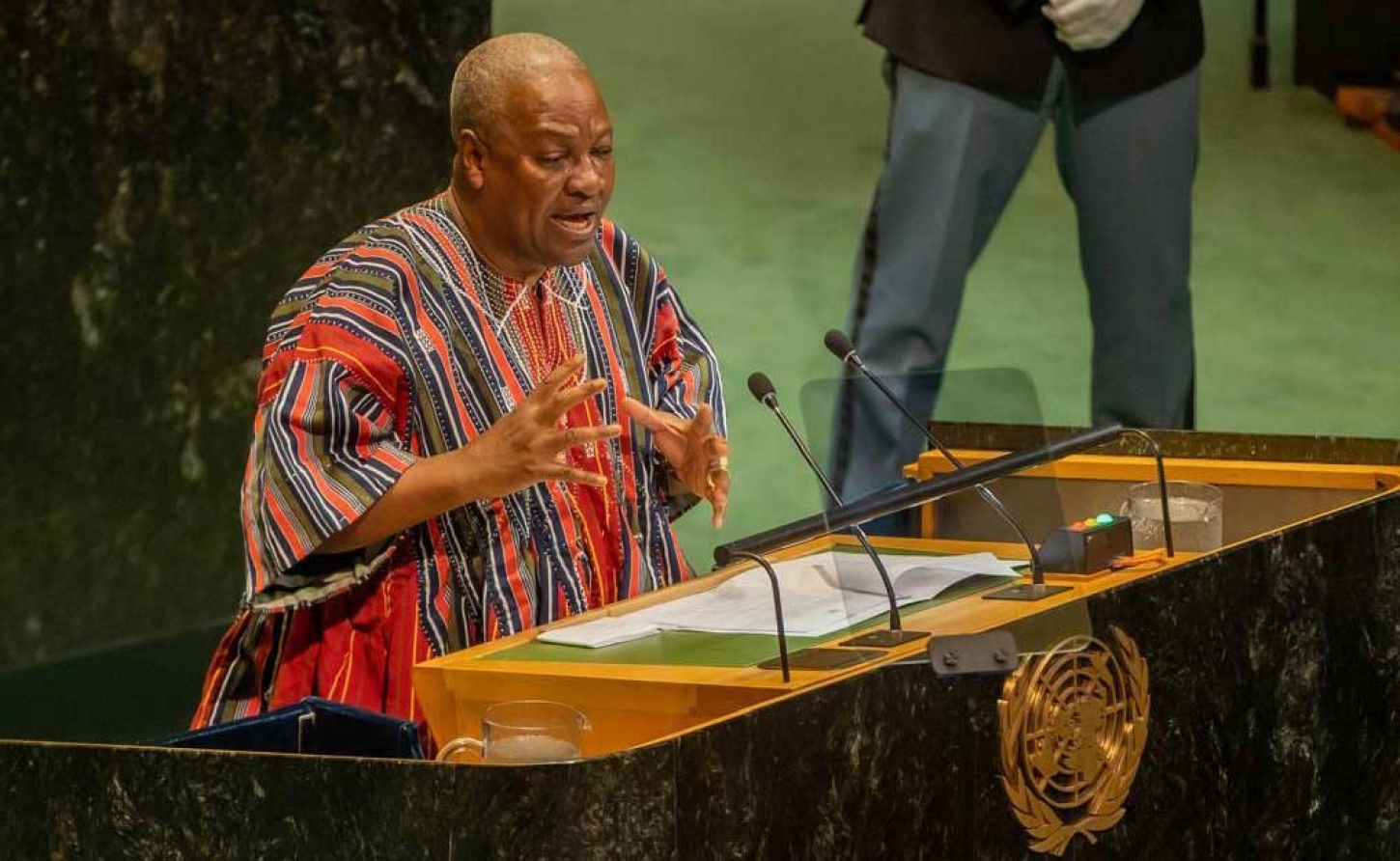
Ghana's President John Mahama addresses the General Assembly of the United Nations
Ghana’s landmark resolution passes 123-3 — but Washington, Buenos Aires and Tel Aviv chose the wrong side of history on the International Day of Remembrance of the Victims of Slavery.
Calvin G. Brown
The applause inside the United Nations General Assembly hall on Wednesday was not polite diplomatic theatre. It was the sound of history exhaling — 123 nations rising, collectively and defiantly, to name what the powerful have spent centuries refusing to name: that the transatlantic slave trade was not merely an unfortunate chapter in the human story, but the gravest crime against humanity ever committed.
And yet, when the final tally came in on a resolution championed by Ghana’s President John Dramani Mahama, three nations chose a different side of history. The United States. Israel. Argentina.
Three against the world. Three nations that looked at 12.5 million African men, women, and children ripped from their homeland — chained, beaten, bred like livestock, and worked to death across Caribbean sugar fields and American cotton rows — and said, in effect: ‘Not our problem. Not our debt.’
“History does not disappear when ignored, truth does not weaken when delayed, crime does not rot … and justice does not expire with time.” — Ghana Foreign Minister Samuel Ablakwa
The resolution was adopted to applause in the General Assembly Hall, receiving 123 votes in favour, with 52 abstentions — including the United Kingdom and all 27 European Union member states.
The United Kingdom’s abstention is its own brand of moral cowardice: a nation whose empire was built on the backs of enslaved Africans, whose city of Bristol bears the architecture of the trade, could not even find the moral backbone to vote yes. But at least Britain had the decency not to vote no.
Washington’s Shameful Arithmetic
The Americans, however, had no such restraint. US Ambassador Dan Negrea called the text “highly problematic,” insisting Washington “does not recognise a legal right to reparations for historical wrongs that were not illegal under international law at the time they occurred.”
Read that sentence again slowly. The United States — a nation whose founding economic prosperity was built on enslaved African labour — is arguing that because slavery was legal when it happened, the crime expires. By that logic, no historical injustice is ever worth confronting. By that logic, the Nuremberg trials were an inconvenience.
The US representative went further, characterising the resolution as the “cynical usage of historical wrongs as a leverage point to reallocate modern resources to people and nations who are distantly related to the historical victims.”
Distantly related. Tell that to the Caribbean mother who cannot pass generational wealth to her children because centuries of forced unpaid labour created no foundation to pass on. Tell that to the Jamaican family living in a zinc-fence community built on land that was never theirs to begin with, the inheritance of dispossession stretching across four hundred years.
The Caribbean at the Centre
For the Caribbean, this vote is not abstract. Our region was the laboratory of slavery — the place where the system was perfected, industrialised, and exported as a model of extraction. Our islands bear the names of European colonisers.
Our economies were engineered for commodity production, not self-sufficiency. Our post-independence governments inherited debt-ridden, monocrop economies deliberately structured to serve London, Madrid, and Amsterdam — not Kingston, Bridgetown, or Port-of-Spain.
Ghana’s President Mahama described the resolution as “a route to healing and reparative justice,” adding that the adoption “serves as a safeguard against forgetting.”
Mahama, who personally presented the resolution on behalf of the 54-member African Group, understood something the dissenting three did not — that justice delayed is not justice denied only to the living, but to every generation yet to come.
What the Resolution Demands
The resolution calls on member nations to engage in talks on reparatory justice, including formal apologies, restitution, compensation, rehabilitation, and guarantees of non-repetition.
It also urges the prompt return of stolen cultural artefacts — artworks, monuments, museum pieces, documents, and national archives — to their countries of origin. That last provision alone indicts the British Museum.
“The transatlantic slave trade was a crime against humanity that struck at the core of personhood, broke up families, and devastated communities.” — UN Secretary-General António Guterres
History Has a Long Memory
The resolution is not legally binding. The naysayers will take comfort in that. But political weight accumulates, and the 123 nations that voted yes represent the moral majority of a world that is simply tired of waiting for the powerful to develop a conscience on their own schedule.
Wednesday’s vote will not cancel the debt. But it names it. And naming, as every Caribbean grandmother knows, is the beginning of reckoning.
The three who voted no have placed their answer in the record of history. History, unlike the United States, does not forget.
— 30 —
wiredja.com/caribbean/un-slave-trade-gravest-crime-humanity-resolution
